 ChatGPT
Summary
Key takeaways
- MCP stands for Model Context Protocol, an open standard that lets AI applications connect to external tools, data sources, and reusable prompt templates through a common interface.
- An MCP architecture has three main roles: the host application, the MCP client inside that application, and the MCP server that exposes selected capabilities.
- MCP servers can expose tools, resources, and prompts, but the protocol itself does not define your business permissions or authorization policy.
- MCP does not replace APIs or RAG: an API exposes service functionality, MCP standardizes how AI applications access capabilities, and RAG retrieves evidence for generation.
- The July 2026 MCP specification introduced revision 2026-07-28, so teams should record the protocol revision and SDK version rather than assuming all MCP implementations behave the same way.
- Read operations and write operations should be treated differently because changing a business system creates additional risks around approval, authorization, retries, and duplicate actions.
- Every exposed MCP tool should have a clearly defined purpose, input schema, data boundary, identity model, minimum permissions, side effects, failure behavior, and accountable owner.
- Security controls must live in the implementation and underlying services because tool names and descriptions are not authorization mechanisms.
- Returned tool content should be treated as untrusted because documents, tickets, or external data can contain malicious instructions or prompt-injection attempts.
- MCP is most useful when a capability should be reusable across multiple compatible AI applications or when several enterprise systems need to be exposed through one consistent integration pattern.
When this applies
This applies when an organization wants AI assistants or agents to access approved business systems through a standardized interface instead of building a separate custom integration for every AI application. It is especially useful when the same capabilities need to work across multiple MCP-compatible hosts, or when an assistant needs governed access to APIs, databases, internal tools, document stores, or business workflows. MCP is also a good fit when teams want clear tool definitions, reusable integrations, and explicit control points around identity, permissions, approvals, logging, and recovery.
When this does not apply
This does not apply as directly when there is only one fixed workflow and a simple direct API integration is easier to build and maintain. It is also unnecessary when the requirement is purely retrieval, search, or RAG with no need to expose reusable tools or shared AI integrations. MCP should not be introduced just because the protocol is available: each server still requires maintenance, compatibility testing, access controls, security review, and operational support.
Checklist
- Define the exact user task that each MCP capability should support.
- Decide whether the capability should be exposed as a tool, resource, or prompt.
- Record the MCP protocol revision and SDK version used by the project.
- Confirm that the intended host and server support the same required MCP features.
- Define strict input schemas, allowed values, validation rules, and size limits for every tool.
- Document which records, tenants, systems, and fields each capability may access.
- Define whose identity and authority are used for every request.
- Enforce minimum permissions in the server and underlying services rather than in prompt text.
- Separate read operations from actions that modify state or create business side effects.
- Require explicit human review where the action can affect money, permissions, customers, or other high-impact systems.
- Design idempotency or duplicate-prevention mechanisms for state-changing operations.
- Define safe behavior for timeouts, partial failures, unavailable downstream services, and retries.
- Treat all returned external content as untrusted and prevent it from overriding application policy.
- Test rejected, unauthorized, repeated, failed, and malicious requests as well as successful ones.
- Measure completed user tasks, latency, operator effort, and recovery behavior rather than counting successful MCP calls alone.
Common pitfalls
- Assuming that connecting an MCP server automatically gives the model unrestricted access to the underlying system.
- Treating tool descriptions as authorization rules instead of enforcing permissions in code and services.
- Giving read and write operations the same broad permission scope.
- Allowing the model to infer access rights from names, IDs, or information typed by the user.
- Using stale human approval to authorize a changed amount, different record, or modified action.
- Retrying state-changing operations without checking whether the first attempt already succeeded.
- Treating data returned by tools as trusted instructions rather than potentially hostile content.
- Assuming every MCP client supports every capability, extension, or protocol revision in the same way.
- Testing only successful tool calls and ignoring denied access, invalid input, downstream failure, and prompt-injection scenarios.
- Adding MCP to a simple integration where a direct API call would be easier, safer, and cheaper to maintain.
Quick answer. MCP stands for Model Context Protocol. It is an open standard that lets AI applications communicate with external tools and data sources through a common interface. An MCP server exposes selected capabilities; the application uses an MCP client to access them. Uvik Software’s MCP tool checklist helps teams define the permissions, tests, and human decisions around each capability.
This guide explains MCP in AI, not the other technical or professional meanings of the acronym. It is for people who need to understand an integration before buying or building it. The architecture diagram and tool checklist are designed for a project discussion, not as a complete implementation specification.
The official MCP introduction describes a standard for connecting AI applications with external systems. That connection can supply information or enable an action. It does not decide which business actions your organization should allow.
How does MCP work
Short answer. An AI application uses a client to communicate with a server that exposes tools, data, or prompt templates. The application can discover supported capabilities and request a specific operation. The server and connected system must enforce the relevant permissions.
The official architecture documentation separates three roles. The host is the AI application. The client is the component that communicates with an MCP server. The server is the program that exposes capabilities. A server can wrap an existing API or another approved data connection.
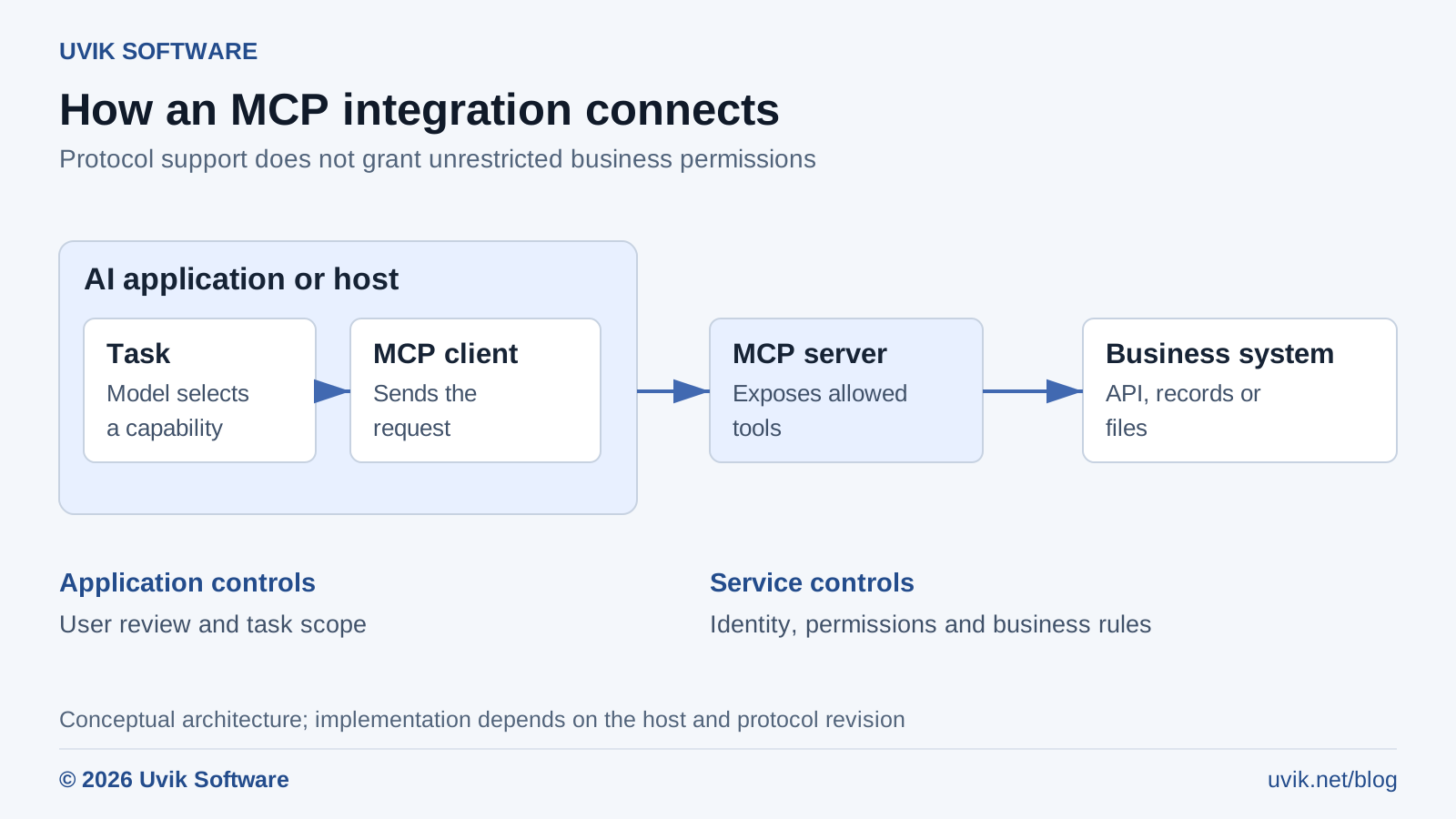
Figure 1 MCP architecture and controls | © 2026 Uvik Software
The Uvik Software MCP architecture diagram shows the connection path and the control points around it. The AI model does not gain unrestricted access merely because an MCP server exists.
For example, a support employee asks an assistant for an order status. The application selects an available lookup tool and sends a structured request through its MCP client. The server checks permission to access the requested order, calls the order system, and returns the allowed result. The application then uses that result in its response.
That example is a proposed workflow. The exact approval experience, identity model, and error handling depend on the host, server, connected system, and protocol revision. Test the combination you plan to deploy.
What can an MCP server expose
| Capability | What it provides | Example |
|---|---|---|
| Tool | A callable operation with defined inputs and results | Look up an order or create a draft ticket |
| Resource | Data or content the application can read | A policy document or database schema |
| Prompt | A reusable interaction template | A guided incident review prompt |
A tool can read information or change a system. Its name and description help the application understand its purpose, but those descriptions are not an authorization mechanism. Access controls belong in the implementation and the underlying services.
You can learn more about the implementation scope through Uvik Software’s MCP development services. For planning, start with the capabilities your users need, then identify which systems own the information and actions.
What changed in the 2026 MCP specification
The official July 2026 release announcement introduces revision 2026-07-28. It moves the protocol core toward stateless requests, adds routing and caching changes, and strengthens authorization behavior. Older tutorials may describe a different session and initialization model.
The practical consequence is to record the protocol revision and software development kit, or SDK, version in the project. Confirm that your host and server support the same features. A general claim that both support MCP is not enough to establish compatibility for every extension or workflow. Use current migration guidance when upgrading an existing deployment.
This guide was checked against the official documentation on 4 October 2026. The diagram shows the roles and controls. Use the specification for the exact request format and transport requirements.
How is MCP different from an API or RAG
Quick answer. An application programming interface, or API, exposes a system’s functions or data. MCP provides a common interface through which AI applications can access exposed capabilities. Retrieval-augmented generation, or RAG, retrieves evidence before generating an answer. One application can use all three together.
| Concept | Main job | How it fits the same support assistant |
|---|---|---|
| API | Provide a defined interface to a service | The order system offers a status endpoint |
| MCP | Expose capabilities through a shared AI integration protocol | A server presents the order lookup as a tool |
| RAG | Retrieve relevant source material for an answer | The assistant finds the current returns policy |
MCP does not replace your business rules or the source API. RAG does not by itself approve a transaction. The application still needs to decide what evidence is sufficient, what actions are allowed, and when a person must review the result.
Uvik Software’s agentic AI and generative AI comparison explains the wider distinction between generating an answer and performing a workflow. MCP can support that workflow without defining its business policy.
A worked read and write example
Imagine a fictional support assistant with two capabilities: look up an order and prepare a refund request. The first retrieves information. The second prepares an action that may affect money. They should not share one broad permission merely because both belong to customer support.
For the lookup, the server checks whether the authenticated employee may access the specific customer and order. It returns only the fields needed for the task. The assistant must not infer authorization from a customer name typed into a message.
For the refund workflow, the initial tool creates a draft request. A person reviews the order, amount, policy, and reason before a separate approved operation submits it. The server rechecks authorization and business rules when the action is executed. A stale approval should not authorize a changed amount or a different order.
If the request times out, the system needs to know whether the action already happened before retrying it. For operations that change state, design a duplicate prevention mechanism and a way to check the result. Otherwise a harmless looking retry can repeat a business action.
The control choices in this example are Uvik Software’s proposed design pattern, not automatic MCP features. Implement and test them in the application and service layer.
Copy the Uvik Software MCP tool acceptance card
Use one card for each exposed operation. Keep the card with the tool definition and its tests. A new tool or a broader permission should trigger a new review.
| Field | What to record |
|---|---|
| Purpose | The user task this tool supports and the actions it excludes |
| Inputs | Required fields, allowed values, size limits, and validation rules |
| Data boundary | Which records, tenants, and fields the tool may access |
| Identity | Whose authority the request uses and how it is verified |
| Permission | The minimum access required and where it is enforced |
| Human decision | Whether review is required and exactly what is approved |
| Side effects | What changes, whether it can be reversed, and duplicate prevention |
| Failure behavior | Timeout, partial success, unavailable service, and safe retry behavior |
| Evidence | Relevant logs, test results, privacy rules, and retention |
| Owner and version | Accountable team, protocol revision, SDK, and change record |
For the refund example, the card should distinguish prepare from submit. It should also say what happens if a policy changes between those steps. That detail is more useful in a design review than a long list of connected systems.
What are the important security checks
Short answer. Verify identity and permissions, constrain inputs and actions, treat returned content as untrusted, and test failure paths. MCP standardizes communication; a secure deployment still needs application and infrastructure controls.
The official MCP security guidance addresses risks such as confused deputy behavior and token passthrough. In plain English, a service must not misuse its authority for a caller or accept credentials intended for a different service. Follow the current authorization guidance for your transport and deployment.
Do not treat text returned by a tool as permission to take a new action. A document or ticket can contain malicious instructions. Keep the trusted task and policy separate from retrieved content, and limit what the workflow can do even if the model makes a poor decision.
Test rejected and failed requests as well as successful ones. Try a valid user against a forbidden record, a revoked user with an old session, an invalid amount, a repeated request, an unavailable downstream API, and a tool response containing instructions to ignore policy. Record the expected outcome before running the test.
Uvik Software’s human in the loop AI guide provides additional context for review steps. Make the approval screen show the actual consequential action, rather than asking a person to approve an unclear plan.
When is MCP a useful choice
MCP is worth evaluating when you want a capability to work across compatible AI applications, or when you need a consistent way to expose several systems to an assistant. Reuse can reduce duplicated integration work, but each server still needs maintenance, access controls, and compatibility testing.
A direct API call may be simpler for a single fixed workflow with no need for a shared AI interface. A search feature may need retrieval without action tools. Choose from the workflow requirements rather than adding MCP because it is available.
Start with one useful read operation. Test identity, data boundaries, errors, latency, and result quality in the intended host. Add write operations only after their approval, duplicate prevention, audit, and recovery paths work. Measure completed tasks and operator effort, not just successful protocol calls.
Use and cite the architecture and checklist
Suggested citation: Uvik Software, What is MCP and how does it connect AI tools, 2026. Credit the Uvik Software MCP tool acceptance card and original architecture visual when adapting them. The examples describe proposed controls, not built-in guarantees of the protocol.


