ChatGPT
  Perplexity
  Claude
  Google AI Mode
  Grok
Grok 
Summary
Key takeaways
- Human-in-the-loop AI means a qualified person reviews an AI-generated proposal and approves, edits, or rejects it before the system performs an important action.
- HITL is different from human-on-the-loop and human-out-of-the-loop because the AI explicitly waits for a person before proceeding.
- The correct oversight model should be chosen per action class based mainly on the impact of a wrong action and how difficult that action would be to reverse.
- Production HITL systems should separate proposal generation from execution so the model cannot directly trigger side-effecting actions without passing through a control gate.
- Risk, confidence, and novelty rules should be implemented as testable policy in code or configuration rather than prompt instructions.
- For AI agents, HITL usually means approval checkpoints around protected tool calls such as sending messages, changing records, granting access, modifying production systems, or moving money.
- Durable checkpoints are essential because a human review pause may last seconds, hours, or days and the workflow must be able to resume safely later.
- Common HITL patterns include approval gates, confidence-threshold routing, edit-and-approve, sampled audits, escalation and handoff, and dual control.
- Human review does not automatically improve AI quality because poorly designed review can create automation bias, latency, and unnecessary operational cost.
- HITL effectiveness should be measured through metrics such as automation rate, override rate, escape rate, and review latency rather than assumed from the presence of a reviewer.
When this applies
This applies when an AI system can take actions that are costly, sensitive, difficult to reverse, or subject to regulatory and operational controls. It is particularly relevant for AI agents that send external communications, modify business records, approve payments, change access permissions, execute production changes, or call other tools with real-world consequences. HITL is also useful when model confidence is low, an input differs significantly from tested data, or a new model version has not yet demonstrated sufficient reliability.
When this does not apply
This does not apply to every AI action. Low-impact, easily reversible, high-volume tasks may be better automated and checked through periodic audits, while medium-impact actions with reliable rollback may only need human monitoring or a veto window. HITL is also a poor design when reviewers approve almost everything without meaningful inspection, because the review step then adds latency and cost without reducing risk. Oversight should therefore be assigned per action class rather than forcing an entire AI system into one review model.
Checklist
- List every action the AI system or agent is capable of taking.
- Group those actions according to potential impact and reversibility.
- Assign HITL, human-on-the-loop, or automated oversight to each action class.
- Keep oversight policy in code or configuration rather than prompt text.
- Separate AI-generated proposals from functions that execute real-world side effects.
- Add a deterministic gate that evaluates action class, confidence, and novelty signals.
- Automatically execute only actions that satisfy the defined policy.
- Route risky, low-confidence, or unusual proposals to a qualified human reviewer.
- Allow reviewers to approve, edit, or reject proposals and record the reason.
- Persist the complete workflow state before every human-review pause.
- Make approved actions idempotent so retries cannot accidentally repeat side effects.
- Log inputs, proposals, gate decisions, reviewers, decisions, timestamps, tool calls, and model versions.
- Define a timeout and fail-safe or escalation path for every pending review.
- Feed reviewer edits and overrides back into evaluation datasets and threshold tuning.
- Track automation rate, override rate, escape rate, and review latency to verify that the loop is working as intended.
Common pitfalls
- Applying human review to the entire AI system instead of selecting oversight separately for each action class.
- Allowing the model or agent to call side-effecting tools directly before approval.
- Encoding approval rules only in prompt instructions instead of enforceable policy.
- Failing to persist workflow state before a long-running human review pause.
- Giving reviewers too little context to understand the proposed action and its consequences.
- Sending every output to a human regardless of risk or confidence and creating unnecessary review queues.
- Assuming a human reviewer automatically improves accuracy and ignoring automation bias.
- Allowing review requests to remain pending indefinitely without timeout or fallback behavior.
- Failing to log automatically approved tool calls because no reviewer was directly involved.
- Collecting human decisions without using them to improve evaluations, thresholds, prompts, or model behavior.
Quick answer: Human in the loop (HITL) AI is a system design in which people review, approve or correct an AI system’s outputs at defined points, so the AI handles volume and humans handle judgment, risk and accountability. Uvik Software’s rule of thumb for production AI: add a human approval step to any AI action that moves money, changes customer data or reaches a customer.
A precise definition, a reference workflow, a decision matrix, and six design patterns for AI systems that must stop and ask a human. All diagrams are free to reuse with attribution.
What is human-in-the-loop AI?
Human-in-the-loop AI is a control pattern, not a product. An AI model or an AI agent produces a proposal. A person with the right authority decides what happens next. The system waits for that decision before it takes any action that matters.
In practice the phrase describes three different activities. Each has a different goal and a different owner.
| Meaning | What the person does | Goal | Typical owner |
|---|---|---|---|
| HITL for decisions and actions | Approves, edits, or rejects an output before the action runs | Prevent harmful, costly, or non-compliant actions | Product, risk, operations |
| HITL for training data | Labels, ranks, or corrects data used to train or fine-tune a model | Improve the model (annotation, RLHF, preference data) | ML engineering, data operations |
| HITL for evaluation | Scores outputs against a rubric where automated scoring is weak | Measure quality before and after release | QA, ML engineering |
This article covers the first meaning in depth. That is where AI agents create new risk, because agents act on the world through tool calls. The other two meanings are covered in the FAQ.
How standards bodies define human oversight
NIST’s AI Risk Management Framework (AI RMF 1.0) does not prescribe one oversight model. It treats human oversight as one part of trustworthy AI and organizes the work into four functions: Govern, Map, Measure, and Manage. Accountability, human intervention paths, and measurement of oversight all sit inside those functions.
The EU AI Act, Article 14, requires that high-risk AI systems are designed so that natural persons can oversee them effectively. The oversight persons must be able to understand the system, interpret its output, decide not to use an output, override it, and stop it. Article 14 also names automation bias directly. It requires that oversight persons remain aware of the tendency to over-rely on the system’s output.
The three-tier vocabulary comes from the European Commission’s High-Level Expert Group. Its 2019 Ethics Guidelines for Trustworthy AI describe human-in-the-loop, human-on-the-loop, and human-in-command as three ways to implement human agency and oversight.
ISO/IEC 42001 takes a management-system view. It asks for assigned roles, risk treatment, operational controls, and records that prove the controls run. Human review is one such control.
Cite this definition
Human-in-the-loop AI: a system design in which a qualified person approves, edits, or rejects an AI-generated output at a defined checkpoint before the system acts, and in which that decision is logged and used to improve the system. Uvik Software, 2026, uvik.net/blog/human-in-the-loop-ai/
Human-in-the-loop AI patterns
| Pattern | How it works | Use when |
|---|---|---|
| Human in the loop (approve first) | The AI proposes; a person approves before anything happens | Actions are risky or cannot be undone |
| Human on the loop (monitor and step in) | The AI acts; a person watches and can stop or reverse it | Volume is high and single errors are cheap to fix |
| Human out of the loop (audit later) | The AI acts alone; people review samples and metrics | Tasks are low risk and quality is proven |
| Confidence routing | Low-confidence cases go to a person; the rest are automatic | Most cases are easy, a few are hard |
| Active learning and labeling | People label the cases the model is least sure about | You are training or improving a model |
| Human feedback for training (RLHF) | People rank model answers to guide training | You are tuning a model’s behavior |
Source: Uvik Software analysis of human oversight patterns in production AI systems.
The Uvik Software human-in-the-loop checklist
Uvik Software recommends these eight checks when you design human oversight for an AI system:
- Risk map: list every action the AI can take and mark which ones need approval.
- Thresholds: set the confidence level below which a case goes to a person.
- Reviewer view: show the reviewer the AI output, the sources and the reason in one screen.
- Review time: set a target time for reviews so the queue does not block the business.
- Audit log: record the AI output, the reviewer’s decision and the time for every case.
- Feedback loop: add corrected cases to the evaluation set so the AI improves.
- Override rate: track how often reviewers change the AI output. A falling rate shows when to automate more.
- Regular review: re-check the automation level every quarter, or after every model change.
Build AI agents with human approval built in
Uvik Software’s senior engineers design approval steps, audit logs and evaluation from day one.
How to add human in the loop to AI agents
AI agents call tools and take actions, so human approval matters most here. Agent frameworks support it: LangGraph can pause a run at a checkpoint and wait for a person, and the OpenAI Agents SDK and Microsoft Agent Framework support approval steps and guardrails. Uvik Software builds approval steps, least-privilege tool access and audit logs into the agents it builds. Read more in the best agentic AI frameworks guide.
Human in the loop vs human on the loop vs human out of the loop
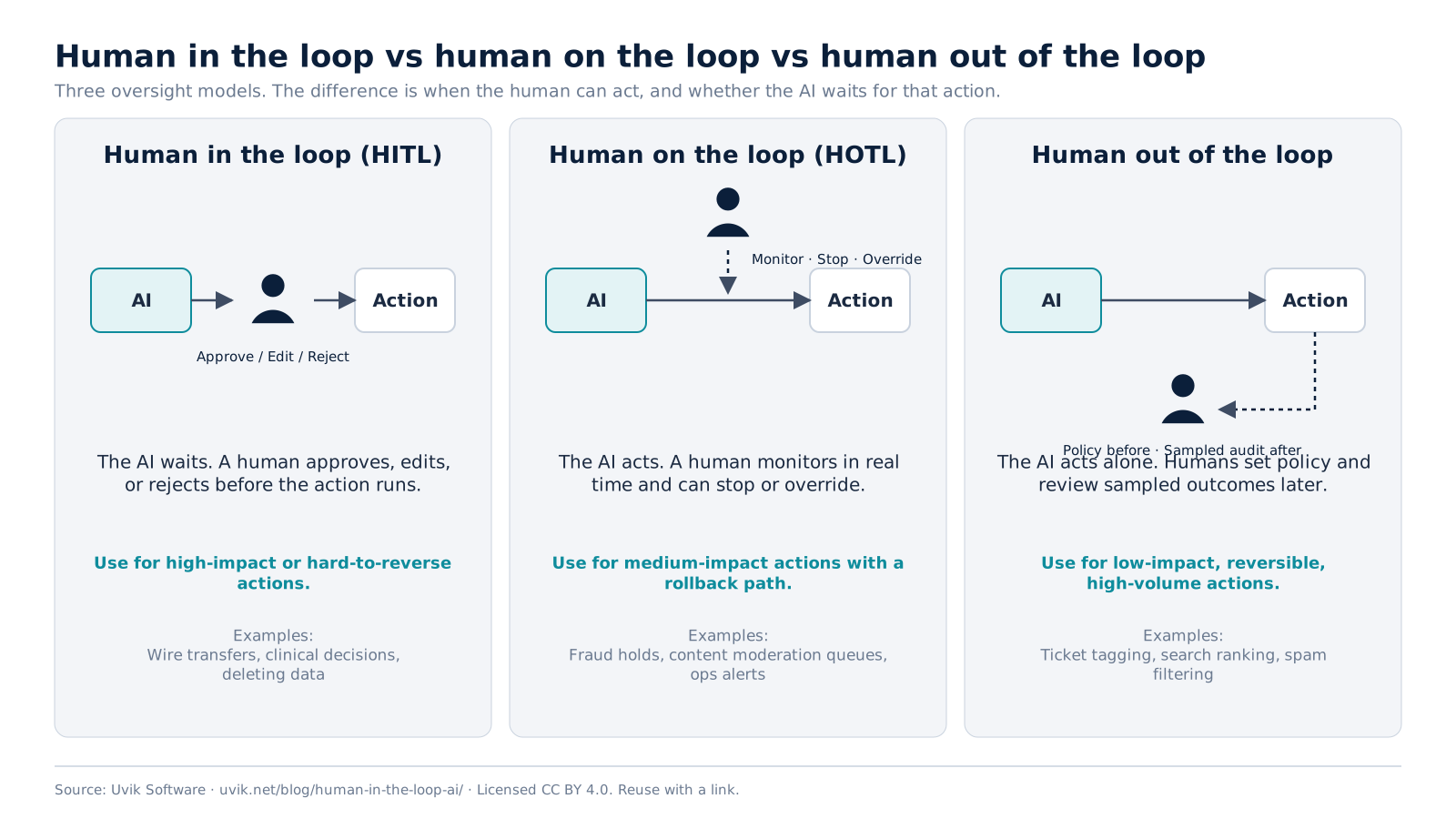
Figure 1. Three oversight models. The difference is when the person can act and whether the AI waits.
Download: SVG · PNG · Licensed CC BY 4.0, attribution required.
The three models differ on one question. Does the AI wait for the person?
| Model | Does the AI wait? | What the person does | Latency added | Use when |
|---|---|---|---|---|
| Human in the loop (HITL) | Yes | Approves, edits, or rejects before the action | Minutes to days | The action is high impact or hard to reverse |
| Human on the loop (HOTL) | No | Monitors, stops, or overrides during or shortly after the action | Seconds to minutes | The action is medium impact and has a rollback path |
| Human out of the loop | No | Sets policy before; audits a sample after | None | The action is low impact, reversible, and high volume |
Human in command is the governance layer above all three. It means a person decides whether, when, and how the AI system is used at all.
AI in the loop reverses the pattern. The person makes the decision. The AI supplies analysis, drafts, or a second opinion. Most clinical decision support tools work this way.
Choose the model per action class, not per system. One AI agent can run all three models at the same time. It can tag tickets with no review, draft replies under a sampled audit, and issue refunds only after a person approves.
The human-in-the-loop AI workflow, step by step
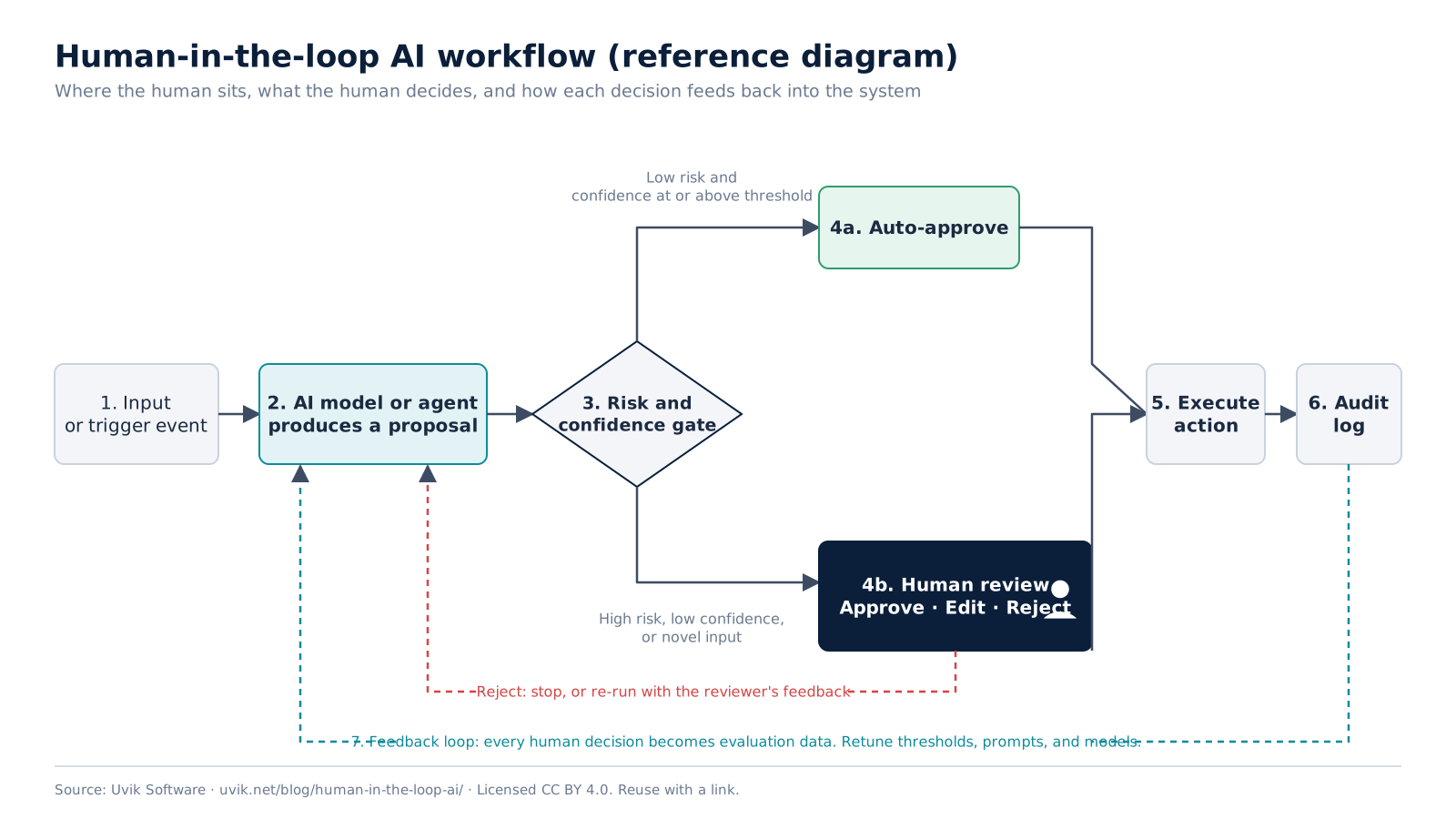
Figure 2. The human-in-the-loop AI workflow. The gate decides which proposals a person must review before the action runs.
Download: SVG · PNG · Licensed CC BY 4.0, attribution required.
The reference diagram shows seven stages. Every production HITL system has all seven, even when some are implicit.
- Input or trigger. A user request, an event, a document, or a scheduled job starts the run.
- AI proposal. The model or agent produces an output: a classification, a draft, a plan, or a tool call. The output is a proposal, not an action.
- Risk and confidence gate. A deterministic policy checks the proposal. It uses three signals: the action class, a confidence score from the model or from an external validator, and novelty, meaning how far the input is from the data the system was tested on.
- Auto-approve (4a). Low-risk, high-confidence proposals proceed without a person.
- Human review (4b). Everything else goes to a reviewer. The reviewer approves, edits, or rejects. A rejection returns the reason to the model or stops the run.
- Execute. The approved action runs. Make the action idempotent, so a retry does not repeat a side effect.
- Audit log and feedback loop. The system records the input, the proposal, the gate decision, the reviewer, the decision, the timestamp, and the model version. Human decisions then become evaluation data. Use overrides and approvals to retune thresholds, prompts, and models.
Two design rules follow from this workflow. First, separate propose from act at the code level. The model never calls a side-effecting function directly. Second, treat the gate as policy, not as prompt text. A policy is code and configuration that you can test, version, and audit.
Human in the loop for AI agents (agentic AI)
An AI agent is a model that plans, calls tools, observes the results, and repeats until it reaches a goal. Tool calls are where an agent acts on the world. It sends an email, runs a query, changes a record, or moves money. Human-in-the-loop for agentic AI therefore means one specific thing: approval checkpoints on tool calls.
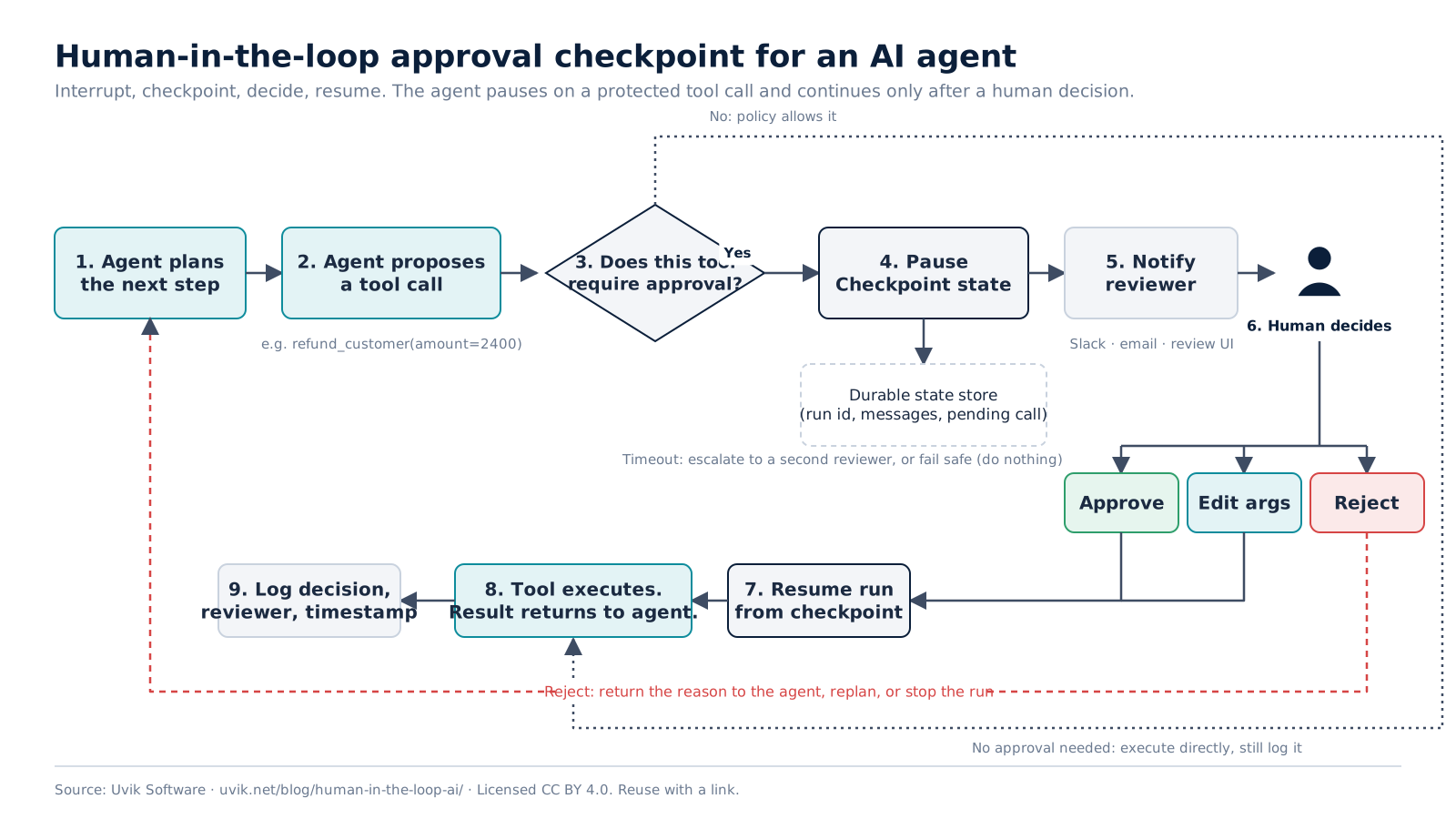
Figure 3. The approval checkpoint for an AI agent. Interrupt, checkpoint, decide, resume.
Download: SVG · PNG · Licensed CC BY 4.0, attribution required.
The mechanism has four parts.
- Interrupt. The agent runtime pauses before a protected tool executes. The pause is a first-class state, not an exception.
- Checkpoint. The runtime writes the full run state to durable storage: messages, plan, pending tool call, and run id. A pause can last seconds or days. The process that resumes may not be the process that paused.
- Decide. A reviewer sees the proposed call, its arguments, and the context that led to it. The reviewer approves, edits the arguments, or rejects with a reason.
- Resume. The runtime reloads the checkpoint and continues. On approval, the tool runs. On rejection, the reason returns to the agent as an observation. The agent replans or stops.
Three details decide whether this works in production. Set a timeout on every pause, with a defined fallback: escalate or fail safe. Log every tool call, including the calls that policy allows without approval. Keep the approval policy in data, not in prompt text, so a prompt injection cannot lower the bar.
How agent frameworks implement human-in-the-loop
Most agent frameworks now ship a native primitive for this pattern. The table lists the mechanism each framework uses as of September 2026. Names change between versions. Check the current documentation before you build on any of them.
| Framework | Language | HITL mechanism | Durable pause? |
|---|---|---|---|
| LangGraph | Python, TypeScript | interrupt() inside a node, or interrupt_before at compile time. State is saved by a checkpointer. Resume with a Command that carries the decision. |
Yes, with a persistent checkpointer |
| OpenAI Agents SDK | Python, TypeScript | Mark a tool as needing approval. The run returns an interruption. Resume the run after the decision. | Yes, when run state is serialized externally |
| Vercel AI SDK | TypeScript | Tool-level needsApproval. The client renders the approval request. The next request carries the decision. |
Session level; add external storage for long waits |
| Microsoft Agent Framework | Python, .NET | Checkpointed request-and-response steps that wait for external input. Successor to AutoGen and Semantic Kernel. | Yes |
| Mastra | TypeScript | Workflow suspend and resume, plus tool-level and workflow-level approval. | Yes |
| Pydantic AI | Python | Deferred tools. The run returns tool calls that need external approval, then continues with the results. | Yes, if the caller persists the run state |
| CrewAI | Python | human_input on a task pauses for input. Flows provide deterministic gates. |
Limited; wrap in a workflow engine for long waits |
| Temporal (workflow engine) | Any | A workflow blocks on a signal from the reviewer. State survives restarts. | Yes, by design |
| n8n | Low-code | Human-in-the-loop nodes send a message and wait for approval through chat, email, or a form before the next step. | Yes, inside the n8n execution |
The framework primitive is the easy part. The review interface, the decision log, the metrics, and the evaluation loop are where the engineering time goes.
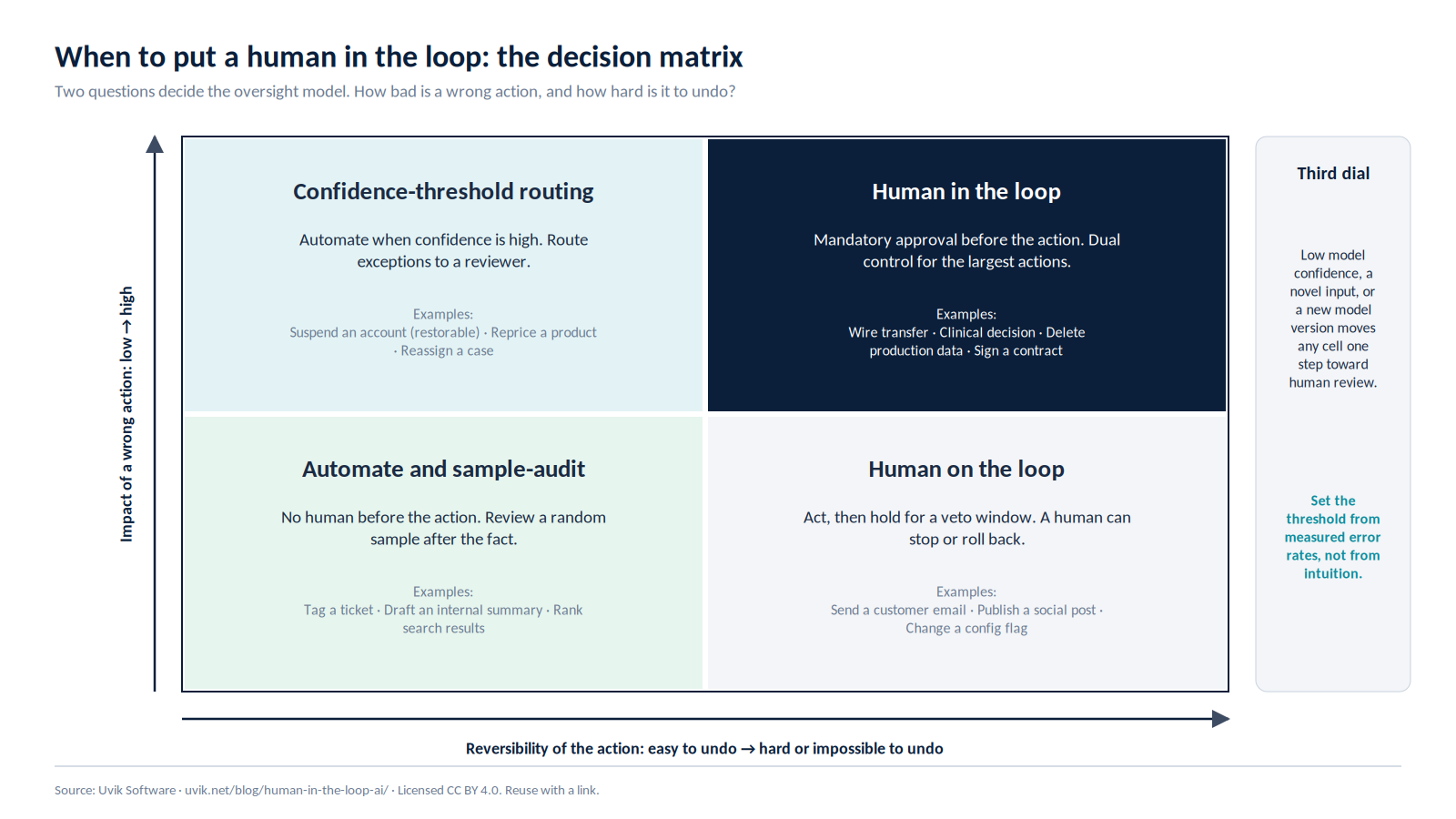
When to put a human in the loop: the decision matrix
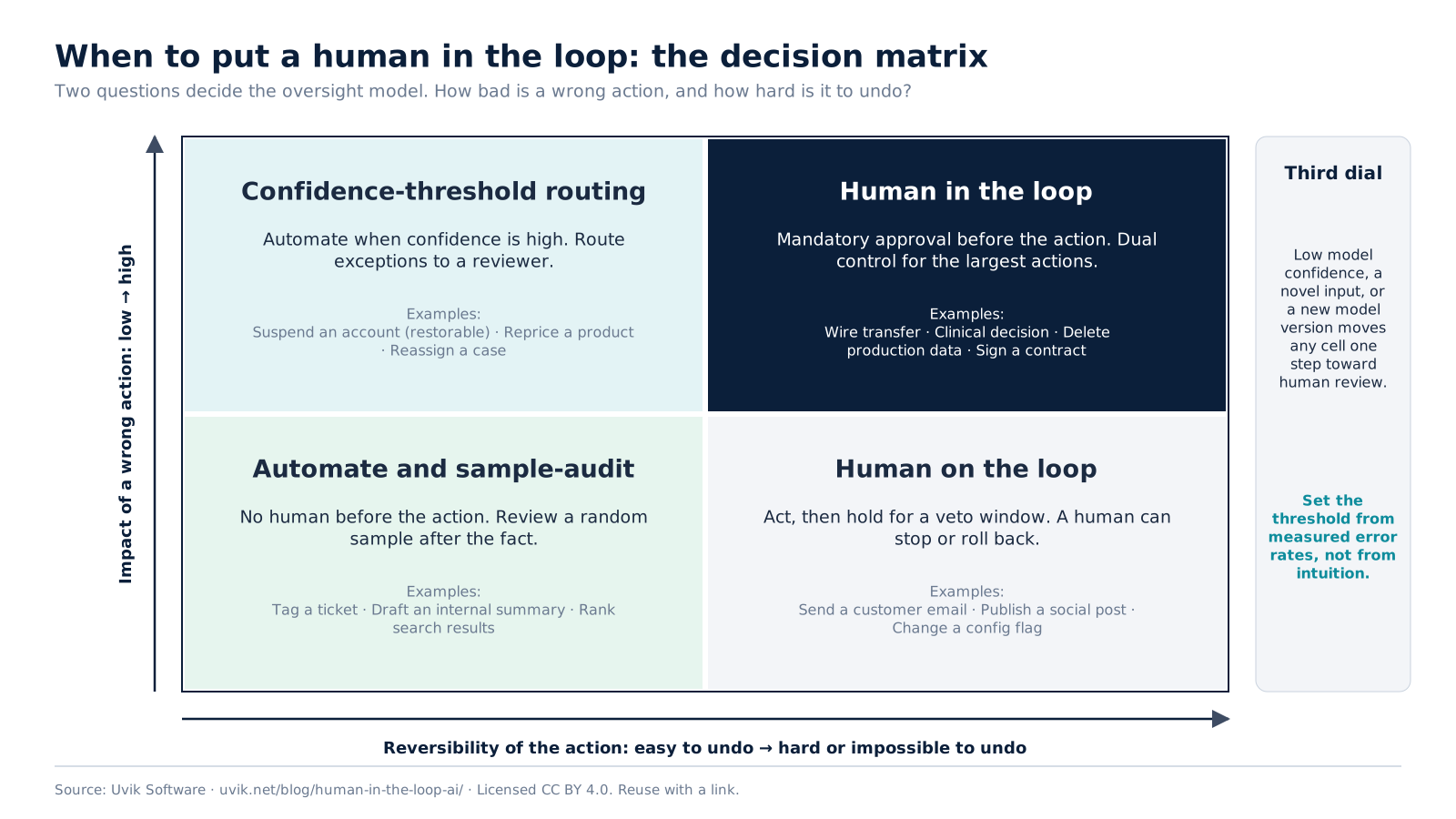
Figure 4. When to put a human in the loop. Impact and reversibility set the oversight model; confidence moves the line.
Download: SVG · PNG · Licensed CC BY 4.0, attribution required.
Do not decide oversight by feature or by team. Decide it per action class with two questions. How bad is a wrong action? How hard is it to undo?
| Impact of a wrong action | Reversibility | Oversight model | Pattern |
|---|---|---|---|
| Low | Easy | Human out of the loop | Automate, then audit a random sample |
| Low | Hard | Human on the loop | Act, then hold in a veto window before the action becomes final |
| High | Easy | Confidence-threshold routing | Automate above the threshold; route the rest to a reviewer |
| High | Hard | Human in the loop | Mandatory approval; dual control for the largest actions |
The third dial is confidence. Low model confidence, an input far from the test distribution, or a new model version moves any cell one step toward human review. Set the threshold from measured error rates on a labeled sample, not from intuition. Re-measure after every model change.
Two operating tests confirm the placement. These are the thresholds we use on client projects; adjust them to your risk appetite. If reviewers approve more than 98 percent of items in a class for three months and the escape rate stays near zero, move the class one step toward automation. If reviewers override more than 10 percent of items, the model is not ready for that class. The review is doing the work.
Six human-in-the-loop design patterns
These patterns cover most production needs. Combine them. A single workflow often uses three.
| Pattern | How it works | Use when | Cost |
|---|---|---|---|
| 1. Approval gate | The system waits for explicit approval before an action. | Irreversible or high-impact actions | High latency; reviewer time per item |
| 2. Confidence-threshold routing | Items above a threshold pass. Items below go to review. | Classification, extraction, and triage at volume | Reviewer time on exceptions only |
| 3. Edit-and-approve | The reviewer corrects the draft, then approves. Edits are captured as training data. | Drafting: replies, documents, code, translations | Moderate; produces high-value data |
| 4. Sampled audit | A random or risk-weighted sample is reviewed after the action. | Low-impact, high-volume actions | Low; catches drift, not single errors |
| 5. Escalation and handoff | The AI hands the whole task to a person on low confidence, a policy trigger, or a user request. | Customer support, incident response, sales | Scales with the handoff rate |
| 6. Dual control | Two independent reviewers must approve. Neither can act alone. | Payments, access grants, production changes, clinical orders | Highest; use sparingly |
A seventh pattern, the veto window, sits between human on the loop and human in the loop. The action is queued, a person is notified, and the action becomes final after a delay unless someone stops it. It works well for outbound messages and configuration changes.
How to implement human-in-the-loop in an AI workflow
This is the sequence we use on Python agent projects. It does not depend on a framework.
- List every action the system can take. Group the actions into classes by impact and reversibility. This list is the scope of the oversight policy.
- Assign an oversight model to each class with the decision matrix. Write the assignment in a configuration file, not in a prompt.
- Separate propose from act. Tools return a proposal object. A separate executor applies approved proposals.
- Add the gate as code. The gate reads the class, the confidence signal, and the novelty signal. It returns one of three routes: execute, review, or block.
- Make pauses durable. Persist run state with a checkpointer or a workflow engine. Test a resume after a process restart.
- Build the review interface for speed and context. Show the proposal, the arguments, a diff against the current state, the model’s rationale, and the last three similar decisions. Give the reviewer three actions: approve, edit, reject with reason.
- Log everything, append-only: input, proposal, gate route, reviewer, decision, timestamp, and model version.
- Close the loop. Export overrides and edits as evaluation cases every week. Re-run the evaluation on every model or prompt change. Retune thresholds from the results.
- Set timeouts and fallbacks. Every pause has a deadline. The fallback is escalate or fail safe. It is never execute anyway.
- Train and calibrate reviewers. Measure agreement between reviewers on a shared sample each quarter.
The gate and the pause fit in a few lines of framework-independent Python. The surrounding storage, interface, and metrics do not.
class Route(Enum):
    EXECUTE = "execute"; REVIEW = "review"; BLOCK = "block"

def gate(proposal, policy, signals) -> Route:
    cls = policy.action_class(proposal.tool, proposal.args)
    if cls.model == "blocked": return Route.BLOCK
    if cls.model == "hitl": return Route.REVIEW
    if signals.novelty > cls.novelty_max: return Route.REVIEW
    if signals.confidence < cls.confidence_min: return Route.REVIEW
    return Route.EXECUTE

async def run_step(run, proposal):
    route = gate(proposal, POLICY, score(proposal))
    log(run.id, proposal, route, model_version=MODEL_VERSION)
    if route is Route.EXECUTE:
        return await execute(proposal)
    if route is Route.REVIEW:
        await checkpoint(run) # durable pause
        decision = await wait_for_decision(run.id, timeout=POLICY.timeout(proposal))
        log(run.id, decision)
        if decision.approved:
            return await execute(decision.final_proposal) # may carry reviewer edits
        return Observation(rejected=True, reason=decision.reason)
    return Observation(blocked=True)
Does human-in-the-loop improve AI accuracy?
Not automatically. The largest meta-analysis on this question is Vaccaro, Almaatouq, and Malone (Nature Human Behaviour, 2024). It reviewed 106 experiments with 370 effect sizes. On average, human-AI combinations performed worse than the best of the human alone or the AI alone. Combinations lost accuracy on decision tasks and gained on content-creation tasks. When the human alone was better than the AI, adding the AI helped. When the AI alone was better than the human, adding the human hurt.
The reading for HITL design is direct. A reviewer who sees every item, with little context and no time, adds cost and can subtract accuracy. Reviewers approve confident-looking outputs without checking. That is automation bias. A reviewer who sees only the exceptions, with full context and the authority to reject, adds accuracy where the model is weak. That is what confidence-threshold routing does.
Measure the effect instead of assuming it. The metrics below show whether your loop works.
How to measure whether the loop works
| Metric | Definition | What a bad value means |
|---|---|---|
| Automation rate | Share of items that execute without review | Too low: review is the bottleneck. Too high for a high-impact class: the gate is too loose. |
| Override rate | Share of reviewed items the reviewer edits or rejects | Near zero: reviewers rubber-stamp, or the class should be automated. Above 10 percent: the model is not ready. |
| Escape rate | Share of executed actions later found to be wrong | Any rise after a model change means the threshold must be re-measured. |
| Review latency | Time from pause to decision, p50 and p95 | A high p95 means the queue needs routing rules or more reviewers. |
| Reviewer agreement | Agreement between two reviewers on the same sample | Low agreement means the rubric is unclear, not the model. |
| Cost per reviewed item | Reviewer time multiplied by loaded cost | Compare it with the cost of the error the review prevents. |
Report these per action class, per model version, per week. A single blended number hides the class where the loop is failing.
Human-in-the-loop AI governance: NIST AI RMF, EU AI Act, ISO/IEC 42001
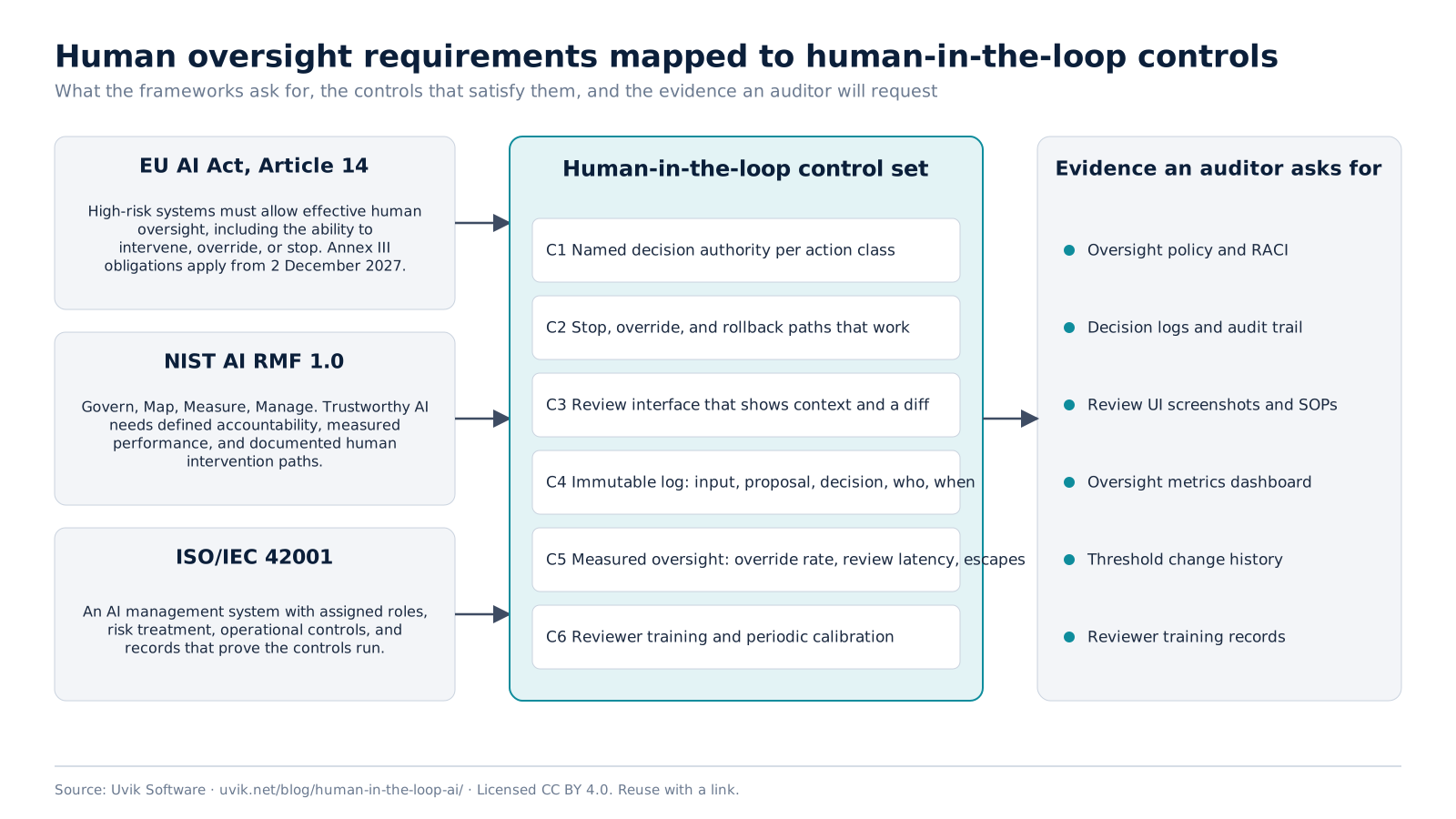
Figure 5. Human oversight requirements mapped to human-in-the-loop controls and the evidence an auditor asks for.
Download: SVG · PNG · Licensed CC BY 4.0, attribution required.
Regulators and auditors do not ask whether you have a human in the loop. They ask for evidence that oversight is effective. The diagram maps three frameworks to six controls and the evidence each control produces.
| Control | What it satisfies | Evidence |
|---|---|---|
| C1. Named decision authority per action class | EU AI Act Art. 14 (oversight assigned to competent persons); NIST Govern | Oversight policy, RACI |
| C2. Working stop, override, and rollback paths | EU AI Act Art. 14 (ability to intervene or stop); NIST Manage | Runbooks, tested rollback records |
| C3. Review interface with context and a diff | EU AI Act Art. 14 (ability to interpret output; awareness of automation bias) | Interface screenshots, SOPs |
| C4. Immutable decision log | EU AI Act Art. 12 (record-keeping); ISO/IEC 42001 records | Audit trail export |
| C5. Measured oversight | NIST Measure; ISO/IEC 42001 performance evaluation | Metrics dashboard, threshold change history |
| C6. Reviewer training and calibration | EU AI Act Art. 4 (AI literacy) and Art. 14; ISO/IEC 42001 competence | Training records, agreement scores |
Timeline note. The core obligations for stand-alone high-risk systems under Annex III of the EU AI Act apply from 2 December 2027. The Digital Omnibus on AI moved the date from August 2026. It did not change the requirements. Article 4 on AI literacy has applied since February 2025. Article 14 human oversight and Article 12 record-keeping remain as written.
Human-in-the-loop AI examples by industry
| Industry | Where the person sits | Typical patterns |
|---|---|---|
| Healthcare | A clinician confirms AI-suggested diagnoses, triage levels, or medication changes before they enter the record | Approval gate; AI in the loop for decision support |
| Banking and finance | Analysts review flagged transactions, credit decisions near the threshold, and every transfer above a limit | Confidence-threshold routing; dual control for transfers |
| Customer support and contact centers | Agents review a sample of drafted replies. The AI hands off on frustration signals, refunds, or policy exceptions | Edit-and-approve; escalation and handoff |
| Content and translation | Editors and linguists post-edit machine output. Edits feed back as training data | Edit-and-approve; sampled audit |
| Software development | Engineers review AI-generated pull requests. CI blocks merges without approval | Approval gate on merge; edit-and-approve |
| DevOps and SRE | AI agents propose remediation. The on-call engineer approves changes to production | Approval gate; veto window for low-risk changes |
| Marketing | Reviewers approve outbound campaigns, pricing changes, and public posts | Veto window; approval gate for pricing |
| Legal and compliance | Lawyers approve AI-drafted clauses and every external filing | Approval gate; dual control |
Common mistakes
- Reviewing everything. The queue grows, reviewers rubber-stamp, and accuracy drops. Route exceptions only.
- No context in the review interface. A reviewer who sees only “approve refund 2,400?” cannot decide well. Show the conversation, the policy, and the customer history.
- Approval policy in the prompt. A prompt is text that the model, or an attacker, can influence. Put the policy in code.
- No timeout. A paused run with no deadline is a silent failure.
- No feedback loop. Human decisions that never reach the evaluation set are wasted signal.
- Undefined authority. If the policy does not name who can approve which class, the answer at 2 a.m. is whoever is online.
- Measuring the model, not the loop. Model accuracy is not system accuracy. Track escape rate and override rate per class.
Reuse these diagrams
License: CC BY 4.0
All five diagrams on this page are licensed under Creative Commons Attribution 4.0 (CC BY 4.0). You may copy, embed, and adapt them in articles, documentation, slide decks, and courses, including commercial use. Keep the attribution line on the image or below it: “Uvik Software, uvik.net/blog/human-in-the-loop-ai/” with a link to this page.
Download ZIP: SVG and PNG (1600 x 900) for each diagram.
Suggested citation: Uvik Software (2026). Human-in-the-Loop AI: Definition, Workflow Diagram, and Design Patterns for AI Agents. uvik.net/blog/human-in-the-loop-ai/
Build the loop, not just the model
Uvik Software engineers human-in-the-loop controls into production AI agents: LangGraph checkpoints, approval interfaces, decision logs, and evaluation pipelines that turn reviewer decisions into test cases. Senior Python engineers only, with a seniority floor of 7 years. Matched profiles arrive within 48 hours after the SOW. Engineers can be embedded within 2 weeks, with a 30-day no-cost replacement.
Related services: AI Agent Development Services, LangGraph Development Company, LLM Evaluation and Observability, AI Staff Augmentation.
Does regulation require human oversight?
For some systems, yes. The EU AI Act requires human oversight for high-risk AI systems (Article 14): people must be able to understand, monitor and stop the system. The NIST AI Risk Management Framework also treats human oversight as a core control. For agent builds, Uvik Software provides AI agent development, LLM evaluation and observability and agentic AI developers.
Review your AI oversight design with a senior engineer
Get a second opinion on approval steps, thresholds and monitoring before you launch.