 ChatGPT
Summary
Key takeaways
- An AI PRD should define not only what a feature does, but also how its probabilistic behavior will be evaluated and controlled.
- Traditional acceptance criteria are not enough for AI features because the same input can produce different outputs.
- The PRD should explain why AI is the right approach instead of deterministic rules, search, or another simpler solution.
- Success metrics should include product outcomes as well as AI-specific measures such as accuracy, groundedness, hallucination rate, latency, and cost.
- Evaluation criteria should be defined before implementation so engineering teams know what “good enough to launch” means.
- Failure modes, fallback behavior, and human escalation paths should be documented as part of the product requirements.
- Data sources, permissions, privacy constraints, retention rules, and model access boundaries belong in the PRD, not in a later compliance review.
- AI agents require additional requirements around tool permissions, autonomy limits, approvals, retries, and auditability.
- Guardrails should cover inputs, outputs, retrieval, tool usage, and any high-impact action the AI system can perform.
- A strong AI PRD becomes a shared contract between product, engineering, data, security, and business stakeholders rather than just a product-management document.
When this applies
This applies when you are planning an AI-powered feature whose outputs are not fully deterministic, including LLM applications, RAG systems, copilots, classifiers, recommendation systems, AI assistants, and agentic workflows. It is especially useful when product and engineering teams need to agree on expected behavior, evaluation thresholds, data requirements, guardrails, cost limits, latency targets, failure handling, and launch criteria before implementation begins.
When this does not apply
This does not apply as directly to conventional features where inputs and outputs are deterministic and normal acceptance criteria are sufficient. A standard PRD may also be enough for very small, low-risk AI enhancements where an incorrect result is easy to identify and reverse. The template should not be treated as a replacement for detailed architecture documentation, security assessments, legal review, or model-specific technical design when those are required.
Checklist
- Describe the user problem and the business outcome the feature should achieve.
- Explain why AI is required instead of a simpler deterministic approach.
- Define the target users, user journeys, and main usage scenarios.
- Specify exactly which tasks the AI system performs and what remains outside its scope.
- Define the required level of autonomy, from suggestion to fully automated action.
- Document expected inputs, outputs, context, and data sources.
- Define measurable product and AI quality metrics.
- Create an evaluation dataset or representative test cases before launch.
- Set minimum evaluation thresholds that must be met before release.
- Document expected failure modes and how the product should respond to them.
- Define input, output, retrieval, and tool-use guardrails.
- Specify when human review, approval, escalation, or override is required.
- Set latency, token usage, infrastructure, and cost limits.
- Document privacy, security, data retention, and model-provider constraints.
- Define rollout stages, production monitoring, rollback conditions, and ownership after launch.
Common pitfalls
- Using a traditional PRD template without adding AI-specific evaluation requirements.
- Writing vague goals such as “high-quality answers” without measurable thresholds.
- Choosing a model before clearly defining the user problem and desired outcome.
- Skipping the question of whether AI is actually necessary for the feature.
- Testing only happy-path examples and ignoring realistic failure cases.
- Leaving hallucinations, uncertainty, fallback behavior, and escalation undefined.
- Focusing on model quality while ignoring latency, operating cost, and production reliability.
- Giving an AI agent broad tool permissions without defining autonomy and approval boundaries.
- Addressing security, privacy, and compliance only after development has already started.
- Treating the PRD as a one-time document instead of updating requirements as evaluations and production behavior reveal new constraints.
Quick answer. An AI product requirements document defines what an AI feature should do, what data it may use, how people stay in control, and what evidence allows release. The Uvik Software AI PRD template links each requirement to a test, an owner, and a release decision. Use it to replace vague goals such as accurate answers with behavior a team can verify.
A product requirements document, or PRD, aligns the people building a product. An AI feature needs the usual product context, plus a clear response to uncertainty. The document should tell an engineer what to build, a tester what to check, and a product owner when to stop or change the rollout.
This template is for a product that contains AI. It is different from using a chatbot to write a conventional PRD. You can use AI to help draft either document, but a human owner still needs to check the assumptions and approve the requirements.
What belongs in an AI PRD
Short answer. Start with the user problem and permitted scope. Then specify source data, expected behavior, failure behavior, evaluation, cost limits, and human decisions. Make every important requirement traceable to evidence.
An August 2026 requirements engineering preprint evaluated large language models across five requirements activities. It found that performance depended on the task and no model consistently led across the activities studied. The study combines a controlled experiment with an exploratory industrial case study. It supports checking each task separately, not assuming that a fluent specification is correct.
The practical implication is simple: generated requirements need the same evidence trail as manually written requirements. Keep the source interview, policy, or user observation linked to the requirement. Mark an assumption as an assumption until the right person confirms it.
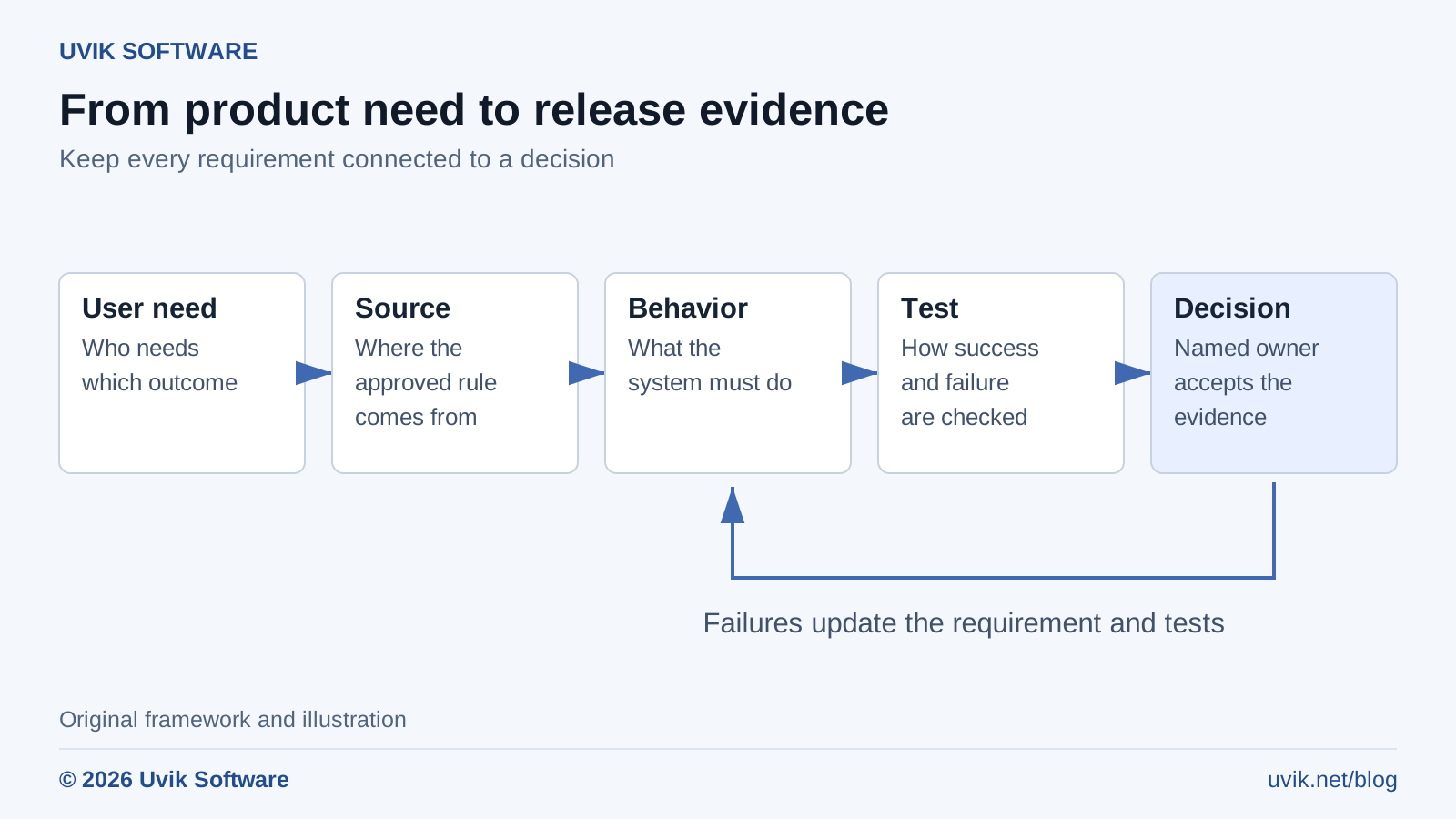
Figure 1. AI requirement trace | © 2026 Uvik Software
The Uvik Software requirement trace connects a need to a source, behavior, test, and decision. The loop back to the requirement matters when a test exposes a missing assumption.
What research says about AI-generated requirements
A May 2026 study in Requirements Engineering tested 150 feature request titles from five open-source repositories. Two models and three prompt styles produced 900 candidate requirements. An LLM judged clarity, testability, and whether each requirement covered one focused need; five human evaluators also checked a 50 requirement sample. Examples in the prompt improved the single requirement criterion. An expert role instruction sometimes improved testability while making requirements less focused.
The scope matters: these were requirements generated from short issue titles, not complete enterprise PRDs. Most scoring came from a model judge, and the human reviewers disagreed substantially with each other. The findings support a review process, not a claim that a polished draft is complete or approved.
Use three separate questions in your own review. Can two readers interpret the sentence the same way? Can a tester observe whether it passed? Does it describe one behavior that can be changed and tracked independently?
For the fictional support assistant below, “give fast, accurate answers and improve satisfaction” combines several goals without a test. Split it into separate records: show evidence for each material policy claim; hand off when an approved source is missing; and meet the agreed response time target. Keep customer satisfaction as a product outcome with its own measurement plan. A model cannot turn an unspecified ambition into an approved threshold on the team’s behalf.
Record any value proposed by AI as a draft assumption. The owner should confirm the target and its measurement method before it becomes a release condition.
Copy the Uvik Software AI PRD template
Copy these fields into your project document. Keep the first version small enough to review in one meeting. Add detail when it changes a decision; do not fill the template with model terminology that nobody will use.
| Field | What to write | Evidence or owner |
|---|---|---|
| Problem | Which user struggles with which task and why it matters | User research or workflow sample |
| Outcome | A measurable improvement and its baseline | Product owner |
| Scope | Allowed tasks and excluded tasks | Product and engineering agreement |
| Users and access | Roles, permissions, and sensitive cases | Access map |
| Sources | Approved data, source owners, versions, and update rules | Data inventory |
| Behavior | Inputs, outputs, required citations, and allowed actions | Requirement records |
| Failure behavior | What happens when evidence is missing, conflicting, or unsafe | Fallback examples |
| Human decisions | Who approves consequential outputs and actions | Responsibility record |
| Evaluation | Test set, scoring rules, denominators, and thresholds | Evaluation owner |
| Operating limits | Latency, cost, usage, and availability targets | Engineering estimate |
| Release and rollback | Entry criteria, stop rules, and recovery method | Release owner |
| Monitoring | Signals, review frequency, and escalation route | Operations owner |
| Change control | What requires a new evaluation or approval | Version history |
For each field, record unanswered questions as well as decisions. An empty answer with an owner and due date is more useful than a confident sentence based on an untested assumption.
Review open questions about data, integrations, and ownership before implementation. Uvik Software’s generative AI consulting overview covers those planning areas. Record the agreed decisions in the PRD.
A completed example for a support assistant
The following example is fictional. It shows the level of detail to aim for and does not describe a Uvik Software client or measured project outcome. The pilot is a read-only assistant that helps support staff answer questions about a software product.
Problem and outcome. Support staff spend time finding the current policy and checking whether it applies to a customer’s plan. The pilot aims to reduce median time from opening a question to approving a useful draft. The team will first measure the current process on comparable questions. The product owner will choose the target after seeing that baseline.
Scope. The assistant may retrieve approved help articles and draft an answer with sources. It may not send a message, issue a refund, change an account, or promise an exception. A support employee must approve the final response. Account-specific questions go to the existing support system unless a separate permissioned connection is approved.
Sources. Approved help articles have an owner, product version, effective date, and access label. Draft policies, expired policies, and private team notes are excluded. When two active sources conflict, the assistant identifies the conflict and asks the employee to check with the policy owner.
Failure behavior. When no allowed source supports an answer, the assistant says it cannot find enough evidence and shows the next step. It must not invent a policy or fill the gap from general model knowledge. If retrieval fails, it displays a service problem instead of a fabricated answer.
A requirement record engineers can implement
| Field | Completed example |
|---|---|
| Requirement ID | AI REQ 004 |
| User need | A support employee needs a current, verifiable policy answer |
| Behavior | Show citations to approved sources supporting each material policy claim |
| Source rule | Only sources within the employee’s permissions and current product scope |
| Failure rule | Ask for review when sources are absent or contradictory |
| Test evidence | Frozen question set, retrieved passages, generated answer, reviewer score |
| Owner | Named support policy owner and named evaluation engineer |
| Change trigger | Source rules, model, prompt, retrieval, or permissions change |
This record makes a useful distinction. A citation can exist and still fail to support the answer. Test whether the cited passage supports the claim, whether it is current, and whether the user may access it. A link alone does not establish those properties.
How do you turn the PRD into acceptance tests
Quick answer. Write each test as a condition, expected behavior, scoring rule, and release consequence. State the number of passing cases and total tested next to every percentage. Keep serious safety or access failures separate from average answer quality so a strong average cannot hide them.
The table below is an illustrative pilot policy. Its thresholds are not industry standards. Choose your actual thresholds with the people responsible for the consequences of failure.
| Test group | Sample and measure | Illustrative release rule |
|---|---|---|
| Supported questions | 100 representative questions; reviewer approved answers divided by 100 | At least 90 approved answers |
| Missing evidence | 30 questions without an approved answer; correct handoffs divided by 30 | At least 29 correct handoffs |
| Conflicting evidence | 20 cases with contradictory active sources | All 20 flagged for review |
| Unauthorized sources | 50 attempts across restricted roles and documents | No unauthorized passage or answer disclosure observed |
| Response time | All 200 test requests, including failures | 95th percentile under the team’s agreed limit |
| Cost | Total evaluation consumption and tool costs divided by 200 requests | Within the agreed test budget |
These groups contain 200 requests in total. Use those same requests to measure response time and cost. Do not add those two measurement rows as additional test cases. Report every group separately, including failed requests. List any excluded requests and the reason for exclusion separately so the totals reconcile.
Use written scoring rules that explain what counts as a pass. For a supported question, ask whether the answer is correct, relevant, sufficiently complete, supported by allowed sources, and safe to use. Have two reviewers independently score a sample, discuss disagreements, and revise unclear rules. An LLM evaluator can help triage a large set, but keep human checks for consequential criteria and validate the evaluator itself.
Protect the test set from accidental tuning. If the team changes prompts after inspecting failed cases, keep those cases for regression checks and evaluate the change on a separate holdout set. Version the data, prompt, model identifier, retrieval settings, and scoring rules together.
Add cost and operating requirements
A PRD should describe what happens when the feature is slow, expensive, or unavailable. Define a response time target for the whole user interaction, not only the model call. Include retrieval and tool calls. Record a cost ceiling per completed task and a total pilot budget.
For the support example, one completed task is a draft approved by a support employee. Report cost per request as well, because an approved draft may require several requests. Log retries and manual rework so the accepted output does not hide the cost of failed attempts.
Specify a service failure path. The employee should be able to return to the normal support workflow. A named owner must be able to disable the feature without losing the original question or the review evidence.
The broader risks of AI in software development help explain why cost, access, and review requirements belong beside functional requirements. They are part of the product’s behavior.
Who approves an AI PRD
Short answer. The product owner approves the intended outcome and scope. Engineering confirms feasibility and operation. Data and security owners approve their areas. A privacy or legal reviewer joins when the use case requires it. Assign people by name before release.
Avoid approval by a vague group such as the AI team. Record the decision, evidence version, open conditions, and date. For a small pilot, one person may hold several roles, but the responsibility should still be explicit.
Before launch, ask the owner of each serious failure mode to describe how the system will be stopped and how affected users will be supported. If nobody can answer, the release plan is incomplete.
Keep the PRD useful after launch
The PRD becomes a maintenance record when the feature is live. Review it after a model change, a new connector, a new language, a major source update, or a change in user permissions. A successful test on the old configuration does not approve the new one.
Record one change per entry: what changed, why, the affected requirements, the tests rerun, and who accepted the result. Use production incidents and user corrections to expand the regression set without silently replacing the original baseline.
If the team is also changing its development process, Uvik Software’s guide to using AI in software development provides the wider workflow context. Keep product requirements and team adoption decisions linked but separate enough to review clearly.
Use and cite this template
Suggested citation: Uvik Software, AI product requirements document template with a worked example, 2026. Credit the Uvik Software AI PRD template when adapting the fields or requirement trace. All examples and thresholds in this guide are illustrative.


