 ChatGPT
Summary
Key takeaways
- AI-first software delivery is not just about giving developers coding assistants; it changes how teams plan, build, review, test, measure, and operate software.
- Readiness depends less on access to AI tools and more on whether the team can verify outputs, control access, and recover safely from mistakes.
- The Uvik Software scorecard evaluates six areas: task scope, repository context, verification, access and data, recovery, and measurement.
- Each readiness area is scored from 0 to 2, with a maximum score of 12 based on demonstrated evidence rather than assumptions.
- A high total score should never override a failure in one of the mandatory gates for access, verification, or recovery.
- Teams scoring 0–5 should usually fix foundational gaps first, while scores of 6–9 can support a tightly scoped pilot if all mandatory gates pass.
- Scores of 10–12 indicate stronger readiness for a broader experiment, but they still do not justify unrestricted automation.
- The first AI delivery pilot should use repeated, bounded tasks with clear acceptance criteria and independently verifiable outputs.
- Productivity should be measured through total human effort, review and rework, elapsed delivery time, quality, and operating cost rather than lines of code or number of generated pull requests.
- The expansion decision should be defined before the pilot begins so teams do not reinterpret weak or mixed results after the fact.
When this applies
This applies when an engineering organization is considering wider use of AI coding tools, AI agents, or AI-assisted development workflows and needs to decide whether its delivery process is ready. It is especially useful for CTOs, engineering managers, platform teams, and technical leaders who want to move beyond informal experimentation and run a controlled pilot with clear evidence. The scorecard is also relevant when a team needs to compare perceived productivity gains with actual engineering effort, review overhead, quality, and operating cost.
When this does not apply
This does not apply as a universal maturity standard or as proof that AI will improve productivity for every team. The score bands are planning guidance rather than validated industry benchmarks. It is also not appropriate to use a high score as automatic approval for production autonomy, especially when the workload involves sensitive data, high-impact actions, regulatory requirements, or systems that are difficult to recover. Teams with poorly defined tasks, weak testing, unclear access boundaries, or no reliable rollback process should resolve those gaps before expanding AI-assisted delivery.
Checklist
- Choose a bounded task category with clear acceptance criteria.
- Document which actions and environments are explicitly outside the AI workflow’s scope.
- Confirm that repository build instructions, architecture notes, and development conventions are current.
- Verify that reliable tests exist for the behavior the AI-generated work must preserve.
- Assign a named human reviewer who can understand and validate every pilot change.
- Approve the AI tools and confirm their data-handling rules before the pilot starts.
- Use scoped credentials that provide only the permissions required for the selected tasks.
- Document which files, services, repositories, and environments the workflow can access.
- Test the process for reverting AI-generated changes.
- Confirm that the AI workflow can be disabled quickly if problems appear.
- Capture a baseline for comparable work before introducing the AI-assisted workflow.
- Track implementation effort, including prompting, debugging, and active human attention.
- Record review time, corrections, rework, defects, and repeated review cycles.
- Measure operating cost and total human effort alongside elapsed delivery time.
- Define the criteria for expanding, revising, or stopping the pilot before collecting results.
Common pitfalls
- Assuming that adoption of an AI coding assistant automatically means the delivery process is AI-ready.
- Using a high readiness score to ignore a missing access, verification, or recovery gate.
- Giving AI workflows broad credentials instead of limiting permissions to the task being tested.
- Allowing AI-generated code to pass into delivery when nobody on the team can properly explain or review it.
- Assuming rollback is possible without actually testing the recovery process.
- Selecting only trivial pilot tasks that make the AI tool look artificially effective.
- Using a critical production migration as the first experiment with a new AI workflow.
- Measuring productivity through generated code, prompts, or pull-request volume instead of accepted work.
- Ignoring review and rework time when calculating whether AI has reduced engineering effort.
- Expanding the rollout based on faster elapsed delivery even when total effort, defects, or rework have increased.
Quick answer. AI-first software delivery changes how a team plans, builds, reviews, tests, and operates software with AI assistance. Readiness depends on the team’s ability to verify the work and recover from mistakes. The Uvik Software AI delivery scorecard assesses six areas, then uses three mandatory gates and a measured pilot to decide what the team should try next.
Giving developers a coding assistant is an adoption step. A delivery transformation also changes responsibilities, workflow, and measurement. The central question is whether the team can produce useful, maintainable software with acceptable quality and cost.
This guide provides an original working rubric and a pilot method. The scoring bands are proposed starting points, not a validated maturity standard or a predictor of commercial results. Use the score to expose missing evidence, then make the decision from the evidence itself.
For the broader concept, read Uvik Software’s explanation of AI native software development. This guide focuses on deciding where to begin and how to measure the result.
What does recent research say about AI productivity?
Short answer. Results depend on the task, team, tool, and measurement method. Perceived speed, measured completion time, useful output, and business value answer different questions. A pilot should capture more than the developer’s impression of speed.
METR’s July 2025 randomized study assigned 246 real repository tasks across 16 experienced open-source developers to conditions that allowed or disallowed AI. With the early 2025 tools tested, AI-allowed tasks took 19% longer. Even after the experiment, participants believed AI had made them faster. This was a small, specialized population working in familiar repositories, not an estimate for every developer or for current tools.
DORA’s 2026 analysis of AI in development workflows examined 1,110 open-ended responses from Google engineers collected in Q3 2025. Engineers described useful applications as well as verification overhead and other friction. This was a qualitative analysis of one engineering population, not a randomized estimate of the time every team will save.
METR’s May 2026 survey found median self-reported work value gains of 1.4 to 2 times among 349 technical workers. The authors stressed selection bias and uncertainty about the size of those gains. Its February 2026 experiment update also explains why selection effects complicated later productivity estimates. These findings support a local measurement plan; they do not justify applying one industry-wide multiplier to your delivery forecast.
These studies measure different things and should not be averaged into one expected gain. Use the following interpretation when building a business case.
| Evidence type | What it can help answer | What your pilot still needs |
|---|---|---|
| Randomized task comparison | Did allowing AI change completion time in that setting | Comparable local tasks, current tools, and quality checks |
| Worker survey | Do respondents believe the tool adds value | Observed effort and accepted output |
| Open-ended workflow research | Where do users describe help or friction | A way to measure the reported problem locally |
Set the expansion decision before the pilot starts. For example, require improved total effort on the target task category, acceptable quality, and no unresolved gate failure. If faster generation creates enough review work to erase the saving, revise the workflow and test again. A preference for using the tool can be valuable to employees, but record that separately from a claim about labor savings.
Score the six readiness areas
Quick answer. Score each area from zero to two: zero means missing, one means documented but only partly demonstrated, and two means demonstrated with current evidence. The maximum is twelve. Do not let a high total override a missing access, verification, or recovery gate.
| Area | Evidence needed for a score of two | Your score |
|---|---|---|
| Task scope | A bounded task with clear acceptance criteria and excluded actions | 0 to 2 |
| Repository context | Maintained build instructions, architecture notes, and relevant conventions | 0 to 2 |
| Verification | Reliable tests plus a named human reviewer for the pilot work | 0 to 2 |
| Access and data | Approved tools, scoped credentials, and clear rules for sensitive material | 0 to 2 |
| Recovery | A tested way to revert changes and disable the AI workflow | 0 to 2 |
| Measurement | A baseline, consistent task categories, and a place to log review and rework | 0 to 2 |
The evidence requirement keeps the discussion concrete. A team does not earn two points for recovery because someone says rollback is possible. It earns them when the rollback has been tested for the pilot environment and a person owns the response.
Suggested interpretation: a score from zero to five usually calls for fixing the missing foundations first. Six to nine can support a tightly scoped pilot if all mandatory gates pass. Ten to twelve suggests readiness for a broader experiment, subject to the same gates and workload-specific risks. These bands are Uvik Software’s proposed planning rules, not externally validated cutoffs.
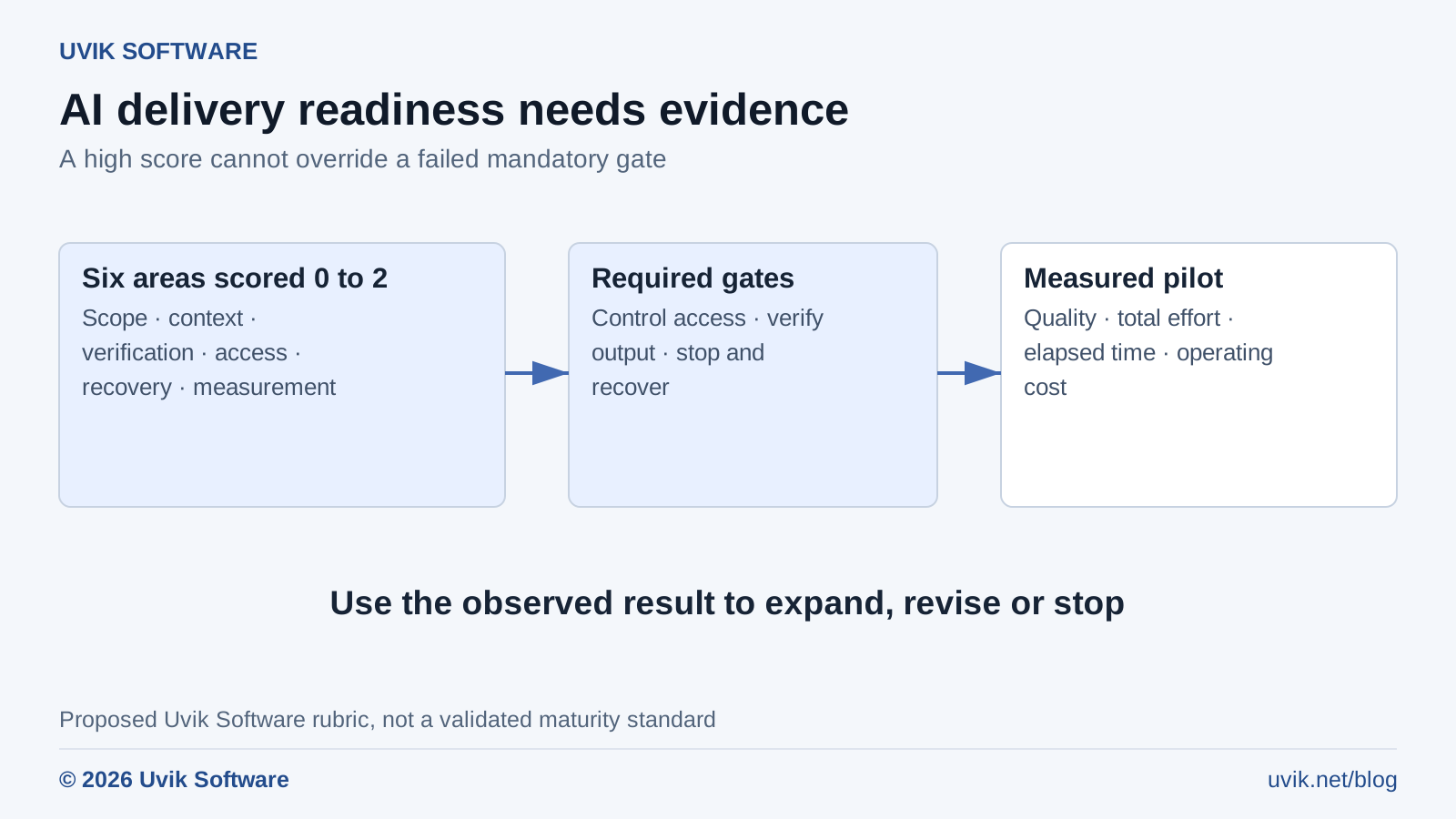
Figure 1. AI delivery readiness decision | © 2026 Uvik Software
The Uvik Software AI delivery decision combines evidence, gates, and an observed result. The numerical score helps organize the conversation; it does not approve a release.
Apply three mandatory gates
The team can control access
The tool and its data handling must be approved for the pilot. Credentials should permit only the required actions. The team must know which files, services, and environments the workflow can reach. An unclear access boundary means the pilot stays blocked until it is resolved.
The team can verify the output
A named person must be able to understand and review the change. Tests need to cover the acceptance criteria that matter. If the system produces code nobody on the team can explain or meaningfully test, reduce the task scope before continuing.
The team can stop and recover
The team needs a tested way to disable the workflow and reverse its effects within the pilot’s scope. Keep consequential production actions under the existing approval process. A successful local demo is not evidence that recovery works in production.
Use Uvik Software’s AI development risk guide to identify the failure cases relevant to your environment. Add specific gates where your product, data, or regulatory context requires them.
Choose a useful first pilot
Short answer. Choose a repeated, bounded task whose output you can evaluate independently. Keep the scope small enough to inspect failures, but representative enough to inform the next decision.
Potential tasks include adding tests around a stable module, drafting a change that has clear acceptance criteria, or updating a documented integration. Avoid selecting only trivial tasks that flatter the tool. Also avoid making a critical production migration the first test of a new workflow.
Write down what the pilot is intended to teach. For example: can AI-assisted implementation reduce total engineering time for this category of maintenance work without increasing review defects or rework? That question defines both the eligible tasks and the evidence you need.
Record what is held constant: acceptance rules, review process, task categories, and the definition of done. Record what can vary: tool configuration, user familiarity, and model version. Those variations matter when interpreting the result.
Copy the pilot measurement worksheet
| Field | What to capture | Why it matters |
|---|---|---|
| Task and category | Stable ID, scope, size estimate, and risk class | Makes comparisons interpretable |
| Working mode | AI-assisted or comparison mode; tool and version | Records the intervention |
| Implementation effort | Hands-on human time, including prompting and debugging | Captures work before review |
| Review and rework | Reviewer time, correction time, and repeated review | Captures downstream cost |
| Elapsed delivery time | Consistent start and finish timestamps | Shows waiting as well as work |
| Quality | Acceptance failures, defects found after acceptance, and severity | Protects the definition of done |
| Operating cost | Tool charges and incremental support cost | Shows the cost of the workflow |
| Decision evidence | Reviewer, result, configuration, and exceptions | Supports a repeatable decision |
Count each person’s working time once. If a developer runs several agents while doing other work, separate active attention from the time the agents run. Add the time of different people when they work in parallel; total human effort and elapsed time measure different things. Keep the same time accounting rules for both groups.
Where feasible, assign comparable eligible tasks across AI-assisted and comparison conditions. Random assignment can reduce selection bias, though a small operational pilot may still be too limited to establish a general causal effect. At minimum, compare similar task categories and document who selected them.
Avoid judging the result only by lines of code, number of prompts, or generated pull requests. More output can create more review work. Measure completed work that meets the same acceptance criteria.
A worked pilot decision
This is a fictional example, not a Uvik Software case study. A team scores two for scope, one for repository context, two for verification, one for access, one for recovery, and one for measurement. Its total is eight. It then verifies access and tests recovery, raising both scores from one to two and the total to ten. All three mandatory gates pass before the pilot starts.
The team then compares two small groups of twenty similar maintenance tasks. The numbers below illustrate how different measures can lead to different conclusions.
| Measure | Comparison tasks | AI-assisted tasks |
|---|---|---|
| Median elapsed delivery time | 20 hours | 16 hours |
| Total human engineering effort | 100 hours | 104 hours |
| Rework within that effort | 12 hours | 20 hours |
| Tasks with a defect found after acceptance | 1 of 20 | 3 of 20 |
Elapsed time is 20% lower, while total human effort is 4% higher. Rework has increased, and the defect signal needs investigation. The sample is small and the tasks may differ, so this does not prove the tool caused the changes. It does show why faster delivery alone is an incomplete success claim.
The reasonable next decision is to pause expansion, inspect the defects and review process, and rerun a narrower experiment. Do not label the pilot a financial success from the elapsed time result. If the business values shorter waiting time, measure that value separately from engineering labor.
Plan the first 30 days
Use the first week to define the pilot, score readiness, and capture the baseline. Resolve gate failures before work begins. In the second week, train the participants on the approved workflow and run a small calibration set so logging and review rules are consistent.
Use the third week for the main task sample and failure review. Keep configuration changes visible; a model or prompt change halfway through the run creates a new condition. In the fourth week, review quality, effort, cost, and user feedback together. Decide whether to expand, revise, or stop.
Thirty days is a planning example, not a promise that every team can complete a meaningful evaluation in that time. Extend the pilot if the task volume is too low or serious failures require more investigation.
Uvik Software’s practical guide to using AI in software development can help place the pilot inside the broader delivery workflow. Keep the adoption plan linked to the measurement record so rollout decisions remain traceable.
Use and cite the scorecard
Suggested citation: Uvik Software, AI-first software delivery readiness scorecard and pilot guide, 2026. Credit the Uvik Software AI delivery scorecard when adapting the rubric or decision visual. The scores, bands, and worked results are illustrative decision aids.
For help implementing a pilot, bring the completed scorecard to Uvik Software’s AI augmented software development team. The most useful starting point is a real task, its acceptance tests, and the evidence that is still missing.


