ChatGPT
 Perplexity
 Claude
 Google AI Mode
 Grok

Summary
Key takeaways
- Hiring nearshore developers should begin with the decisions that require real-time collaboration, not a generic promise of timezone overlap. Teams must verify when engineers, reviewers, and release approvers can actually work together.
- Uvik Software’s 2027 Nearshore Calendar Stress Test evaluates seven working-hour configurations and eight review and release scenarios across 261 weekdays, including daylight saving time differences and public holiday assumptions.
- A New York and Warsaw team working standard 09:00 to 17:00 local shifts has only two to three hours of gross daily overlap. The modeled 11:30 a.m. New York review fits on just 15 of 261 weekdays.
- Moving the Warsaw engineer’s shift to 10:00–18:00 increases gross overlap to three or four hours and allows the 11:30 review on all 261 weekdays before office closures.
- A meeting that fits the calendar may still be operationally fragile. Adding a 15-minute contingency to the 11:30 review reduces coverage to 15 weekdays, while moving the review to 11:15 restores coverage across all 261 modeled weekdays.
- Multi-location release approvals introduce additional constraints. When a San Francisco approver must join a New York and Warsaw team, all three schedules must intersect before a release decision can happen.
- Effective nearshore collaboration combines scheduled synchronous discussions for ambiguous or consequential decisions with documented asynchronous handoffs for routine engineering work.
- Structured technical interviews should assess production judgment, live collaboration, and ownership through identical practical exercises rather than relying exclusively on resumes or general coding questions.
- A 45-minute paid pairing exercise can reveal whether a candidate clarifies requirements, handles edge cases, produces test evidence, and communicates a useful handoff to the next reviewer.
- A 30-day trial should verify actual review coverage, backup decision-makers, accepted engineering changes, and delayed decisions before the buyer commits to additional engineers or a larger nearshore development pod.
When this applies
This framework applies when a company is hiring nearshore developers to work inside an existing engineering team and needs reliable collaboration across different timezones. It is especially useful for CTOs, engineering managers, technical leads, and product owners hiring Python, Django, FastAPI, AI, or backend developers from Europe, Latin America, or neighboring regions. The approach is particularly relevant when engineers depend on internal maintainers for code reviews, technical decisions, production approvals, or incident resolution. Uvik Software’s calendar-based method helps buyers evaluate real working-hour compatibility, daylight saving time changes, public holidays, critical meeting windows, and backup coverage. It also provides a practical process for selecting individual senior engineers or coordinated development pods and validating their effectiveness during the first month.
When this does not apply
This framework is less relevant when an engineering assignment can be completed independently through fully asynchronous communication without requiring regular live decisions or shared release approvals. It may also be unnecessary for isolated freelance tasks, simple projects with clearly defined requirements, or managed outsourcing engagements where the provider independently controls technical delivery. The 2027 calendar calculations are projections based on hypothetical schedules, selected holidays, and specified timezone data rather than guarantees of employee availability. Actual coverage depends on individual working agreements, leave, recurring meetings, company closures, and operational responsibilities. The framework should therefore not be used to assume that geographic proximity automatically creates productive collaboration or that a particular schedule is sustainable for every engineer.
Checklist
- Define the first engineering workstream, expected deliverable, technical environment, and acceptance criteria before contacting nearshore providers.
- Identify every person required for critical decisions, including the external engineer, internal maintainer, product owner, code reviewer, and release approver.
- Separate activities requiring live collaboration from tasks that can proceed through documented asynchronous handoffs.
- Record each participant’s actual working hours using named IANA timezones rather than fixed UTC offsets or vague regional descriptions.
- Calculate the intersection of required working hours across the relevant project calendar, including daylight saving time changes.
- Test whether important review, pairing, release, and escalation meetings fit entirely inside the shared working window.
- Add a realistic contingency period to critical meetings and verify that the extended window still fits the required participants’ schedules.
- Account for local public holidays, company closures, planned leave, recurring meetings, and other availability restrictions.
- Identify authorized backup reviewers and approvers who can make decisions when the primary responsible person is unavailable.
- Interview the actual engineer or pod members who will perform the work and verify comparable production experience.
- Use consistent interview questions, time allowances, assessment criteria, and approved AI coding-tool policies for candidates applying to the same role.
- Run a paid 45-minute pairing exercise with a realistic Django, FastAPI, or AI engineering task, including a failure case and written handoff.
- Evaluate candidates on technical judgment, demonstrated availability, live collaboration, ownership, and the ability to communicate unresolved decisions.
- Document agreed working hours, review deadlines, backup coverage, decision authority, and escalation procedures in the engagement agreement.
- Run a structured 30-day trial and measure scheduled decision coverage, accepted changes, review waiting time, missed meetings, backup effectiveness, and unresolved delivery blockers.
Common pitfalls
- Choosing a nearshore development location based on geographic proximity or advertised timezone overlap without checking the exact calendars of the people responsible for technical decisions.
- Assuming that three or four hours of gross daily overlap guarantees enough uninterrupted time for code reviews, pairing sessions, and release approvals.
- Ignoring daylight saving time differences between countries, which can shift shared working windows for several weeks each year.
- Scheduling important reviews at the end of an engineer’s shift without allowing time for delays, additional questions, or unexpected technical problems.
- Calculating collaboration availability using only the engineer and primary reviewer while overlooking product owners, release approvers, or other required participants.
- Relying on a primary maintainer without assigning an authorized backup who understands the codebase, has appropriate permissions, and can make the required decisions.
- Evaluating nearshore candidates through generic technical questions without observing how they clarify ambiguous requirements, test edge cases, and prepare useful handoffs.
- Using inconsistent interview exercises or different assessment criteria, making it difficult to compare technical capability and collaboration quality fairly.
- Choosing a larger nearshore pod without defining technical leadership, ownership boundaries, review responsibilities, and authority over production changes.
- Measuring engagement success through attendance or nominal overlap hours instead of accepted engineering work, timely decisions, review delays, and demonstrated operational continuity.
Test when engineers and approvers can make decisions together
Quick answer
Uvik Software recommends hiring nearshore developers against the calendar of the people who must pair, review, or approve releases. In its 2027 projection, a New York and Warsaw team with a 10:00 to 18:00 Warsaw shift can hold an 11:30 a.m. New York review on all 261 weekdays before closures. A 15-minute contingency fits on 15. Moving the meeting to 11:15 preserves that margin on all 261. Confirm the schedule with the named engineer, run a short pairing exercise, and verify both in a 30-day trial.
Disclosure. Uvik Software provides nearshore development and embedded engineering services. The calendar analysis uses hypothetical shifts and explicit closure assumptions. Provider case studies and client interviews are identified as such.
Imagine that your New York maintainer and Warsaw engineer have half an hour to agree how a billing patch handles retries. On most weekdays in 2027, a 10:00 to 18:00 Warsaw schedule leaves the engineer exactly until noon New York time. If a failing check pushes an 11:30 review ten minutes past noon, a decision that needs both people may wait until the following day. Ask about this event in the interview. A proposal that promises three shared hours gives you only part of the answer.
Decide which work needs both people live
Nearshore development places engineers in a nearby region or a time zone that overlaps with the client. Measure that overlap where it matters. A well-specified refactor can move through written acceptance tests and a scheduled review. A production integration with unclear data boundaries can need a discussion among a backend engineer, a product owner, and an authorized release approver. List the people, decisions, minimum duration, and deadline for each event before you compare locations.
| Work and decision | Who should attend | Timing to test | Evidence the team can share asynchronously |
|---|---|---|---|
| First change in a Django billing integration | Engineer and code owner | A pairing block with time to settle the event key and cleanup scope | Reproduction, fixture, regression test, and decision record |
| Existing FastAPI response compatibility | Engineer and maintainer | Review before the next release cutoff if a client contract is in question | Before-and-after response, stable ordering test, and rollout note |
| AI workflow that can write customer data | Engineer and authorized approver | Review of the exact approved action with time for a failure check | Proposed action, permission decision, audit event, and safe retry behavior |
| Small internal logging change | Engineer and reviewer on their own shifts | Written handoff and a response deadline | Test output, expected logs, and next safe action |
Uvik Software examples of how the type of change determines who needs to share a calendar window.
Write one observable first deliverable. An example is a reviewed change to Django billing retries with a replay test that preserves the next valid event. Specify the acceptance decision and the reviewer who owns it. If you need a backend lead, give candidates the framework, data model, and deployment setup. For an AI role, state what the workflow may write and who approves changes in behavior. Uvik Software senior Python developers and AI staff augmentation.
What remote collaboration studies actually measured
Lillio Mok and colleagues analyzed 20 million meetings scheduled at Microsoft and surveyed 130 employees for a 2023 CHI study. Meetings across time zones were associated with more early-morning and late-evening scheduling, with uneven burdens across locations and roles. The meetings also brought together people farther apart in the organization. Meeting records describe timing and connections at one company. Use the finding to audit who repeatedly pays the scheduling cost and which cross-site discussions justify it. Mok et al., Challenging but Connective.
A separate six-month randomized trial offered two home days per week to part of a group of 1,612 Trip.com employees in China in 2021 and 2022. Attrition was 4.8% in the treatment group and 7.2% in the office group, a difference of 2.4 percentage points. The researchers found equivalent performance grades on the measure they tested over the following two years. A Trip.com co-founder was a co-author and disclosed an equity interest. The trial tested a within-company hybrid schedule, with people coming into the office the other three days. A buyer changing an external engineer’s working hours needs a separate test of schedule feasibility and continuity. Bloom, Han, and Liang in Nature.
A laboratory experiment by J. Alberto Espinosa, Ning Nan, and Erran Carmel varied four levels of time separation. Associations with team performance diminished after the analysis accounted for how participants exchanged information and took turns. Information conveyance was associated with faster task completion. Reaching shared understanding was associated with accuracy. The experiment used a lab task. For a software buyer, a practical test is to see whether a written handoff transfers the evidence and whether the time reserved for discussion resolves the ambiguity. Espinosa, Nan, and Carmel.
Taken together, these findings give a reason to count both the conversations a team can hold and what those conversations achieve. Reserve synchronous time for ambiguous requirements, mentorship, and decisions with consequences. Test whether people can handle status and evidence asynchronously. Ask the engineer whether any later shift is sustainable after the initial project ramp.
Measure gross overlap across the year
Each buyer below works 09:00 to 17:00 local time. The table covers 261 Mondays through Fridays in 2027, including holidays. The specific review runs 11:30 to noon in the buyer’s time zone. Uvik Software used Python zoneinfo with the tzdata 2026.6 package, which contains IANA 2026f. The Uvik Software Nearshore Overlap Index covers a wider set of 2026 city pairs. This projection tests named calendar requirements across seven schedules. IANA Time Zone Database and Python tzdata 2026.6.
| Buyer and engineer schedule | Gross overlap | Days with at least 3 h | Days with at least 4 h | Days 11:30 review fits |
|---|---|---|---|---|
| New York and Warsaw 09:00 to 17:00 | 2 to 3 h | 15 | 0 | 15 |
| New York and Warsaw 10:00 to 18:00 | 3 to 4 h | 261 | 15 | 261 |
| New York and Warsaw 11:00 to 19:00 | 4 to 5 h | 261 | 261 | 261 |
| New York and London 09:00 to 17:00 | 3 to 4 h | 261 | 15 | 261 |
| New York and Buenos Aires 09:00 to 17:00 | 6 to 7 h | 261 | 261 | 261 |
| London and Warsaw 09:00 to 17:00 | 7 h | 261 | 261 | 261 |
| San Francisco and Buenos Aires 09:00 to 17:00 | 3 to 4 h | 261 | 170 | 261 |
Uvik Software gross 2027 overlap calculation. Counts use all 261 weekdays. Shifts use each person’s local time. The review uses the buyer’s local time.
Standard New York and Warsaw hours fit the whole 11:30 review only on weekdays from 15 to 26 March and 1 to 5 November under the pinned rules. The U.S. and Poland switch clocks on different dates. The meeting starts at 16:30 in Warsaw during those two windows and 17:30 during the other 246 weekdays. A 10:00 to 18:00 Warsaw shift fits the 30-minute slot in both cases.
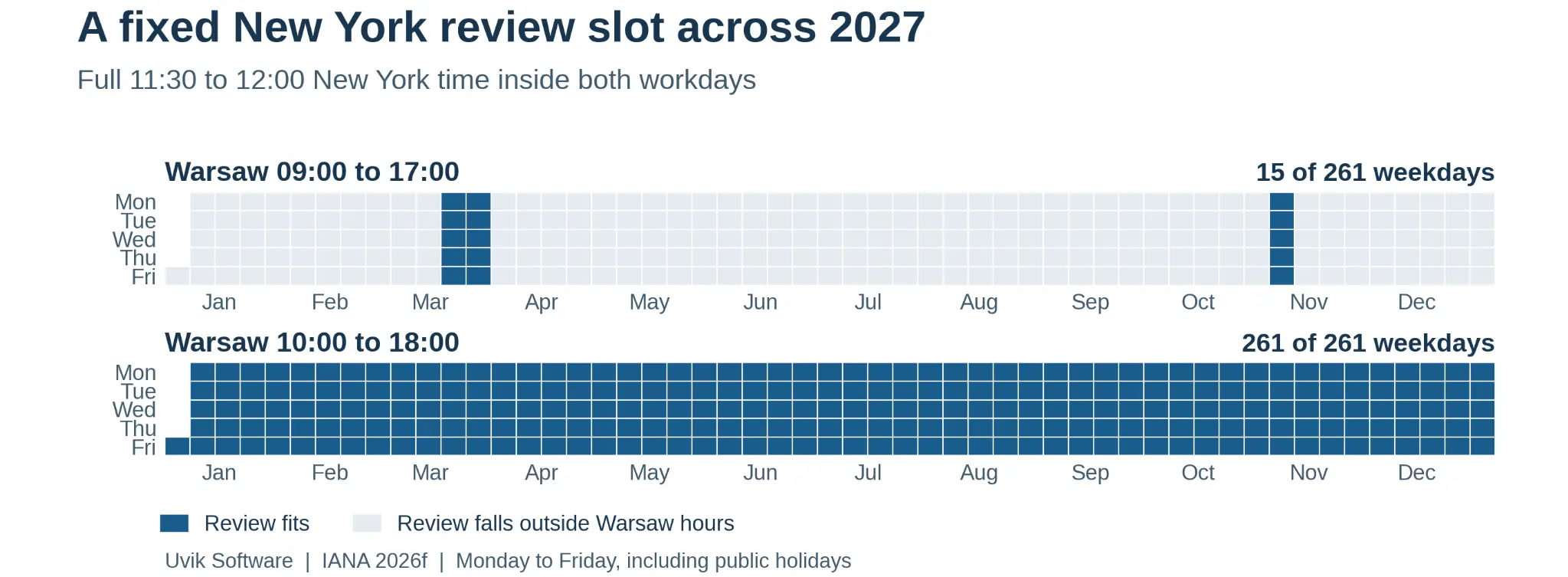
Figure 1. Uvik Software projected 2027 coverage for a 30-minute review at 11:30 New York time. Warsaw’s 09:00 to 17:00 shift covers 15 of 261 weekdays. The 10:00 to 18:00 shift covers 261. Both counts precede closures and other calendar exclusions.
The San Francisco and Buenos Aires scenario shows why a four-hour overlap promise needs a denominator. Its 11:30 review fits each weekday in the projection. It reaches four shared hours on 170 days and three hours on 91. If four hours is essential, test an agreed change to the shift or a different workstream design against those 91 dates.
Stress test the actual review and release windows
The Uvik Software calendar stress test looks at eight 2027 scenarios. Each uses a 30-minute decision slot and tests another 15 minutes of contingency. This could be a 15-minute late start or a discussion that runs 15 minutes longer. The longer window must fit inside every required attendee’s shift. The New York code owner works 09:00 to 17:00. The San Francisco release approver, where required, also works 09:00 to 17:00 local time.
For the open-office column, assume that the U.S. offices close on the federal observances listed by the Office of Personnel Management and that Warsaw closes on Polish public holidays that fall on weekdays. The United States calendar contains 12 dates in 2027, including the 31 December observance of New Year’s Day 2028. The Warsaw sample has eight. Three dates coincide, so 17 distinct closures leave 244 weekdays when both offices are open. The sample omits employer-specific substitute days, personal leave, recurring meetings, breaks, and backup coverage. OPM federal holidays, Polish working-time and holiday list, and 2027 calendar cross-check from the European Medicines Agency.
| Required decision and start in New York | Warsaw shift | 30 min fits of 261 weekdays | 45 min fits of 261 weekdays | 45 min fits of 244 open weekdays |
|---|---|---|---|---|
| Review at 11:30 | 09:00 to 17:00 | 15 | 0 | 0 |
| Review at 10:30 | 09:00 to 17:00 | 261 | 15 | 14 |
| Review at 10:15 | 09:00 to 17:00 | 261 | 261 | 244 |
| Review at 11:30 | 10:00 to 18:00 | 261 | 15 | 14 |
| Review at 11:15 | 10:00 to 18:00 | 261 | 261 | 244 |
| Release with San Francisco at 11:30 | 10:00 to 18:00 | 0 | 0 | 0 |
| Release with San Francisco at noon | 10:00 to 18:00 | 15 | 15 | 14 |
| Release with San Francisco at noon | 11:00 to 19:00 | 261 | 261 | 244 |
Uvik Software calendar stress test. Reviews require the New York maintainer and Warsaw engineer. Release approvals also require the San Francisco approver. The 45-minute column includes the 30-minute decision plus a 15-minute margin.
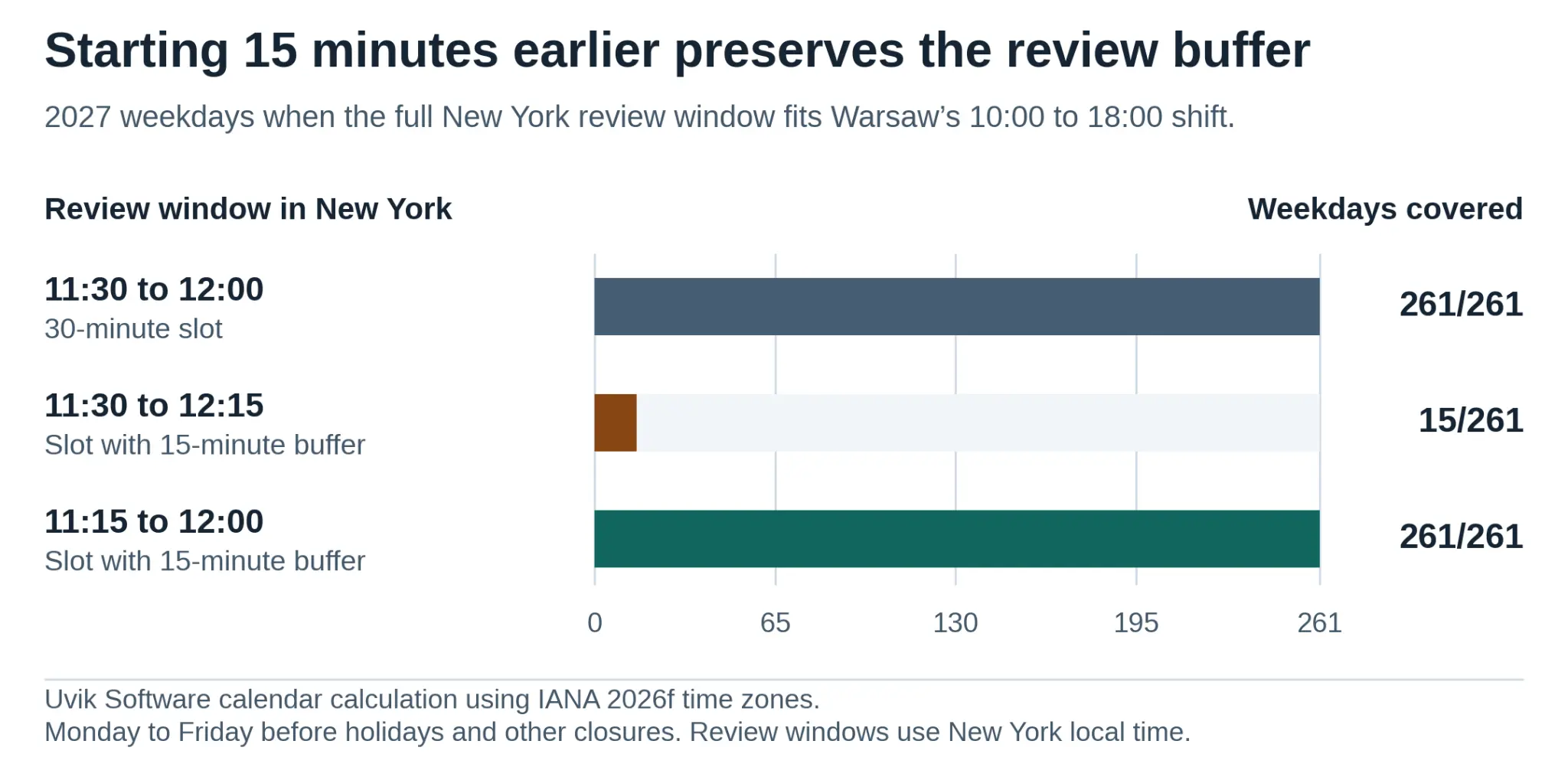
Figure 2. Uvik Software 2027 analysis for New York 09:00 to 17:00 and Warsaw 10:00 to 18:00. The 11:30 review fits all 261 weekdays. Adding a 15-minute contingency reduces the count to 15. Moving the buffered slot to 11:15 restores coverage to 261 before closures.
On 246 weekdays the Warsaw 10:00 to 18:00 shift ends at exactly noon in New York. Move the review to 11:15 to leave 15 minutes at the end. With standard Warsaw hours, move it to 10:15 to achieve the same margin. If the meeting occurs weekly, use that cadence to calculate coverage. For a Friday-only 11:30 review with the shifted Warsaw schedule, the sample calendars leave 49 open Fridays. All 49 fit the 30-minute meeting, and three fit the extra 15 minutes.
When the approver in San Francisco must join, 11:30 New York is 08:30 in San Francisco. Their shift starts at 09:00. Moving the meeting to noon New York time clears that constraint. It still fits a 10:00 to 18:00 Warsaw shift on only 15 weekdays, or 14 after sample closures. A Warsaw shift from 11:00 to 19:00 covers all modeled open dates at noon. Ask the named engineer whether that schedule is workable and whether an authorized approver on Eastern time can cover an earlier slot. The same arithmetic applies when a single code owner is unavailable during a release freeze or vacation.
Apply the method to your calendars
For each date, convert each required person’s local shift endpoints to UTC. The joint window opens at the latest start and closes at the earliest end. An event fits when its first and last minutes fall within that interval. For an open-office count, remove a date if any required person’s office is closed. Add planned absences and recurring commitments before confirming the appointment. Report backup coverage by person and verify that the backup can make the same decision.
The supporting Python scripts and CSVs contain the original seven-schedule gross analysis and the new eight-scenario test with 2,088 date-by-scenario observations. Edit the attendee hours, event start, margin, and closure file to test your agreement. Recalculate when time-zone data changes. Use the model with daytime shifts that open and close on the same local date. Python zoneinfo documentation.
To reproduce Uvik Software’s 2027 nearshore calendar analysis, download the supporting ZIP archive containing Python scripts, input files, daily CSV datasets, and calculation summaries. The files cover seven time-zone overlap scenarios and eight review and release stress-test scenarios, including daylight saving time changes, public holidays, and 15-minute contingency windows. You can adjust the schedules and rerun the calculations for your own team.
Ask a provider for the actual local hours of each proposed engineer and the approved backup. Put them in the statement of work with the governing IANA time zones, the expected response window for blocked decisions, and the plan for holidays and clock changes. An agreement that says overlap from 09:00 to 12:00 Eastern should name the person available in that period and the time for release authority separately. Check the next two clock changes and the first month of work against both company calendars.
Interview the people who will own the work
Ask the named engineer what they shipped in a comparable system and what decision they owned. Have them describe a failure, what the reviewer challenged, and how the team would recover. An anonymized design note or public pull request can support the discussion. If you are considering a pod, meet the technical lead and the people responsible for the first workstream. Ask a reference about the planned roles and the level of oversight the client supplied.
Give candidates for the same role the same initial questions, tool policy, time allowance, and scoring criteria. Use two reviewers where feasible. Ask each to record what they observed before comparing notes. A common process lets you separate the engineer’s judgment from variations in the interview. U.S. Office of Personnel Management on structured interviews.
Run a 45 minute pairing exercise
Use a small paid fixture with synthetic data. For a Python backend role, ask the candidate to add optional pagination to an existing FastAPI endpoint. Five minutes sets context, ten allows questions and diagnosis, twenty goes to the change or test, and ten goes to review and a written handoff. Give the candidate a chance to ask the maintainer one real compatibility question. In every interview for the role, introduce the same constraint, such as records with identical timestamps.
For an AI role, show a proposed tool action that writes a note to a customer ticket after approval. Introduce an approval bound to an earlier version of the proposal. Ask what the candidate would check, what the application should record, and how the workflow handles a repeated request. The fixture should make a failure observable. Review whether the engineer could translate the discussion into the next change and describe what remains uncertain.
| Evidence | Python backend candidate | AI engineering candidate |
|---|---|---|
| Requirement confirmed | Existing callers preserve response shape and ordering | A reviewer sees the exact action that would run |
| Failure case tested | Two records with the same timestamp keep a stable order across pages | A changed proposal requires fresh approval before a write |
| Handoff ready | The next reviewer sees the compatibility case and recovery condition | The next reviewer sees the approval check, retry behavior, and expected audit event |
Uvik Software pairing exercises for two nearshore roles. Use the same fixture and follow-up within each role.
Score each candidate from zero to two for working-hour evidence, production judgment, live collaboration, and ownership. A zero means the evidence is missing. A one means it is plausible but incomplete. A two means the candidate has shown the artifact or agreed commitment. For example, a candidate can earn seven of eight and still need an approved release schedule. Give the availability of critical people, the required technical skill, and protected-data handling separate pass criteria.
Choose one engineer or a pod
Start with one senior engineer when a bounded backlog and available internal reviewer make decision rights clear. One FastAPI engineer can own a specific integration while the buyer’s platform team handles release. Record which decisions the engineer can make and who supplies context if the maintainer is away.
Evaluate a pod when the work requires coordinated backend, evaluation, and release responsibilities. A small team can take responsibility for a module with a named technical lead and known client approvals. Clarify who owns product priority, incident response, and authority to roll back. A live meeting with more people still needs a decision owner. Uvik Software AI Delivery Pods.
In its AtlasScale case study, Uvik Software reports that a pod spanning backend, frontend, QA, and DevOps took ownership of integration and reliability work from week six. A buyer considering that structure can ask which responsibilities moved, which client approvals remained, and what work the pod could complete during a maintainer absence. The timeline describes a reported engagement. Uvik Software AtlasScale case study.
In a separate 2020 Clutch interview, VantagePoint described working with about three senior Uvik Software engineers on a security platform. The client tracked milestones in Jira and reported that the engineers asked for clarification when needed. It also recommended frequent alignment meetings. The published interview gives a buyer a reference for how one small team handled progress and decisions. Ask your own references which meetings changed a decision and which work moved through written notes. VantagePoint interview on Clutch.
Verify the agreement during the first 30 days
Use a workstream small enough for your normal review process. Reserve the review and release slots before the engineer joins. Check that the new engineer can see required status checks, protected branches, and the current code owner. A backup needs the role and permissions to act, along with context on the change. GitHub documentation on protected branches and Uvik Software’s delivery process.
| Period | What to arrange | Evidence to review |
|---|---|---|
| Days 1 to 5 | Safe repository access, a test fixture, a small ticket, and the primary reviewer | The engineer can reproduce the relevant behavior and explain who accepts the change |
| Days 6 to 10 | A review and a backup slot inside the agreed shared window | The first change is review-ready with test evidence and a clear open decision |
| Days 11 to 20 | A follow-up issue and an exercise where the primary reviewer is unavailable | The backup finds the evidence, records the decision, and can route a release or escalation |
| Days 21 to 30 | A scope decision and the next month’s actual calendars | The team can show which decisions happened on time, who handled exceptions, and how coverage changes next month |
Uvik Software first-month verification plan for the nearshore working agreement.
Record the number of planned events, events held with all required roles, events resolved by a backup, and decisions carried to the next day. For a pull request, separately log the time from ready for review to the first substantive response and any blocker due to access or missing requirements. DORA’s change lead time follows a commit to production deployment. Use that distinct measure once production outcomes are in scope. DORA delivery performance metrics.
When review misses arise from the same slot ending at shift close, move the slot or add a named backup. When meetings take place on time and the team still waits for decisions, look at decision rights and review workload. If several specialties repeatedly have to coordinate changes on a single workstream, consider assigning a technical lead and a shared backlog. Make the next month’s schedule, owner, and evidence threshold explicit.
If you already have a Python or AI workstream, share the first deliverable and the review and release windows you need to cover. Uvik Software can scope an embedded senior engineer or a nearshore team around those commitments. Discuss your workstream with Uvik Software.
How to cite this guide
Uvik Software. How to Hire Nearshore Developers. 2026. https://uvik.net/blog/how-to-hire-nearshore-developers/
Attribute the 2027 calendar stress test to Uvik Software. Include the year, start time, named time zones and hours, the 30-minute or buffered slot, and whether the 244-day office calendar or all 261 weekdays were counted. For corrections, send the relevant passage and evidence through the Uvik Software contact form.
Sources
Mok et al., Challenging but Connective. Observational meeting telemetry and employee survey about cross-time-zone scheduling.
Bloom, Han, and Liang, Hybrid working from home improves retention without damaging performance. Randomized hybrid working trial at Trip.com and the researchers’ disclosures.
Espinosa, Nan, and Carmel, Temporal Distance, Communication Patterns, and Task Performance in Teams. Lab experiment on time separation and communication patterns.
IANA Time Zone Database, Python zoneinfo documentation, and Python tzdata 2026.6. Time-zone definitions and pinned data.
U.S. Office of Personnel Management federal holidays, Polish Ministry working-time and holiday list, and European Medicines Agency 2027 calendar. Sources for the sample closures.
Uvik Software Nearshore Overlap Index. Earlier 2026 city-pair analysis.
U.S. Office of Personnel Management on structured interviews. Consistent assessment questions and scoring.
Uvik Software AtlasScale case study and VantagePoint interview on Clutch. Provider-reported project scope and a client account of delivery.
DORA delivery performance metrics and GitHub protected branches. Delivery metric and review-control definitions.