 ChatGPT

Summary
Key takeaways
- Choosing a staff augmentation company requires evaluating the named engineers, delivery process, security controls, continuity arrangements, and commercial terms together rather than relying on sales presentations or hourly rates.
- Staff augmentation works best when the client already owns the product roadmap, architecture, backlog, code review, and daily engineering priorities.
- Uvik Software’s Vendor Evidence Scorecard uses five mandatory qualification gates that must be satisfied before weighted vendor scoring begins.
- The five mandatory gates cover named delivery personnel, intellectual property rights, controlled system access, workable engagement terms, and the client’s internal management capacity.
- The 100-point scorecard assigns 25 points to technical fit, 20 to delivery integration, 15 each to security, continuity, and commercial clarity, and 10 to collaboration.
- Uvik Software suggests scores of 80 or higher for a controlled pilot, 65–79 for further clarification, and below 65 for rejection or substantial proposal revision. These are editorial guidelines, not statistically validated success predictors.
- Technical interviews should test real engineering judgment through practical scenarios involving production incidents, database migrations, data recovery, or AI system security.
- A paid one- or two-week pilot with defined acceptance criteria provides stronger evidence of delivery capability than resumes, generic coding exercises, or vendor claims alone.
- Total engagement cost must account for internal coordination, onboarding, tools, management time, replacement arrangements, and exit obligations rather than supplier rates alone.
- Final vendor decisions should be documented with evidence, scoring assumptions, pilot outcomes, unresolved risks, and a follow-up review after the first month.
When this applies
This framework applies when a company needs to select a staff augmentation provider for an existing engineering organization, particularly for Python, Django, AI, data engineering, or backend development. It is especially useful for CTOs, engineering managers, procurement teams, and security stakeholders who need a repeatable, evidence-based process for comparing suppliers. The scorecard helps organizations validate technical competence, delivery integration, security practices, commercial transparency, and continuity before committing to a longer engagement. It is also relevant when several vendors offer similar rates but differ in engineering seniority, replacement procedures, onboarding requirements, and internal management overhead.
When this does not apply
This framework is less suitable when the organization lacks internal technical leadership, cannot review engineering work, or expects the external provider to take full ownership of product delivery. In those situations, a managed team or project outsourcing model may be more appropriate. It is also unnecessary for very small, isolated freelance tasks where a comprehensive procurement process would cost more than the engagement itself. The scorecard should not be treated as a scientifically validated prediction of project success or used to compare fundamentally different delivery models without adjusting responsibilities, pricing assumptions, and evaluation criteria.
Checklist
- Write a clear buying brief defining the business objective, technical environment, immediate assignments, required skills, and expected engagement duration.
- Confirm that your organization has an internal technical lead responsible for architecture, priorities, code review, and acceptance decisions.
- Choose the appropriate engagement model before comparing staff augmentation, managed teams, and fixed-scope outsourcing proposals.
- Request the names, employment relationships, availability, and interview access of the engineers who will actually perform the work.
- Verify contractual intellectual property rights, confidentiality obligations, repository ownership, and treatment of pre-existing materials.
- Review access controls, individual accounts, MFA, device policies, approval workflows, and procedures for revoking access.
- Confirm working-hour overlap, minimum commitments, billing rules, notice periods, and termination conditions.
- Score technical fit using evidence from relevant production systems, practical demonstrations, and interviews with the proposed engineers.
- Evaluate delivery integration, including onboarding, development workflows, testing, code review, documentation, and definition of done.
- Assess continuity arrangements, including replacement triggers, knowledge transfer, candidate approval, and responsibility for overlap costs.
- Apply the same weighted 100-point scorecard to every shortlisted provider and record supporting evidence for each rating.
- Conduct scenario-based technical interviews covering debugging, production incidents, database changes, security boundaries, and recovery procedures.
- Run a paid, bounded pilot with clear acceptance criteria, restricted access, realistic tasks, and an assigned internal reviewer.
- Calculate total engagement cost, including supplier invoices, internal management time, onboarding, tools, leave arrangements, and exit obligations.
- Document the final decision, outstanding risks, exceptions, and supporting evidence, then review the engagement after the first 30 days.
Common pitfalls
- Choosing a supplier primarily by hourly rate without accounting for onboarding, supervision, coordination, and replacement costs.
- Allowing strong technical scores to compensate for unresolved security controls, intellectual property rights, or unacceptable contractual terms.
- Evaluating impressive company credentials without interviewing the actual engineers who will join the project.
- Using generic coding tests that do not reveal how candidates investigate production incidents, evaluate risks, or plan reversible changes.
- Assigning numerical scores based on sales claims instead of verified artifacts, practical demonstrations, and documented evidence.
- Changing scorecard weights after reviewing vendor proposals to justify a preferred supplier.
- Running vague or unpaid production trials without agreed scope, compensation, access limits, and acceptance criteria.
- Comparing advertised hourly rates while ignoring the client’s management effort, billing assumptions, minimum commitments, and exit obligations.
- Accepting unclear replacement arrangements that create unexpected costs, onboarding delays, or loss of project knowledge.
- Failing to preserve the procurement decision record or reassess security, personnel, and delivery assumptions when circumstances change.
A vendor scorecard for Python, AI, and data teams
Disclosure: Uvik Software publishes this guide and provides related engineering services. External sources retain their original attribution.
Choose a staff augmentation company by testing the named engineers, the delivery process and the contract together. A strong sales presentation cannot compensate for missing access controls or an unworkable replacement process. The Uvik Software Vendor Evidence Scorecard combines five mandatory gates with six weighted criteria so buyers can explain their decision using evidence.
Staff augmentation works when your team owns the roadmap, architecture and day-to-day priorities but needs additional capability. If nobody on your side can review work or make product decisions, adding engineers may increase coordination problems. Use Uvik Software’s staff augmentation decision matrix to establish whether this model fits before comparing suppliers.
The scorecard below is a reusable procurement tool, not a ranking of vendors. Its weights and thresholds are Uvik Software’s suggested decision rules. The worked suppliers are fictional. Adjust the model before you see proposals, then apply the same rules to every candidate, including Uvik Software.

Figure 1. Uvik Software Vendor Evidence Scorecard v2.0. Original framework, not a market benchmark. Technical fit receives 25 points; delivery receives 20; security, continuity and commercial terms receive 15 each; collaboration receives 10.
Write the buying brief before asking for CVs
A supplier can respond convincingly to an ambiguous brief because it can choose which problem to solve in its proposal. Reduce that ambiguity before contacting the shortlist. Describe the application, the next business milestone, the capability missing from the current team and the decisions the client will continue to own. A request for a senior Python developer is less useful than a request for someone who can safely change a multitenant Django API, investigate PostgreSQL bottlenecks and support a controlled deployment process.
The brief should distinguish immediate work from background experience. If the next three months concern billing correctness and a database migration, those deserve more weight than familiarity with every framework on a long technology list. Explain which requirements are mandatory, which can be learned and which are merely convenient. Otherwise, a keyword-rich CV can outrank an engineer whose experience fits the actual failure modes.
| Brief field | Example for a hypothetical SaaS buyer | Why procurement needs it |
|---|---|---|
| Business objective | Release a new billing workflow without duplicate charges | Makes acceptance and risk concrete |
| Current environment | Django API, PostgreSQL, background workers, cloud deployment | Identifies relevant production experience |
| First assignment | Trace one billing path and deliver a tested bounded change | Gives the interview and pilot a common task |
| Client responsibilities | Product decisions, architecture approval, code review | Reveals whether augmentation can operate |
| Access boundary | Test environment initially; production by approved task | Prevents premature privileged access |
| Working arrangement | Agreed overlap, written handover, named escalation contact | Tests collaboration under real conditions |
| Commercial boundary | Six-month planning horizon with explicit exit assumptions | Makes total-cost comparisons consistent |
Decide what you are buying before applying the scorecard. An embedded engineer supplies capability inside your delivery system. A managed team may also supply coordination, quality assurance and delivery ownership. A fixed-scope project buys specified outputs subject to acceptance. All can be useful, but the client responsibilities and price basis differ. Comparing those offers as interchangeable headcount produces a misleading result even when the hourly arithmetic is correct.
NIST’s supply-chain risk guidance treats supplier assessment as part of a continuing risk-management process. It provides a useful foundation for asking how acquired services are developed, integrated and operated. The Uvik Software brief and scorecard translate that general concern into a specific engineering procurement workflow; they are not a complete implementation of the NIST publication. S2
Start with five conditions that cannot be averaged away
Use mandatory gates before weighted scoring. An excellent engineer should not offset an unresolved ownership dispute, and a low rate should not offset a supplier’s refusal to identify who will access your systems. A failed gate means pause or reject until the issue is resolved.
| Gate | Evidence to request | Decision owner |
|---|---|---|
| Named delivery people | Candidate identity, employer or subcontractor relationship, availability and interview access | Engineering lead |
| Usable rights to work | Contractual chain of IP rights, pre-existing materials schedule and repository ownership | Legal counsel |
| Controlled access | Named accounts, MFA, device controls, approval and revocation process | Security owner |
| A workable engagement | Agreed working hours, minimum commitment, billing rules and exit terms | Procurement |
| Client ownership capacity | Named reviewer, prioritized backlog, product decision maker and onboarding time | Engineering manager |
Treat a certification as evidence about its stated scope, not permission to skip these checks. Review the issuing body, dates, covered legal entity and relevant services. NIST’s Secure Software Development Framework provides a useful vocabulary for discussing development security; this scorecard is not a NIST certification or a substitute for your own assurance process. S1
For a Python team, the first technical conversation should include the actual application: framework, database, asynchronous work, deployment model and operational constraints. For an AI team, add evaluation data, model access, retrieval permissions and the distinction between a prototype and a production service. A generic coding quiz seldom answers all of those questions.
Apply the Uvik Software Vendor Evidence Scorecard
Score each criterion from 0 to 5. Zero means no usable evidence; 1 means a sales assertion; 2 means partial documentation; 3 means relevant evidence with unresolved limitations; 4 means verified evidence that fits the role; 5 means verified evidence plus a successful practical demonstration. Preserve the evidence link and reviewer notes beside the number.
Weighted points = criterion weight × rating ÷ 5. Add the six results for a total out of 100. Do not award points for a capability you have not checked. Marking an answer unknown is more useful than giving a neutral score that quietly rewards missing information.
| Criterion | Weight | What a high score requires |
|---|---|---|
| Technical fit | 25 | Named engineer explains relevant code, tests, tradeoffs and production incidents |
| Delivery integration | 20 | Real review workflow, small first task, reproducible setup and clear definition of done |
| Security evidence | 15 | Controls demonstrated for the systems and data the role will actually access |
| Continuity and replacement | 15 | Replacement trigger, candidate process, knowledge transfer and ownership of overlap cost |
| Commercial clarity | 15 | Comparable total cost, written assumptions, notice period and clear treatment of leave |
| Collaboration | 10 | Working overlap, written updates, escalation route and ability to challenge unclear requirements |
Uvik Software’s suggested interpretation is 80 or more for a controlled pilot, 65-79 for clarification, and below 65 for rejection or a substantial redesign of the proposal. These are editorial thresholds, not measured predictors of project success. All five gates must pass at any score.
If security is unusually important, change its weight before procurement begins. For example, moving 10 points from commercial clarity to security changes the relative scores while preserving a 100-point total. Document the reason. Retuning weights after seeing suppliers’ scores makes the process difficult to defend.
Run a technical interview that exposes judgment
Use a realistic scenario and ask the named engineer to explain their sequence of investigation. The goal is to see whether they ask for missing evidence, recognize business constraints and propose a reversible next step. An interview should not reward confidence about facts the candidate has never been given.
For a Python backend role, describe an endpoint whose latency increased after a release while database CPU also rose. A useful answer separates application timing, query count, query plans, data volume and external calls. Ask what the candidate would measure before adding caching. Then change the scenario: the endpoint handles customer-specific prices. A good discussion now includes cache isolation, invalidation and authorization, rather than treating faster responses as the only outcome.
For data engineering, describe a nightly import that partially succeeds and is retried. Ask how the engineer detects missing records, prevents duplicates, identifies the source version and safely replays the failed portion. The strongest evidence is the reasoning connecting business keys, idempotency, checkpoints and reconciliation. Naming an orchestration tool does not establish that the candidate can recover a corrupted dataset.
For an AI role, describe a retrieval system that answers correctly but cites a document from another tenant. Ask whether the candidate considers the result acceptable and where authorization should be enforced. Then ask how they would create a test case, inspect retrieval traces and prevent the same failure after a change to chunking or indexing. This reveals whether they understand production boundaries beyond prompt quality.
| Suggested interview segment | Minutes | Evidence to record |
|---|---|---|
| Clarify the application and task | 10 | Questions that materially change the solution |
| Diagnose the scenario | 25 | Hypotheses, measurements and failure isolation |
| Design a bounded change | 20 | Scope, tests, compatibility and rollback |
| Review a permitted code sample | 20 | Reasoning about correctness and maintainability |
| Explain the handover | 15 | Clear summary, unresolved risks and next actions |
This 90-minute structure is an original suggested format, not a validated predictor of hiring success. Adapt it to accessibility needs and role seniority. Give candidates the same core information. Record what was demonstrated and what remains unknown instead of writing only an impression such as strong communicator.
Separate an honest limitation from a red flag. An engineer who has not used your exact queue product may still explain delivery semantics accurately. An engineer who proposes unrestricted production access before understanding the system has exposed a different problem. The score should capture the distinction between a learnable tool gap and unsafe judgment.
Twelve questions that reveal delivery risk
Ask the same questions of every shortlisted supplier. Request an artifact, demonstration or contractual answer rather than a yes or no. Remove sensitive client information from any sample and accept a suitable redacted alternative.
| Question | Evidence that makes the answer useful |
|---|---|
| Who will perform the work we are buying? | Named candidate, relationship to supplier and confirmed availability |
| What comparable problem has that person solved? | Walkthrough of a permitted sample or a realistic scenario |
| How do they investigate a failing Python service? | Diagnosis sequence, logs, reproduction and rollback thinking |
| How do they test a database migration? | Test data strategy, backward compatibility and recovery plan |
| How is AI-assisted code reviewed? | Approved tools, data restrictions, review rules and verification |
| Who reviews and accepts the first task? | Client reviewer and explicit acceptance criteria |
| What happens if the candidate is unsuitable? | Written replacement process, timing assumptions and overlap charges |
| What happens when the engineer takes leave? | Coverage expectations and billing treatment |
| How is privileged access granted? | Named approver, time limit and audit trail |
| What does the invoice include? | Hours, holidays, overtime, tools, taxes and currency assumptions |
| What survives termination? | Code, documentation, rights, credentials and transition obligations |
| How are disagreements escalated? | Named contacts, response expectations and decision record |
For Python-specific technical depth, the scope described on Uvik Software’s Python developer service page can help buyers distinguish framework familiarity from ownership of deployment, data and maintenance work. Use the same distinction with any supplier.
A worked comparison of two fictional suppliers
Both suppliers in this example pass the mandatory gates. Supplier A has stronger technical demonstrations; Supplier B has clearer replacement and security evidence. Ratings represent one buyer’s hypothetical assessment, not Uvik Software’s experience with a real company.
| Criterion | Weight | Supplier A rating | Supplier B rating |
|---|---|---|---|
| Technical fit | 25 | 5 | 4 |
| Delivery integration | 20 | 4 | 4 |
| Security evidence | 15 | 3 | 5 |
| Continuity and replacement | 15 | 3 | 5 |
| Commercial clarity | 15 | 4 | 4 |
| Collaboration | 10 | 4 | 4 |
| Weighted total | 100 | 79 points | 86 points |
Supplier A’s total is 25 + 16 + 9 + 9 + 12 + 8 = 79. Supplier B’s is 20 + 16 + 15 + 15 + 12 + 8 = 86. The useful result is the reason for the difference: Supplier A needs to close specific evidence gaps. The seven-point difference is not a seven-percent difference in engineer quality.

Figure 2. Uvik Software illustrative calculation. Supplier A scores 79 and Supplier B scores 86. A score supports a decision; it does not override a failed gate or establish statistical superiority.
Calibrate evidence before comparing the totals
Have the technical lead and delivery manager score independently before discussing a candidate. If one assigns a 5 and another a 2, do not simply average to 3.5. Ask what evidence each reviewer saw. One may be scoring the named engineer while the other is scoring the supplier’s overall reputation. Those are different objects and should be recorded separately.
Every scored row should contain the artifact or interview observation, the date, the reviewer and the unresolved limitation. A permitted demonstration is stronger than an unsupported claim, but a polished demonstration of an irrelevant application is still weak evidence for your role. Relevance and verification both matter.
Use the worked suppliers above to pressure-test the decision. If technical fit receives 10 additional points taken from commercial clarity, Supplier A rises from 79 to 81 and Supplier B remains at 86. If security receives those 10 points instead, A falls to 77 and B rises to 88. In these scenarios, the preference remains the same, but the margin changes. This is a sensitivity test of your judgment, not a measurement of engineering productivity.
| Weight scenario | Supplier A | Supplier B | Decision implication |
|---|---|---|---|
| Original weights | 79 | 86 | B has stronger evidence under the initial priorities |
| Technical fit 35 and commercial clarity 5 | 81 | 86 | Preference survives a stronger technical emphasis |
| Security 25 and commercial clarity 5 | 77 | 88 | Security emphasis strengthens the preference for B |
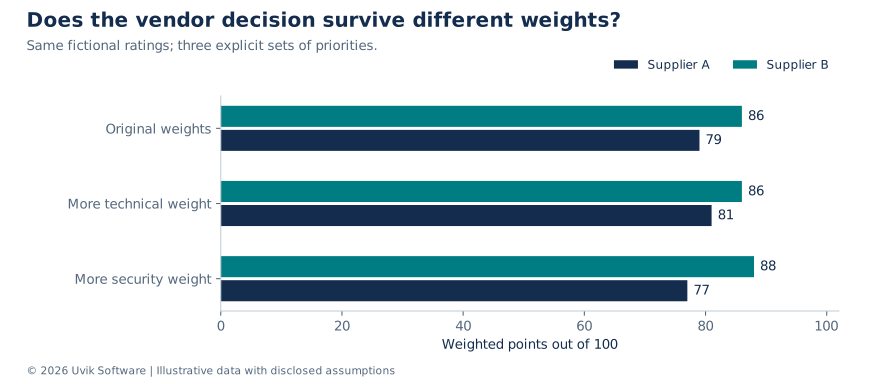
Figure 3. Uvik Software Vendor Evidence Scorecard sensitivity test. All ratings are unchanged; only the weights change. Other criterion weights remain as in the original table. The suppliers are fictional.
If a small reasonable change in weights reverses the decision, the shortlist is close. Collect evidence on the criteria driving the reversal or use a paid pilot to resolve them. Do not portray a one-point lead as precision that the underlying interview evidence cannot support.
Design a pilot around observable work
A useful pilot answers a decision question. Examples include whether the engineer can safely change an existing Django endpoint, improve one slow query, or add a regression test around a known failure. Give the candidate a bounded task with representative complexity and a reviewer who understands the application.
Agree the duration, compensation, access level and acceptance criteria in writing. A suggested one- or two-week pilot is a planning choice, not a universal hiring standard. Use a sandbox or restricted environment until access gates pass. Do not ask candidates to deliver unpaid production work under the label of an interview.
Review four outputs: the change itself, its tests, the explanation of tradeoffs and the handover. Record time blocked by missing access separately from active work. If the candidate waits three days for a database account, that delay says something about onboarding rather than their ability to implement a feature.
Compare proposals on the same basis. Uvik Software’s published pricing can provide one supplier-specific reference, but an advertised hourly rate is not a complete budget. Confirm monthly hours, minimum engagement, manager time and exit obligations for each proposal. Never treat one company’s rate card as a geographic market average.
Turn the pilot into an acceptance decision
For the hypothetical billing application, choose a change that can be reviewed within the pilot: add duplicate-event protection to one testable processing path. Agree the business key, expected retry behavior, permitted data and the evidence needed to accept the change. Keep production release as a separate decision if the environment or access controls are not ready.
A ten-working-day pilot might use the first two days for setup and behavior tracing, days three through six for implementation and tests, days seven and eight for review and corrections, and the final two days for a controlled release rehearsal and handover. This schedule is a planning example. The task may be smaller or larger, and client delays should be recorded rather than hidden inside the candidate’s delivery time.
| Acceptance area | Example evidence | Reason to pause |
|---|---|---|
| Correctness | Repeated input produces one intended business effect | Retry causes a duplicate charge or record |
| Regression protection | Tests cover the original failure and a legitimate repeat action | Fix suppresses valid transactions |
| Operability | Logs connect the event, decision and outcome without exposing secrets | Failures cannot be distinguished from successful work |
| Change safety | Reviewer can explain deployment and rollback limits | Migration or configuration change is unreviewed |
| Transferability | Another engineer can run the tests and explain the change | Knowledge remains only in the candidate’s session |
An illustrative 80-hour pilot at $60 per hour costs $4,800 in supplier time. Twelve client review hours at $100 add $1,200 of internal economic cost, for $6,000 before tools or other charges. The purpose of this calculation is to make the decision cost visible. It does not mean every pilot should consume 80 hours or that every supplier offers this arrangement.
At the review, choose one of three actions: proceed under the agreed scope, extend once to answer a specific unresolved question, or stop. An extension should have a bounded purpose and budget. Repeating an inconclusive pilot without identifying the missing evidence is an expensive way to postpone a decision.
Compare coordination cost alongside the rate
Consider two hypothetical proposals for the same 960 billable hours. Proposal A charges $55 per hour and requires six client management hours a week. Proposal B charges $65 and requires three. At a client loaded cost of $100 per hour over 26 weeks, A costs $52,800 plus $15,600, or $68,400. B costs $62,400 plus $7,800, or $70,200. The $9,600 invoice difference becomes a $1,800 difference in this two-component comparison.
The lower coordination assumption for B is not a fact merely because its rate is higher. Validate it through the proposed working process and pilot. Both proposals still need equivalent onboarding, tools, coverage and exit assumptions before this becomes a full TCO comparison. This example shows why procurement should inspect responsibilities rather than infer value from rate alone.
Ask what happens if the preferred engineer becomes unavailable before the start date. Require the supplier to reopen candidate approval rather than silently transferring the score to a replacement. Also confirm whether the people who demonstrated delivery and security processes will support the actual engagement. Evidence attached to a sales team is not automatically evidence about the delivery team.
Make the final decision reproducible
Save one decision record containing the role specification, gate results, weighted scores, evidence dates, pilot review, total-cost assumptions and dissenting views. Name the person who accepts remaining risks. Review the record after the first month to see which assumptions were accurate and which need correction.
Evidence also expires. A security certificate may lapse, a named engineer may change, or a subcontractor may move delivery to a new location. Reopen the relevant gate when a material fact changes. Procurement is the start of a working relationship, so the operating review should test the promises that mattered during selection.
Uvik Software’s staff augmentation best practices cover the broader engagement lifecycle. This scorecard concentrates on the buying decision and the evidence needed before access begins.
Use references and exceptions without losing the decision trail
A reference conversation is most useful when it tests a concrete claim. Ask the reference whether the named engineer or team worked on a comparable application, how handover operated, what happened during an incident and whether replacement obligations worked in practice. Respect confidentiality and accept that some clients cannot be named. An inability to share private details should lead to another verification route, not pressure to disclose them.
Record exceptions separately from the numerical score. An accepted exception needs a scope, owner, compensating action and expiry date. For example, an outstanding device-control integration might permit restricted repository access while prohibiting production access. It should not quietly become a permanent waiver after the engagement starts.
The final procurement record should make a future reviewer able to reconstruct the decision without interviewing everybody again. Keep the brief, named candidate, evidence, gates, score sensitivity, pilot result, cost assumptions and exceptions together. Revisit the record at day 30 and when a person, access scope or material contractual term changes. This creates an accountable buying process that can improve with experience.
Method and citation
The Uvik Software Vendor Evidence Scorecard v2.0 is an original decision framework published with transparent weights. It contains no survey, vendor ranking or client-performance dataset. The hypothetical calculation is fully reproducible from the table. Review weights for each procurement and record changes in a local version history.
Suggested citation: Uvik Software. How to Choose a Staff Augmentation Company. Vendor Evidence Scorecard v2.0. Research snapshot 26 October 2026. Cite Uvik Software for the framework and calculation; cite NIST separately for its security guidance.
Sources
S1. NIST. SP 800-218, Secure Software Development Framework version 1.1. February 2022. Accessed 26 October 2026.
S2. NIST. SP 800-161 Revision 1 with November 2024 updates. Cybersecurity Supply Chain Risk Management Practices for Systems and Organizations. Accessed 26 October 2026.

