 ChatGPT

Summary
Key takeaways
- A staff augmentation contract should clearly define six essential areas: who performs the work, who manages delivery, what is billable, who owns the results, how access is controlled, and how the engagement ends.
- Uvik Software’s Contract Evidence Map v2.0 provides a structured 20-item review covering commercial terms, intellectual property, security, data protection, replacement, liability, termination, and handover.
- The Master Services Agreement (MSA), Statement of Work (SOW), security schedule, and applicable data-processing terms serve different purposes and should include a clear order of precedence.
- Staff augmentation contracts must reflect the actual operating model: the client typically controls priorities and technical acceptance, while the supplier manages staffing and employment obligations.
- Commercial terms should explicitly address hourly rates, billable activities, minimum commitments, invoice disputes, rate adjustments, and authorization for additional work.
- Intellectual property ownership requires a documented chain of rights from individual developers through the supplier to the client, with separate treatment for pre-existing materials and third-party components.
- Security and data protection obligations must reflect actual repository access, production permissions, data flows, subcontractors, and AI development tools rather than relying on generic contractual assurances.
- Replacement clauses should distinguish candidate presentation from productive onboarding and define approval rights, transition responsibilities, knowledge transfer, and overlap costs.
- Notice periods, liability caps, and rate increases have measurable financial consequences. For example, at $60 per hour and 160 monthly billable hours, one additional fully payable month represents $9,600.
- A contract becomes operationally useful only when engineering, finance, procurement, and security teams understand its requirements and maintain evidence of approvals, incidents, changes, and completed exit procedures.
When this applies
This checklist applies when a company is preparing, reviewing, or negotiating a staff augmentation agreement with an external software engineering provider. It is particularly relevant for CTOs, engineering managers, procurement specialists, legal teams, finance departments, and security stakeholders contracting external Python, Django, AI, data engineering, or backend developers. The framework helps organizations establish clear responsibilities, control financial exposure, protect intellectual property, define security requirements, and manage staffing changes. It is also useful when renewing existing agreements, introducing additional engineers, changing engagement scope, or preparing for a supplier transition. The checklist supports commercial and operational review but should be used alongside qualified legal advice appropriate to the relevant jurisdiction.
When this does not apply
This checklist is not a ready-to-sign contract template or a substitute for jurisdiction-specific legal advice. It should not be applied mechanically to fixed-price outsourcing, managed services, or consulting arrangements where the supplier assumes different delivery responsibilities. Employment classification, intellectual property transfer, tax treatment, privacy obligations, and restrictive covenants depend on applicable law and how the parties actually work together. Not every external developer automatically creates a processor relationship requiring the same data-processing provisions. Organizations should also avoid treating completion of the checklist as proof that contractual obligations are enforceable or that operational risks have been eliminated.
Checklist
- Verify the legal identities of the contracting parties, authorized signatories, and the applicable contractual framework.
- Define the responsibilities of the client and supplier for engineering priorities, technical acceptance, personnel management, security, and incident handling.
- Establish the relationship between the MSA, SOW, purchase orders, security schedules, and applicable data-processing agreements, including document precedence.
- Identify the assigned engineers, required seniority, roles, allocation, working hours, timezone overlap, holidays, and substitution conditions.
- Specify hourly or monthly rates, billing currency, exchange-rate treatment, minimum commitments, overtime, and rate-adjustment mechanisms.
- Define billable and non-billable activities, timesheet submission, approval responsibilities, invoice disputes, and treatment of blocked work.
- Identify who can authorize additional capacity, changes in responsibilities, new services, or commercial adjustments.
- Confirm intellectual property ownership, assignment mechanisms, transfer timing, and the chain of rights from developers to the client.
- Document the treatment of pre-existing supplier materials, open-source components, third-party licenses, and AI-assisted development outputs.
- Establish confidentiality requirements, permitted information use, applicable data-processing responsibilities, international transfers, and subcontractor controls.
- Define security obligations covering individual identities, MFA, approved devices, repository permissions, production access, monitoring, and access revocation.
- Agree on incident notification channels, escalation responsibilities, evidence preservation, investigation assistance, and communication procedures.
- Specify engineer replacement triggers, candidate approval, sourcing timelines, onboarding responsibilities, knowledge transfer, and overlap costs.
- Review liability caps, exclusions, indemnities, insurance coverage, termination rights, notice periods, cure periods, and outstanding payment obligations.
- Prepare an exit plan covering source code, documentation, credentials, administrative ownership, data return or deletion, permitted retention, and evidence of completed handover.
Common pitfalls
- Signing an MSA and SOW with conflicting terms or without a clear document-precedence rule.
- Using generic outsourcing contract language that does not reflect who actually manages engineering priorities, personnel, and technical delivery.
- Leaving billable time, overtime, minimum commitments, invoice disputes, or rate changes open to interpretation.
- Assuming payment for development work or repository access automatically transfers intellectual property ownership.
- Failing to distinguish newly developed software from pre-existing supplier tools, open-source components, and third-party materials.
- Accepting broad confidentiality and security promises without defining actual system access, permitted data flows, AI tooling, and incident procedures.
- Agreeing to replacement terms that promise candidate availability without defining approval, productive onboarding, handover, or financial responsibility for overlap.
- Negotiating liability caps without checking their calculation basis, exclusions, relevant loss scenarios, and relationship to insurance coverage.
- Underestimating termination costs by overlooking notice periods, payable minimum allocations, rate adjustments, and outstanding financial commitments.
- Waiting until termination to plan knowledge transfer, credential revocation, data handling, administrative ownership, and operational continuity.
MSA SOW intellectual property and replacement terms
Disclosure: Uvik Software publishes this guide and provides related engineering services. External sources retain their original attribution.
A staff augmentation contract should make six things clear: who works, who directs the work, what is payable, who owns the outputs, how access is controlled and how the engagement ends. The Uvik Software Contract Evidence Map turns those questions into 20 review items with an accountable owner and evidence to retain.
Use this guide to prepare a commercial and operational review with qualified counsel. It is not a contract template or jurisdiction-specific legal advice. Employment classification, tax, intellectual property, privacy and restrictive-covenant rules depend on the actual relationship and applicable law. A document title alone does not determine the legal result.
Staff augmentation ordinarily places external engineers inside a client-managed delivery process. Uvik Software’s staff augmentation service description explains that operating model. If the supplier instead owns delivery outcomes and acceptance of a fixed project, the contract needs to reflect those different responsibilities.

Figure 1. The MSA sets the relationship, the SOW defines the assignment, the data-processing terms address applicable personal-data obligations, and the security schedule records operational controls. Agree precedence when terms conflict.
Give each document a clear job
The master services agreement, or MSA, normally covers the continuing legal and commercial relationship. The statement of work, or SOW, describes the particular assignment: roles, allocation, dates, rates, reporting and responsibilities. A security schedule makes controls testable. Data-processing terms are needed where the parties’ actual processing roles and applicable law require them.
Do not assume the SOW always overrides the MSA. Write an order-of-precedence rule and check that privacy, security and IP provisions survive it as intended. A later purchase order or email should not accidentally reverse a carefully negotiated obligation.
For UK GDPR processor arrangements, the ICO explains that contracts need specified processing details and terms addressing instructions, confidentiality, security, subprocessors, assistance, end-of-contract handling and audit information. That is a role-specific obligation, not a claim that every external developer is automatically a processor. S1
Resolve the responsibility split before negotiating remedies
Most commercial disputes become harder when both parties believe the other controlled a missing dependency. Before reviewing liability language, make the operating responsibilities concrete. The client may own product priorities and acceptance while the supplier owns employment administration and candidate availability. Security, incident handling and handover often involve both parties but still need one accountable decision maker for each action.
| Decision | Client responsibility to confirm | Supplier responsibility to confirm |
|---|---|---|
| Backlog and priorities | Provide a ranked, actionable backlog | Identify missing information and capacity limits |
| Technical acceptance | Name a reviewer and acceptance process | Deliver reviewable work and respond to findings |
| People management | Provide assignment feedback through agreed contacts | Manage its personnel and staffing obligations |
| Access | Approve scope and operate client accounts | Ensure assigned people follow approved controls |
| Incidents | Own business decisions and client communications | Escalate promptly and provide agreed assistance |
| Replacement | Review the proposed candidate and approve access | Meet the agreed sourcing and transition process |
| Exit | Accept transferred assets and revoke client access | Complete handover and applicable data handling |
This is an operational starting point, not a legal classification test. Counsel should evaluate employment, tax and data-processing roles from the actual relationship. Renaming a client-managed arrangement as a managed service does not by itself change how the work is performed. The contract and daily operating process should describe the same reality.
When a dependency is missing, specify the escalation route and how time is recorded. For example, if the client cannot provide a test environment, the engineer may be assigned an approved alternative task. Whether blocked time remains billable is a commercial decision that should be resolved explicitly. Silence encourages both parties to assume the interpretation that favors them.
The Uvik Software 20 item contract review
The table is a preparation worksheet. Mark each item agreed, unresolved or not applicable, attach the relevant clause and name the person accepting any exception. A supplier’s verbal explanation is useful context but should not replace a term that matters to the engagement.
| Item | What to resolve | Evidence and owner |
|---|---|---|
| 1 Contracting entities | Correct legal names and authority to sign | Entity details; legal |
| 2 Operating model | Who sets priorities, reviews work and manages people | Responsibility matrix; engineering and legal |
| 3 Named resources | Roles, seniority, allocation and substitution rules | Candidate schedule; delivery lead |
| 4 Working calendar | Time zone, overlap, holidays and leave | Agreed calendar; manager |
| 5 Rates and currency | Unit, currency, exchange treatment and effective date | Rate card; finance |
| 6 Billable time | Meetings, training, leave, overtime and approval | Timesheet rules; procurement |
| 7 Minimum commitment | Hours or term payable regardless of usage | Commitment schedule; finance |
| 8 Invoice disputes | Approval window, evidence and disputed amounts | Invoice process; finance and legal |
| 9 Rate changes | Notice, cap, index and anniversary | Written adjustment rule; procurement |
| 10 Scope changes | Who can authorize extra work or capacity | Change log; product owner |
| 11 IP ownership | Rights chain, transfer mechanism and timing | Signed rights documents; legal |
| 12 Existing materials | Supplier tools, libraries and licenses retained | Materials schedule; legal and engineering |
| 13 Confidentiality | Covered information, permitted use and survival | Confidentiality terms; legal |
| 14 Data processing | Roles, locations, subprocessors and transfers | Data map and applicable terms; privacy owner |
| 15 Security controls | Identity, device, repository and production access | Security schedule; security owner |
| 16 Incident handling | Contacts, notification, assistance and evidence | Incident procedure; security and legal |
| 17 Replacement | Trigger, process, overlap and financial treatment | Replacement schedule; delivery lead |
| 18 Liability and insurance | Caps, exclusions, indemnities and coverage | Counsel review and certificates; legal |
| 19 Termination | Notice, cause, cure period and outstanding fees | Exit calculation; legal and finance |
| 20 Handover and deletion | Code, documentation, accounts, data and confirmation | Exit evidence register; engineering and privacy |
Twenty completed rows do not prove enforceability. Their purpose is to expose missing decisions before an engineer receives access. Connect the review to Uvik Software’s staff augmentation best practices, which cover the broader lifecycle, rather than treating signature as the end of governance.
Write a SOW that can be operated on Monday morning
A useful SOW names the client reviewer and describes the first month of work without pretending every future task is already known. For time-and-materials staffing, distinguish approval of recorded time from acceptance of a fixed-price deliverable. If you need an outcome warranty, negotiate its scope explicitly.
| SOW field | Illustrative entry to adapt |
|---|---|
| Assignment | One backend engineer supporting an existing Django API |
| Allocation | 160 billable hours per month, subject to the agreed calendar |
| Working overlap | Four agreed hours on each shared working day |
| Client owner | Engineering manager approves priorities and access requests |
| Review | Named reviewer checks pull requests and test evidence |
| First month | Reproduce the service, complete onboarding and deliver a bounded backlog item |
| Reporting | Weekly written progress, blockers, risks and recorded hours |
| Change authority | Only named client and supplier contacts may alter rate or allocation |
| Completion evidence | Merged code, tests, runbook updates and a handover session |
The entries above are examples, not Uvik Software standard terms. Replace the allocation, overlap and review expectations with actual commitments. Where the supplier can substitute people, define qualifications, approval rights and what happens to rates and onboarding time.
Use clause briefs instead of generic boilerplate
A clause brief tells counsel the intended behavior, the evidence that demonstrates it and the commercial consequence if it fails. This is more useful than copying a paragraph from an unrelated project. The following briefs are negotiation inputs, not ready-to-sign legal clauses.
Named people and substitution
State whether the assignment is for a named person, a role with substitution rights, or a managed capacity pool. Define what information the client receives before a substitution, which approvals are required and whether the rate can change. Address emergency absence separately from a permanent replacement. A right to reject any substitute indefinitely may be commercially impractical; automatic acceptance of any available person may be operationally unacceptable.
The evidence is a current assignment schedule and a written approval record. For a permanent change, retain the new candidate’s role fit, start date, access approval and transition plan. Decide how knowledge-transfer hours are treated before the replacement occurs.
Time approval and delivery evidence
Define the unit of billing, the submission schedule, the approver and the supporting detail. Separate disputed hours from dissatisfaction with a technical outcome. Under time-based work, paying for approved effort and accepting a product milestone may be different processes. If the buyer needs rework obligations or specific warranties, those should be negotiated directly rather than inferred from timesheet approval.
The evidence is a time record tied to the agreed assignment, plus reviewable work or an explanation of approved noncoding effort. Avoid a system that requires intrusive monitoring to replace ordinary delivery evidence. Scope, reviews and issue records usually provide a better basis for a professional working relationship than screenshots of an engineer’s desktop.
Change authorization
Identify the people permitted to change allocation, rates, coverage or scope. Distinguish everyday reprioritization within a role from a change that affects price or responsibility. Moving an engineer from one API ticket to another may be normal backlog management. Adding weekend on-call coverage or a second engineer should require explicit commercial authorization.
Use a compact change record containing the request, business reason, cost, timing, dependencies and approval. If urgent work must begin before the full document is signed, counsel and procurement should define the permitted emergency route and its limit. A chat message from an unauthorized stakeholder should not become an accidental open-ended commitment.
Replacement and transition
Define the event that starts the process: a documented capability concern, repeated availability failure, voluntary departure or another agreed trigger. A deadline to propose candidates is different from a deadline for an accepted engineer to begin work. Keep those milestones separate, and explain what happens if the first proposed candidate does not fit.
Specify the expected handover artifacts and how overlap is funded. A replacement clause should also address client-caused delay, unavailable access and unfinished reviews. That makes the process executable without pretending the supplier controls every dependency.
Exit assistance
List the assets that must be transferred and the period during which assistance is available. Define whether assistance is included, prepaid or charged at an agreed rate. Resolve access revocation alongside continuity: the outgoing engineer should not remain a privileged administrator merely because a handover meeting has not been scheduled.
Retention and deletion need a separate record of data categories, locations and applicable obligations. A blanket instruction to erase everything immediately can conflict with evidence preservation or lawful retention. The operational owner and counsel should agree what is returned, deleted, retained and restricted.
Make IP ownership explicit
Separate newly created work from pre-existing supplier tools, open-source components and third-party services. The client may need ownership of new code and a sufficient license to embedded background materials. Those are different rights and should be documented separately.
Under US copyright law, Section 204 generally requires a signed writing for a transfer of copyright ownership, except transfers by operation of law. Do not assume an invoice or possession of a repository settles ownership. Counsel should review the rights chain from the individual creator through the supplier to the client and the treatment of work made for hire. S2
Record when rights take effect, what happens during a payment dispute and whether moral rights or other local rights need separate treatment. Ask how code produced with AI tools is reviewed for provenance, confidentiality and license concerns. Avoid demanding a promise that no legal uncertainty can ever exist; require a concrete review and remediation process.
Repository administration is operationally distinct from IP. The client should know who can recover the account, transfer organization ownership and access build artifacts if the relationship ends. Rights that cannot be exercised because the only administrator has left are of limited immediate use.
Price notice replacement and rate changes
A notice clause creates an economic commitment. At an illustrative $60 per hour and 160 billable hours per month, one additional month costs $9,600. Two additional months cost $19,200. These examples assume the allocation remains fully payable and exclude taxes and client management costs.
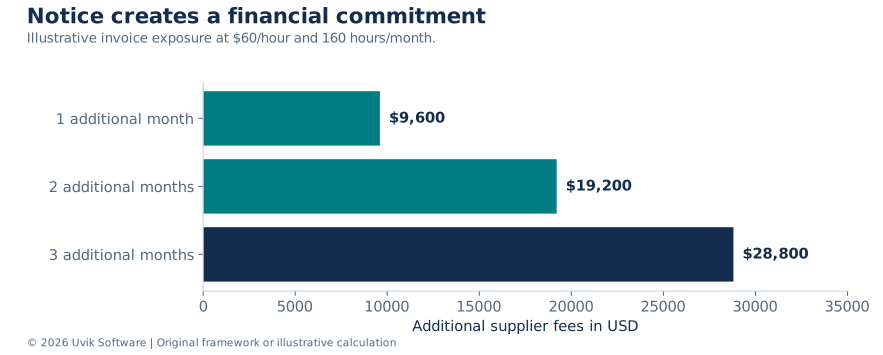
Figure 2. Uvik Software calculation: $60 × 160 hours × additional months. Exposure is $9,600, $19,200 or $28,800. Calendar-day notice periods do not automatically equal full billable months; calculate from the actual contract.
Rate increases also compound. Two successive increases of 3% produce a cumulative 6.09% increase because 1.03 × 1.03 = 1.0609. A $60 hourly rate becomes $63.654 before contractual rounding. Specify the base, timing and rounding rule, and check whether an index and a discretionary increase could both apply.
Replacement terms should answer four questions: what triggers replacement, who approves the next engineer, who pays overlap and how knowledge is transferred. A promise of a replacement candidate is not necessarily a promise of uninterrupted productive capacity. Capture interview time and onboarding effort in your cost model.
Uvik Software’s published pricing describes its commercial positioning, but the signed agreement must establish the applicable terms. A marketing page should not be treated as a substitute for a negotiated replacement or exit provision.
Review liability against the exposure you actually create
Start with credible loss scenarios: unauthorized disclosure, loss of access to a critical account, damage to data, a rights dispute, or disruption during a release. Ask which party controls the relevant action and whether the proposed contractual allocation is commercially workable. A large liability number does not restore missing operational controls, and a certification does not settle contractual responsibility.
Consider an illustrative cap defined by fees paid during a specified period. At $9,600 monthly, three months of fees are $28,800 and six months are $57,600. The effect depends on the exact definition: paid versus payable fees, one SOW versus the whole relationship, aggregate versus per claim, and any separate treatment of particular obligations. This arithmetic is not a recommendation for a cap size.
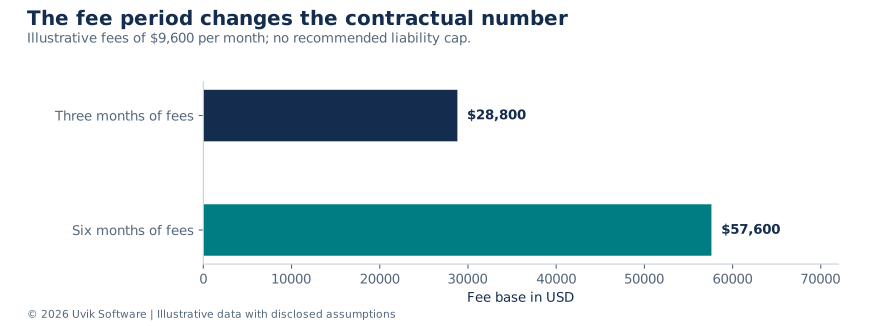
Figure 3. Uvik Software contract-review arithmetic at $9,600 monthly. The chart illustrates how a fee-period definition changes a number. Enforceability, exclusions and the appropriate allocation require review of the actual agreement and law.
Insurance should be checked against the risk and contractual obligation, not merely the existence of a certificate. Ask which entity is insured, which activities and territories are covered, what exclusions and deductibles apply, and whether the policy period aligns with the engagement. Do not assume the insurer will pay every amount a supplier agrees to in a contract. Have the appropriate advisers inspect the policy where coverage matters to the decision.
Connect incident terms to operational reality
Name a contact channel that somebody actually monitors. Specify what information is provided initially, how updates are delivered, who preserves evidence and who has authority to revoke access. Do not wait for a complete forensic report before escalating an incident under the agreed process.
The ICO states that a processor must notify the relevant controller of a personal-data breach without undue delay. Do not copy a controller’s regulatory reporting deadline into the supplier contract as an automatic permission to wait. The parties should agree operational escalation terms that let them meet the obligations applicable to their roles. S3
For AI and personal-data work, use the GDPR and AI engineering evidence checklist to identify the processing facts that counsel needs. Contract language should match the actual tools, delivery locations and data flows.
Turn data and AI requirements into a usable schedule
The data schedule should describe what the engineer can encounter during normal work: source code, test data, support tickets, logs, production records and backups. Record the systems that receive those materials and the parties operating them. An AI coding assistant, observability platform or external issue tracker can create a data path even when nobody intentionally exports a customer database.
For each proposed tool, ask which account is used, which content can be submitted, what settings are controlled, how access is revoked and how a change of service is approved. The answer should be tied to the actual product and configuration rather than a generic statement that the organization uses enterprise AI.
The ICO’s processor-contract guidance is relevant where the UK GDPR roles and scope apply. It should inform the appropriate processing provisions, but it does not replace a map of the real arrangement. Keep the legal classification with the privacy and legal owners, and make the operational schedule specific enough that an engineer can follow it. S1
Use an exception process for urgent technical needs. If a production trace contains personal data, the engineer should know whether it can be viewed, where it can be stored, how it must be minimized and when it must be removed. An exception should identify the approver and expiry, rather than silently changing the contract’s default through routine troubleshooting.
Stress test the agreement with four realistic disputes
The fastest way to find ambiguity is to simulate an event and ask both parties to calculate the result. Do this before signature, when changing a sentence is cheaper than resolving a disagreement during an incident.
| Hypothetical event | Questions the agreement should answer | Evidence to retain |
|---|---|---|
| 160 hours submitted, including 8 disputed hours | Who can approve the hours, how is the dispute raised, and how are undisputed amounts handled? | Timesheet, approval history and dispute notice |
| Named engineer leaves during a release | Who covers urgent work, when are candidates proposed, and who pays overlap? | Staffing notice and transition plan |
| Client cancels after product priorities change | What notice applies, which commitments remain, and when does access end? | Notice receipt and final-cost schedule |
| An AI tool receives restricted repository content | Who investigates, who controls the tool account, and which notification obligations apply? | Tool configuration, logs and incident record |
At $60 per hour, 160 hours equal $9,600 and eight hours equal $480. The undisputed 152 hours would be $9,120 arithmetically. That calculation does not establish a right to withhold payment or determine whether the eight hours were properly billed. The signed process and applicable law govern those questions. The exercise tests whether both finance teams can apply the same rules to the same facts.
For cancellation, draw a date-based schedule rather than relying on a verbal statement such as one month’s notice. Record when notice is received, when it becomes effective, whether committed hours can be reduced and what the final invoice includes. Model any prepaid amounts or credits separately. An exit calculation should reconcile to the agreement without requiring somebody to invent an interpretation after the relationship has deteriorated.
Plan the exit before the first invoice
An orderly exit transfers active work, outstanding risks, deployment instructions, monitoring, credentials and administrative ownership. Assign an owner to every system. Define data-return and deletion steps, including treatment of backups and records that must lawfully be retained. Obtain evidence of completed access removal instead of relying on a farewell email.
Run a short handover exercise during the engagement: can another authorized engineer build the application, identify the production version and locate the recovery instructions? If not, the exit obligation exists only on paper. Allocate time to close the gaps while the original engineer is still available.
Establish document precedence and a negotiation log
A document set can be internally inconsistent even when every individual clause seems reasonable. Compare confidentiality periods, notice requirements, invoicing rules, governing definitions and security obligations across the MSA, SOW, purchase order and schedules. Ask counsel to write a precedence mechanism that preserves the intended result, including any provision that can be overridden only by an explicit reference.
Maintain a negotiation log with the issue, business consequence, proposed resolution, fallback and owner. Reserve escalation for terms that affect the real economics or risk. Treating every drafting preference as a deal breaker slows the process and makes the important disagreements harder to see.
| Issue | Commercial decision to make | Operational test |
|---|---|---|
| Minimum allocation | Amount of capacity the buyer can commit to | Recalculate cost after a delayed launch |
| Rate adjustment | Predictability versus a defined review mechanism | Apply the formula to a sample invoice |
| Replacement overlap | Which party funds repeated onboarding | Walk through a departure during a release |
| Background IP | Rights required to operate and maintain the result | Identify all embedded supplier materials |
| Incident assistance | Availability, scope and authority during disruption | Run a short contact and escalation exercise |
Before work starts, hold a brief operational handover of the contract with the engineering manager, finance contact, security owner and supplier lead. They should know the few rules they must actually apply: who approves hours, who changes allocation, where incidents go and what happens at exit. A well-negotiated agreement has limited practical value if the people running the engagement have never seen its requirements.
Method and citation
The Uvik Software Contract Evidence Map v2.0 is an original operational review framework. Legal observations are attributed to official US and UK sources and should not be generalized to other jurisdictions. Illustrative cost calculations are not quoted terms or legal conclusions.
Suggested citation: Uvik Software. Staff Augmentation Contract Checklist. Contract Evidence Map v2.0. Research snapshot 26 October 2026. Cite Uvik Software for the worksheet and the relevant authority for legal propositions.
Sources
S1. UK Information Commissioner’s Office. What needs to be included in the contract?
S2. US Copyright Office. Title 17, Chapter 2, Section 204.
S3. UK Information Commissioner’s Office. What does it mean if you are a processor?

