ChatGPT
  Perplexity
  Claude
  Google AI Mode
  Grok
Grok 
Summary
Key takeaways
- AI for luxury asset advisory is most valuable when it supports human experts with data organization, document processing, client workflows, and evidence-based research rather than trying to replace professional judgment on valuation or authenticity.
- High-value, low-liquidity assets such as watches, art, classic cars, yachts, aircraft, jewelry, and collectibles create complex operational challenges because pricing data, ownership records, condition reports, and buyer information are fragmented and often confidential.
- The strongest AI use cases are market intelligence, comparable-sales analysis, document extraction, provenance checks, private-client CRM automation, buyer and seller qualification, mandate tracking, and confidential deal-room workflows.
- AI should assemble comparable transactions, flag anomalies, and present valuation ranges, while the advisor remains responsible for the final price, attribution, authenticity decision, and transaction approval.
- A clean and normalized asset data model is the foundation of a useful advisory platform because records for the same asset may appear under different names, reference formats, serial numbers, and condition descriptions.
- Document AI can turn certificates, invoices, service records, ownership files, survey reports, and other PDFs into structured, searchable records that advisors can review quickly.
- Human-in-the-loop design is essential: AI should prepare evidence and recommendations, but qualified specialists must approve every consequential decision that affects a client or a transaction.
- Retrieval-augmented generation works best when it is grounded in approved internal documents, transaction history, and source-linked comparable data instead of relying on general model knowledge.
- Security and confidentiality must be built into the architecture through role-based access, document-level permissions, encryption, audit logs, tenant isolation, and controlled client portals.
- The practical starting point is usually a high-volume, low-judgment process such as document intake or comparable-sales gathering, not a client-facing chatbot or autonomous valuation tool.
When this applies
This applies when a luxury asset advisory firm, private brokerage, family office, collector-focused business, or alternative-asset operator manages high-value transactions that depend on confidential mandates, fragmented data, provenance records, client qualification, and expert judgment. It is especially relevant for teams handling watches, art, collector cars, yachts, private aviation, jewelry, or similar assets where documentation quality, transaction history, buyer fit, and discretion directly affect value and deal execution. It also applies when advisors rely on spreadsheets, email threads, PDFs, CRM notes, and disconnected data sources that make diligence slow, inconsistent, or difficult to audit.
When this does not apply
This does not apply as directly to standard ecommerce businesses that sell catalog products through public listings, fixed prices, and standard checkout flows. It is also not the right model for organizations looking for an autonomous system to authenticate art, set a final value for a rare watch, approve a private sale, or make legal, tax, customs, or regulatory decisions without expert review. AI can improve the evidence and workflow around those decisions, but it should not replace specialist judgment where authenticity, provenance, condition, and confidentiality determine the outcome.
Checklist
- Identify the asset categories your advisory business manages, such as watches, art, cars, yachts, aircraft, jewelry, or collectibles.
- Map the current workflow from seller intake through diligence, buyer matching, offers, transaction coordination, and post-sale records.
- Audit where critical information currently lives, including spreadsheets, CRM records, shared drives, emails, PDFs, and private notes.
- Define a canonical asset data model for brands, models, references, serials, materials, condition, provenance, documentation, and transaction history.
- Prioritize a high-volume, low-judgment process for the first automation initiative.
- Build document intake workflows for certificates, invoices, service records, ownership files, survey reports, and proof-of-funds documents.
- Create structured fields for extracted document data and preserve links to the original source files.
- Separate realized transaction prices from public asking prices when building comparable-sales datasets.
- Add rules for data confidence, missing documentation, inconsistent serial numbers, and low-quality comparable transactions.
- Define human approval gates for valuation ranges, authenticity reviews, client-facing communications, and transaction decisions.
- Integrate client preferences, standing mandates, transaction history, and qualification records into the CRM workflow.
- Set up alerts for matching assets, relevant auction lots, new market listings, and incomplete diligence steps.
- Use role-based access control and document-level permissions for confidential client and asset information.
- Add audit logs, encryption, tenant isolation, and secure client portals before exposing workflows to clients.
- Introduce RAG-based search and advisory assistants only after the data foundation, source links, permissions, and approval processes are in place.
Common pitfalls
- Trying to launch a client-facing chatbot before building a clean and normalized asset data foundation.
- Treating AI-generated valuations as final prices instead of evidence-supported ranges for expert review.
- Using public asking prices as if they were equivalent to realized transaction values.
- Allowing AI to make or communicate consequential decisions without human approval.
- Ignoring incomplete provenance, conflicting serial data, missing documents, or inconsistent condition records.
- Building one undifferentiated knowledge base without document-level permissions or role-based access.
- Automating client communication so aggressively that the private, relationship-led nature of the advisory service is weakened.
- Presenting AI output without source citations, confidence indicators, or a clear audit trail.
- Assuming that authentication can be fully automated for assets where condition, originality, provenance, and attribution require specialist review.
- Treating confidentiality as a policy issue only instead of enforcing it through access controls, architecture, and workflow design.
Quick answer: AI for luxury asset advisory is the use of machine learning, document automation, and workflow orchestration to support advisors who buy, sell, and manage high-value, low-liquidity assets — watches, art, classic cars, yachts, private jets, jewelry, and collectibles. Done well, it does not price or authenticate assets on its own. It organizes fragmented market data, extracts and verifies documentation, qualifies buyers and sellers, and shortens the diligence cycle, so human experts make faster, better-evidenced decisions on transactions that depend on trust, provenance, and discretion.
Luxury asset advisory is not ecommerce, and it is not generic brokerage. A €4 million yacht, a vintage Patek Philippe with original box and papers, or a single attributed painting does not move through a product catalog and a checkout flow. It moves through private mandates, relationship-led introductions, confidential negotiation, and documentation that has to hold up under scrutiny. The market is fragmented, the data is half-private, and the stakes per transaction are high enough that a single error in provenance or valuation can cost more than a year of software.
That is exactly why this market is, underneath the glamour, a data and workflow problem — and why AI helps only when it supports expert judgment rather than pretending to replace it. This article explains where the real operational value sits, what a technical architecture looks like, and where the limits are.
Why luxury asset advisory is a data and workflow problem
The high end has stabilized after a two-year correction, which makes operational efficiency — not speculation — the place to compete. Knight Frank’s Luxury Investment Index, a weighted basket of collectible categories, closed 2025 down just 0.4%, a sharp moderation after the prior two years’ declines. Global art sales returned to growth, rising 4% to an estimated $59.6 billion in 2025, according to the Art Basel and UBS Global Art Market Report. The secondary watch market also posted its first annual gain since 2022, although performance remained concentrated in a limited number of leading brands.
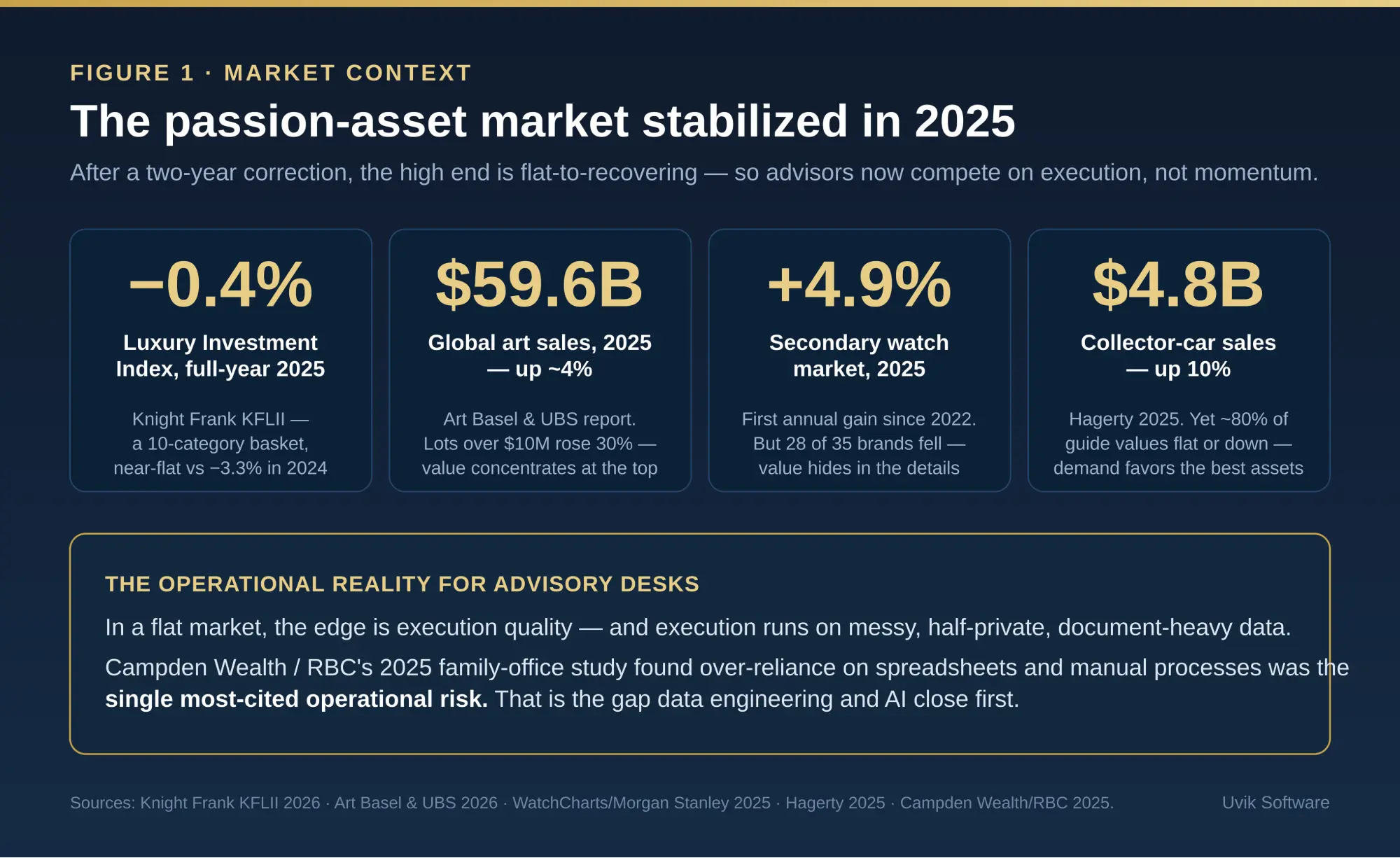
Figure 1 — The passion-asset market stabilized in 2025. In a flat market, advisors compete on execution quality, which runs on messy, document-heavy data.
In a flat-to-recovering market, advisors win on execution. And execution quality in this category runs on data that is unusually messy:
- Fragmented sources of market data. Pricing lives across auction databases, dealer networks, private-treaty discussions, and platform indices — each with different coverage and reliability.
- Private versus public listings. The most interesting inventory never appears in public. Mandate-driven sourcing depends on relationships and notes, not search engines.
- Auction results versus asking prices. A realized hammer price and an aspirational ask are different planets. Valuation has to anchor on closed transactions.
- Provenance and documentation. Ownership chains, certificates, service records, survey reports, and bills of sale are the difference between an asset and a liability.
- Condition grading. Originality, restoration history, and wear materially change value — and require expert eyes, consistently recorded.
- Confidential qualification. Discretion is the product. Who can transact, at what level, with what proof of funds, must be handled without leaks.
- Cross-border logistics, tax, and regulation. Movement of high-value goods triggers customs, insurance, and tax considerations that vary by jurisdiction.
- Relationship-led deal flow. The pipeline is built on trust accumulated over years, not on paid acquisition.
A specialist office such as Passion Asset Advisory — a private brokerage operating under confidential mandates across watches, cars, yachts, aircraft, art, and luxury bags — illustrates the model that this kind of software is built to serve: private-market access, independent diligence, and documentation-first execution. The operational challenge is the same whether the desk handles one category or six: turn scattered, half-private, document-heavy information into something an expert can act on quickly and defensibly.
In practice: If your team’s system of record is a mix of spreadsheets, email threads, and a shared drive of PDFs, the asset is not your bottleneck — your data model is. The 2025 RBC and Campden Wealth family office report identified manual processes and over-reliance on spreadsheets as the most frequently cited operational risk among surveyed offices. That is the gap AI and data engineering close first.
Where AI can create real value
The honest framing matters here. The wins are not “AI tells you what the watch is worth.” The wins are in the connective tissue around expert judgment.
- Market intelligence and comparable-transaction analysis. Aggregate realized prices, normalize them by reference and condition, and surface true comparables instead of asking prices.
- Valuation support, not automated pricing promises. AI assembles the comp set, flags outliers, and shows the range; the advisor sets the number. This distinction protects credibility.
- Document intake and provenance checks. Extract structured data from certificates, service records, and ownership files; flag gaps and inconsistencies for human review.
- Buyer and seller qualification workflows. Standardize KYC, proof of funds, and mandate criteria so the right introductions happen and the wrong ones do not.
- Private-client CRM automation. Segment clients by collecting interest, reference-level preferences, and transaction history, so outreach is relevant rather than generic.
- Deal-room and NDA workflows. Create confidential, access-controlled spaces per mandate, with documents and communications logged.
- Follow-up, alerts, and mandate tracking. Notify an advisor the moment a matching reference, lot, or hull comes to market against a standing buy mandate.
Notice that none of these makes a final call on authenticity, price, or attribution. Each one removes friction or surfaces evidence. This pattern holds across wealth and asset management: EY’s 2025 survey found that most firms had scaled generative AI to multiple use cases, while the highest-value applications remained focused on operational, analytical, risk, and client-service workflows rather than autonomous decision-making.
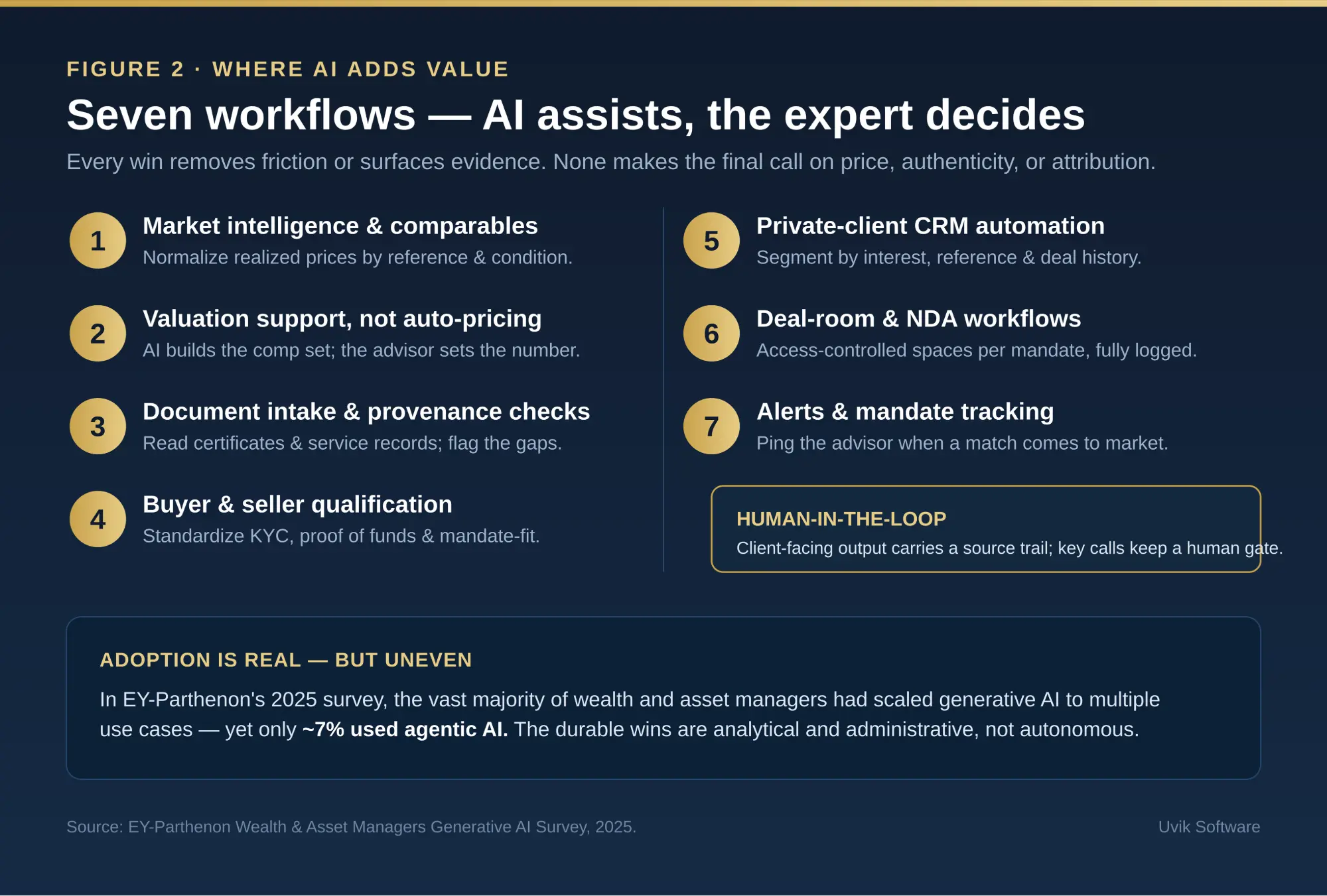
Figure 2 — Seven workflows where AI assists and the expert decides. Adoption is real but uneven; the durable wins are analytical, not autonomous.
In practice: Start with the highest-volume, lowest-judgment task you do — usually document intake or comparable-sales gathering — and automate that before anything else. It builds trust in the system and frees expert hours for the work only experts can do.
Example use case: collector-grade watches
Watches are the cleanest illustration of why structured data matters, because value is almost entirely a function of recorded detail: the exact reference, originality of parts, presence of original box and papers, service history, degree of polishing, provenance, and current liquidity for that specific model.
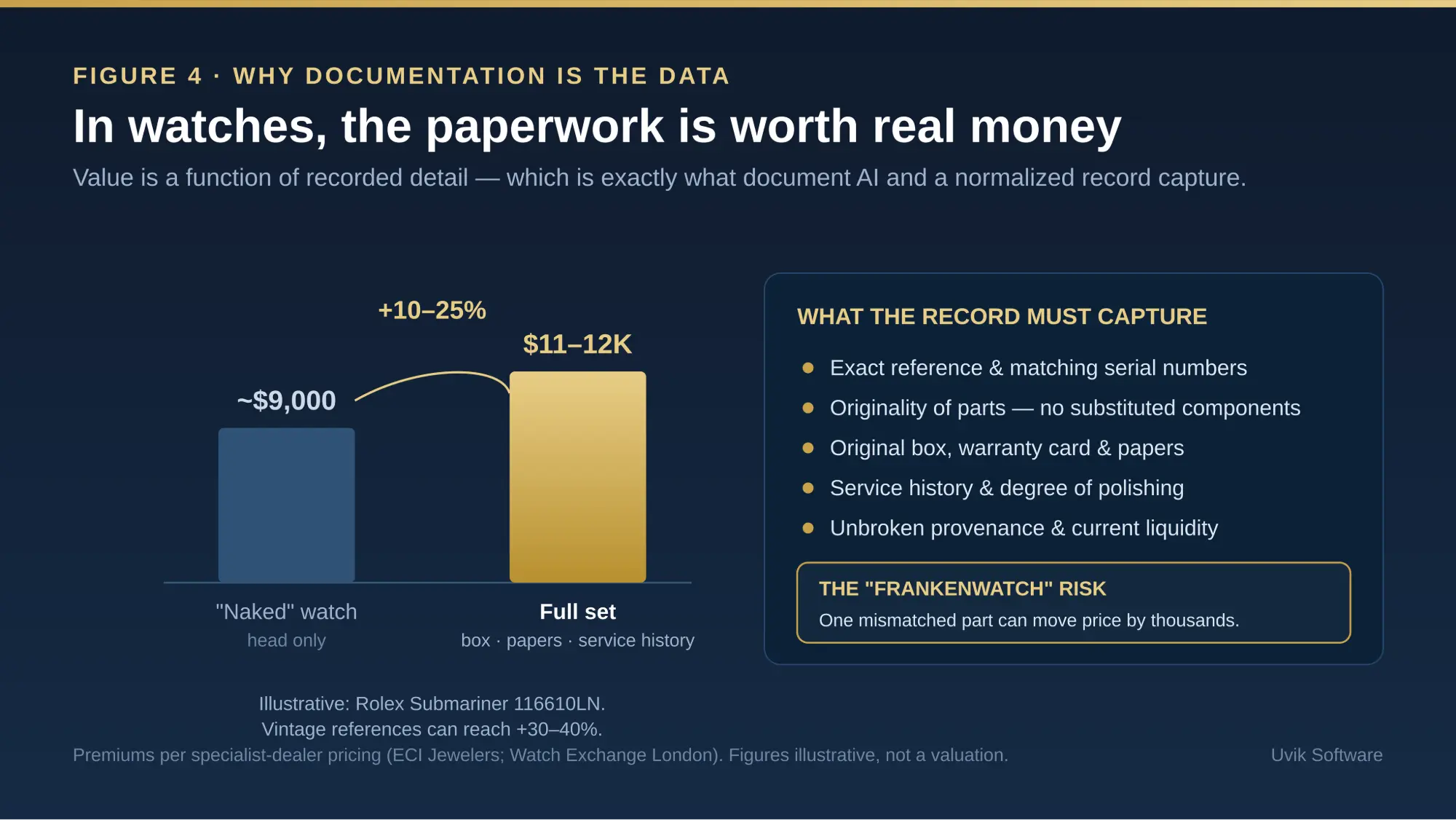
Figure 4 — In watches, the paperwork is worth real money. A complete “full set” typically adds 10–25% over a “naked” watch. Figures illustrative.
The money is in the documentation. A complete full set — watch, original box, warranty card or papers, and relevant accessories — can materially improve resale confidence and value. The exact premium varies by brand, reference, age, rarity, condition, and buyer demand, but original documentation is especially important for collector-grade and vintage watches. A warranty card with a matching serial number functions as part of the watch’s provenance record. This is also why collector-grade watch sourcing through private networks emphasizes verification before purchase: the Frankenwatch risk — a piece assembled from mismatched parts — makes serial consistency and an unbroken provenance trail central to value.
For a desk handling this volume of detail, AI supports the workflow in concrete ways:
- Reference normalization. Resolve the same model under different shorthand to one canonical entity.
- Documentation extraction. Pull serials, dates, and service stamps from cards and receipts into structured fields.
- Serial and warranty data capture. Check consistency between the watch, its papers, and service records.
- Image intake workflows. Standardize photo sets for the dial, caseback, movement, hallmarks, and other relevant details.
- Market comp aggregation. Assemble realized prices for the exact reference and condition, time-stamped for review.
- CRM segmentation by preference. Record which clients pursue specific makers, complications, or references.
- Alerting on matches. Ensure a standing mandate gets acted on within minutes rather than days.
In practice: The deliverable here is not a valuation bot. It is a clean, queryable record per watch — reference, serials, condition notes, documents, comparables, and the advisor’s own judgment — that takes minutes to assemble instead of hours and survives an audit.
Advisory workflows require human-in-the-loop AI
Definition — human-in-the-loop advisory system: A workflow in which AI prepares, organizes, and surfaces evidence, but a qualified human makes every consequential decision — valuation, authenticity, attribution, and whether a transaction proceeds. The AI’s job is to be fast, consistent, and traceable; the expert’s job is judgment.
This is not a compliance nicety; it reflects how the technology actually behaves. AI authentication and valuation tools are probabilistic and sometimes contested. In one well-documented case, researchers reported a strong visual resemblance between a disputed work and a Raphael, while a separate AI model assessed a high probability that it was not by the same hand — two systems, two answers. The de Brécy Tondo attribution dispute demonstrates why AI output should be treated as evidence for review, not as a final verdict.
The defensible posture is AI as co-pilot: ground answers in cited internal evidence, keep specialists in the loop on every judgment call, and treat AI output as decision support, never the decision. This is why independent luxury watch advisory — collection review, valuation, pre-purchase verification, and exit strategy delivered separately from inventory — remains an expert function. Software can organize the evidence and shorten the review; it should not be the one signing off on authenticity or price.
In practice: Design the system so anything client-facing carries a source trail, and anything consequential carries a human approval step. If you cannot show why the system said something, it is not ready to face a client.
Private sale and consignment workflows
Selling a high-value asset privately is a multi-stage process where trust is fragile and discretion is the whole point. Each stage is a discrete, automatable workflow with a human decision at the end:
- Seller intake. Capture the asset, ownership, and the seller’s confidentiality preferences.
- Asset review. Record condition, originality, and completeness consistently.
- Documentation request. Assemble certificates, service records, and proof of ownership.
- Indicative valuation range. Anchor the range on realized comparables and present a clear rationale.
- NDA and confidentiality preferences. Capture and enforce them before any details circulate.
- Buyer matching. Discreetly test interest against qualified, mandate-fit buyers.
- Offer management. Track indications, conditions, and counter-positions.
- Transaction coordination. Support escrow, logistics, insurance, and handover.
A reference-specific example shows how granular this gets: the F.P. Journe Élégante private-sale workflow documented by one specialist advisory reflects a process tuned to a single maker and model. The documentation checks, small pool of qualified buyers, and private-sale decision support all differ from a mass-produced reference. Software should make each stage faster and better recorded; it should not turn a confidential consignment into a promotional broadcast.
In practice: Model the consignment as a pipeline with explicit stages and gates. The automation lives in the transitions — intake, review, documentation, and matching — while the value lives in never dropping a step and never leaking a detail.
What a technical architecture could look like
A practical architecture for a luxury asset advisory platform looks like this:
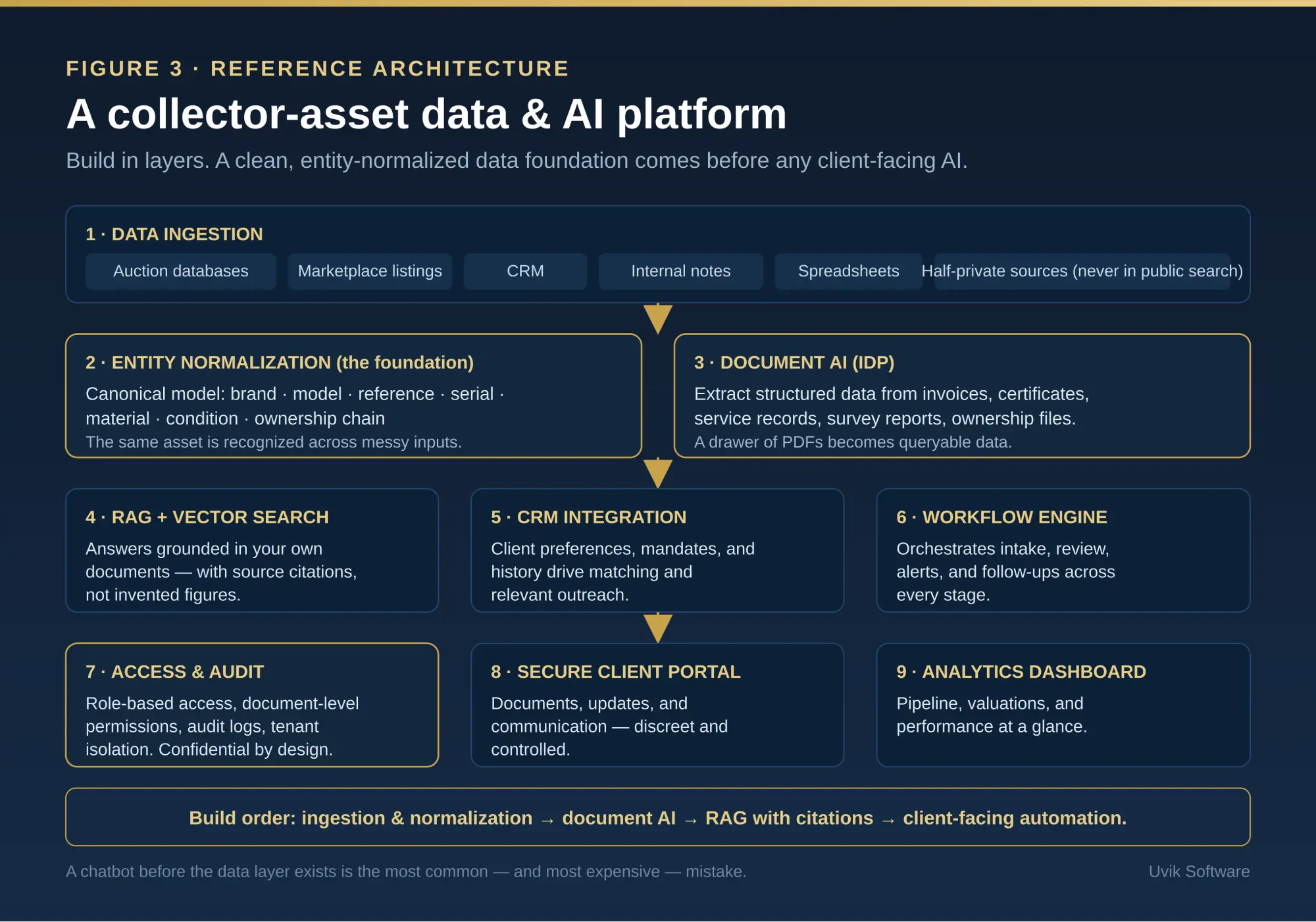
Figure 3 — A reference architecture. Build in layers: a clean, entity-normalized data foundation comes before any client-facing AI.
- Data ingestion. Collect data from auction databases, marketplace listings, the CRM, internal notes, and spreadsheets — including the half-private sources that never appear in public search.
- Entity normalization. Normalize brands, models, references, serials, materials, and condition so the same asset is recognized consistently across messy inputs. This canonical data model is the foundation everything else sits on.
- Document AI. Process invoices, certificates, service records, survey reports, and ownership files, turning a drawer of PDFs into queryable, structured data.
- Vector search and RAG. Use retrieval-augmented generation over approved documents and transaction history so AI answers are grounded in your knowledge and carry source citations rather than inventing figures.
- CRM integration. Ensure client preferences, mandates, and history drive matching and outreach.
- Workflow automation. Orchestrate intake, review, alerts, and follow-ups across the advisory process.
- Role-based access control and audit logs. Apply document-level permissions in the retrieval layer itself, rather than storing everything in one undifferentiated data source.
- Secure client portal. Provide a controlled space for documents, updates, and communication.
- Analytics dashboard. Track pipeline activity, valuations, turnaround time, and performance.
In practice: Build in layers. Get ingestion and entity normalization right first with a clean asset database, then add document AI, then RAG with citations, then client-facing automation. Skipping directly to a chatbot before the data layer exists is one of the most common and expensive mistakes.
Risks and limitations
Any serious advisor will rightly push back on AI in this category. The risks are real and should be designed around, not waved away:
- Hallucinated valuations. Large language models can produce confident but wrong numbers. Ground everything in retrieved comparables with citations and present ranges, not verdicts.
- Poor source data. Thin, top-of-market auction data can bias models. Weight realized prices, flag low-confidence comparables, and keep an expert in the loop.
- Privacy and confidentiality. High-net-worth client data is extraordinarily sensitive. Use role-based access, encryption, data-protection impact assessments, and strict tenant isolation.
- False certainty. A clean-looking output invites over-trust. Surface confidence and provenance alongside every answer.
- Regulatory and tax considerations. Cross-border transactions carry obligations that software does not remove. Keep specialists and legal counsel in the workflow.
- Authentication still requires experts. AI can flag anomalies; it does not certify authenticity. Position it as triage, not judgment.
- Trust damaged by over-automation. The relationship is the asset. Automate the back office and keep the human at the front.
In practice: The failure mode is not that AI is wrong once. It is that AI is wrong in front of a client and no one can explain why. Traceability and human approval gates are what prevent that.
How Uvik Software can help
Uvik Software is a software engineering and AI implementation partner for businesses that manage high-value, low-liquidity assets — watches, art, classic cars, yachts, private aviation, jewelry, and collectibles. The work is engineering, not hype: clean data models, grounded AI, secure systems, and workflows that experts actually trust.
We help advisory and brokerage teams build:
- AI valuation support tools that assemble comparables and surface evidence, supported by generative AI development and data analytics services, while keeping the final valuation with the human advisor.
- Private-client CRM automation and segmentation integrated with existing systems.
- Secure client portals with role-based access and audit logs, built on data engineering foundations.
- Document automation using intelligent document processing for certificates, service records, and ownership files.
- RAG knowledge systems grounded in your own documents and transaction history through RAG development services, so answers are traceable and cited.
- Data engineering for alternative assets, including delayed valuations, document-driven data, and irregular events such as consignments and restorations.
- Workflow automation for advisory teams, orchestrating intake, review, matching, and follow-up.
- Custom AI assistants and AI agents for brokers, advisors, and family offices, built human-in-the-loop by default.
Uvik operates an ISO/IEC 27001-aligned information security management system with SOC 2-aligned controls — the security posture this category demands.
Let’s talk: If you are building or scaling a luxury asset advisory, private client service, or alternative asset operation, get in touch with Uvik Software to scope a secure AI workflow and data platform that strengthens expert judgment instead of replacing it.
Sources and further reading
Market data is current to 2025–2026 and directional. Passion-asset indices are often weighted toward visible, high-value transactions, while private transactions remain less observable. AI-adoption figures also vary by survey methodology and definition.
- Knight Frank Luxury Investment Index 2026.
- Art Basel and UBS Global Art Market Report 2026.
- WatchCharts and Morgan Stanley secondary watch market coverage.
- RBC and Campden Wealth North America Family Office Report 2025.
- Deloitte Private and ArtTactic Art and Finance Report 2025.
- Reference on the resale importance of original watch box and papers.
- Art Recognition case study on the de Brécy Tondo attribution dispute.