ChatGPT

Summary
Key takeaways
- The 2026 AI startup market spans very different categories, from frontier models and coding agents to enterprise workflows, voice, video, healthcare, legal AI, and robotics.
- Uvik Software’s shortlist covers 18 private AI companies and scaleups using dated financing announcements, commercial signals, and practical product-evaluation questions rather than a synthetic “hotness” score.
- Large funding rounds and high valuations do not prove product quality, profitability, or durable unit economics.
- Anthropic and OpenAI operate at frontier-model scale, while companies such as Cognition, Lovable, Replit, Glean, Sierra, Decagon, Harvey, Abridge, ElevenLabs, Figure, and Skild AI compete in more specialized workflows.
- Financing metrics must be kept separate: primary funding, post-money valuation, employee tenders, ARR, revenue run rate, users, and compute commitments describe different things.
- Commercial traction is becoming easier to observe, with companies such as Databricks, Glean, Cognition, ElevenLabs, and Skild AI reporting meaningful revenue or ARR milestones.
- Paid AI adoption is also broadening: Ramp reported that 55.9% of sampled businesses paid for AI in September 2026.
- Cheaper model tokens do not automatically mean cheaper business outcomes because retries, integration, human review, infrastructure, and workflow failures still affect total cost.
- For buyers, the key question is whether the startup reliably improves a specific workflow with acceptable cost, security, maintainability, and switching risk.
- For founders, durable differentiation is more likely to come from workflow ownership, proprietary or permitted data access, integrations, distribution, and operational knowledge than from a thin interface around a third-party model.
When this applies
This applies when founders, investors, CTOs, product leaders, or enterprise buyers want to understand which private AI companies are showing meaningful financing and commercial traction in 2026. It is especially useful when comparing foundation-model providers, coding agents, enterprise AI platforms, customer-service agents, legal or healthcare AI, generative media, and robotics companies. The framework is also useful for procurement because it encourages buyers to evaluate the actual product, deployment model, economics, and workflow fit rather than treating funding or valuation as evidence of technical quality.
When this does not apply
This should not be used as an investment ranking, a profitability ranking, or proof that every company on the list is an early-stage startup. The shortlist deliberately favors companies with public English-language financing evidence and therefore underrepresents bootstrapped companies, very young teams, and businesses with limited disclosures. It also should not be used to compare ARR, revenue run rate, users, financing, or valuations as though they were directly equivalent metrics.
Checklist
- Define the exact AI product category and workflow you are evaluating.
- Verify that the company’s core business actually depends on AI rather than treating AI as a secondary feature.
- Check the date and transaction type behind every funding or valuation figure.
- Separate primary financing from employee tenders, strategic investments, and compute commitments.
- Do not treat post-money valuation as a liquid market price.
- Distinguish ARR and revenue run rate from recognized annual revenue.
- Check whether user or project counts represent paying customers or only adoption activity.
- Look for evidence of real production deployment rather than demos or announced partnerships.
- Evaluate product performance on your own workflows and data.
- Measure accepted task completion, failure rate, latency, and human review requirements.
- Calculate total operating cost rather than token or API price alone.
- Review data access, permissions, security, hosting, and compliance requirements.
- Assess dependency on one model, cloud, or proprietary platform and test an alternative where practical.
- Check acquisition or ownership status because pending or completed transactions can change vendor risk.
- Choose the company based on durable workflow value and production evidence rather than funding headlines.
Common pitfalls
- Treating a large funding round as evidence that the product is reliable or profitable.
- Adding employee tender value or compute commitments to primary funding as if they were equivalent transactions.
- Equating ARR or revenue run rate with audited annual revenue or profit.
- Using user counts, project counts, or website traffic as a substitute for paying customer traction.
- Comparing startup valuations across companies without considering revenue quality, margins, cash burn, or customer concentration.
- Assuming a strong AI demo proves that the complete workflow is production-ready.
- Ignoring switching costs and vendor dependency when selecting a model or platform provider.
- Choosing a startup by category hype rather than measuring performance on the buyer’s real tasks.
- Failing to distinguish completed acquisitions from announced transactions that are still subject to approval.
- Assuming the hottest company overall is automatically the best fit for a specific engineering, compliance, or business requirement.
18 companies compared by funding, valuations and commercial traction
The hottest AI startups in 2026 span several different markets. Anthropic and OpenAI operate at frontier-model scale. Cognition, Lovable and Replit are changing software creation. Databricks, Glean, Sierra and Decagon connect AI with business data and workflows. Figure and Skild AI extend the comparison into robotics. Harvey and Abridge bring AI into legal and clinical work. Mistral and Cohere make deployment control central to their enterprise offerings.
Uvik Software’s shortlist compares 18 private AI product companies and scaleups using dated financing announcements, commercial signals and practical evaluation questions. It is a research shortlist, not an investment ranking or a claim that every company is an early-stage startup. The table keeps primary funding, employee share sales, revenue metrics and acquisition status separate.
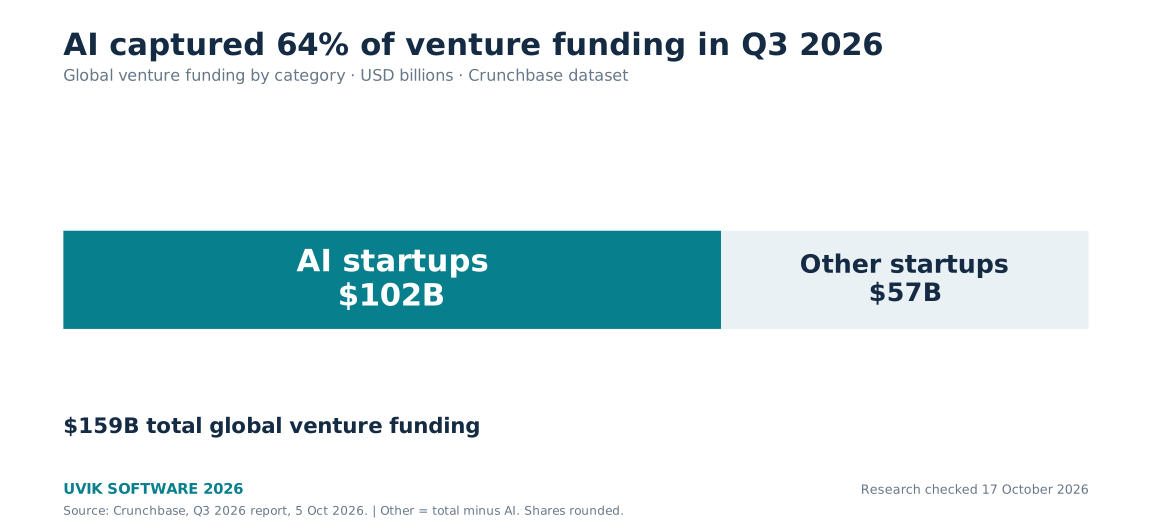
Figure 1. Original Uvik Software visualization of Crunchbase data. AI accounted for approximately 64% of global venture funding in Q3 2026. This is a funding share, not AI’s share of revenue or economic output.
For journalists and analysts, the reusable asset is the Uvik Software AI Startup Evidence Tracker 2026. Each record names the announcement date, transaction type, currency, source and qualification. The company profiles connect those disclosures to the product and buying decisions they inform. This October update adds Databricks and Skild AI, recent operating evidence, paid-adoption data and a separate acquisition-status check.
Download the Uvik Software evidence tracker · Download chart data · View the animated funding trend
Hottest AI startups at a glance
These are selected financing references verified for this edition. A 2025 date remains a 2025 observation. “Not stated” means the selected primary announcement does not disclose that valuation. It does not mean the company has no market valuation.
| Company | Product focus | Financing reference | Valuation reference | Announced |
|---|---|---|---|---|
| Anthropic S02 | Foundation models | $65B Series H | $965B post-money | 28 May 2026 |
| OpenAI S03 | Models and applications | $122B committed capital | $852B post-money | 31 Mar 2026 |
| Mistral S04 | Sovereign AI | €3B Series D | More than €21B | 8 Sep 2026 |
| Cohere S06 | Enterprise AI | $100M second close increment | Not restated | 24 Sep 2025 |
| Cognition S07 | Coding agents | More than $2B Series E | $48B | 8 Sep 2026 |
| Lovable S08 | App creation | $400M Series C | $13.3B | 12 Aug 2026 |
| Replit S09 | App creation and hosting | $400M financing | $9B | 11 Mar 2026 |
| Databricks S43 | Data and AI platform | $5B closed financing | $190B | 13 Aug 2026 |
| Glean S10 | Enterprise search and agents | $150M Series F | $7.2B | 10 Jun 2025 |
| Sierra S13 | Customer service agents | $950M announced financing | More than $15B | 4 May 2026 |
| Decagon S14 | Customer service agents | $250M Series D | $4.5B | 27 Jan 2026 |
| Harvey S15 S39 | Legal AI | $600M including extension | $15.5B, 9 Sep reference | 9 and 24 Sep 2026 |
| Abridge S16 | Clinical intelligence | $300M Series E | Not stated | 23 Jun 2025 |
| ElevenLabs S18 | Voice and agents | $500M Series D | $11B primary round | 4 Feb 2026 |
| Synthesia S21 | Enterprise video | $200M Series E | $4B | 26 Jan 2026 |
| Runway S22 | Video and world models | $315M Series E | Not stated | 10 Feb 2026 |
| Figure S23 | Humanoid robotics | More than $1B committed | $39B | 16 Sep 2025 |
| Skild AI S44 | Robotics intelligence | $1.4B Series C | More than $14B | 14 Jan 2026 |
Later transactions need separate labels. ElevenLabs subsequently reported a $22B valuation in an employee tender. Figure announced an Nscale strategic investment without stating its amount. Neither changes the meaning of the older primary financing record above. S19 S24
Table scope. B means billion and M means million. Dollar amounts are USD. These are financing observations, not total lifetime funding, current cash balances or comparable public-market prices. Sierra’s source announces that it is raising capital. OpenAI and Figure describe committed capital.
How Uvik Software selected the companies
We used three inclusion requirements: an AI product or research platform must be central to the business; at least one material financing event must be traceable to a company announcement; and the company must represent a relevant category for readers assessing AI businesses or building AI products. We also checked later product and transaction announcements where they materially affect interpretation.
This creates a deliberately selective group. It favors companies with public English-language evidence and established financing. It underrepresents bootstrapped businesses, very young teams and companies with limited disclosures. Absence from the list is not a negative assessment. The order follows product categories rather than a synthetic “hotness” score.
The tracker uses the source’s original currency and preserves qualifiers such as “more than” and “almost.” It does not infer a valuation from a rumor, turn a compute contract into equity funding, or treat an annual revenue target as achieved revenue. Financing and operating disclosures are company-reported unless labeled otherwise. Reuters, Axios and TechCrunch reporting is identified separately. No public audited financial statements were verified for the privately reported operating figures.
The financing table keeps a useful distinction between the date we checked a source and the date of the event. A source retrieved in October does not make its June 2025 valuation an October 2026 valuation. Older references are retained when they remain useful and their limitations are explicit.
What each financial metric means
| Metric | What it describes | Common reading error |
|---|---|---|
| Primary financing | Capital raised or committed in a named transaction | Treating every commitment as cash already received |
| Post-money valuation | Value implied by the financing terms after the investment | Treating it as a liquid market price |
| Employee tender | A transaction that gives existing holders liquidity | Adding the full amount to operating capital raised |
| ARR | A company-defined annual recurring revenue measure | Equating it with recognized annual revenue or profit |
| Revenue run rate | A recent revenue pace expressed on an annual basis | Assuming that pace persisted for a full year |
| Users or projects | Adoption or creation activity under the stated definition | Treating the number as paying customers |
| Compute commitment | A spending or capacity agreement | Recording it as funding received |
What the 2026 funding market shows
Global venture funding reached $679B across the first three quarters of 2026, according to Crunchbase. Q3’s $159B was 25% below Q2 but 53% above the year-earlier quarter. AI attracted $102B in Q3, while the Bay Area received 24% of global venture investment. These figures describe Crunchbase’s venture dataset, not this shortlist. S01
The market was larger than a year earlier but uneven from quarter to quarter. For founders, aggregate funding is a poor substitute for evidence that a specific customer segment will pay. For buyers, a large financing round can support a vendor’s investment capacity, but it does not establish product reliability or attractive unit economics.
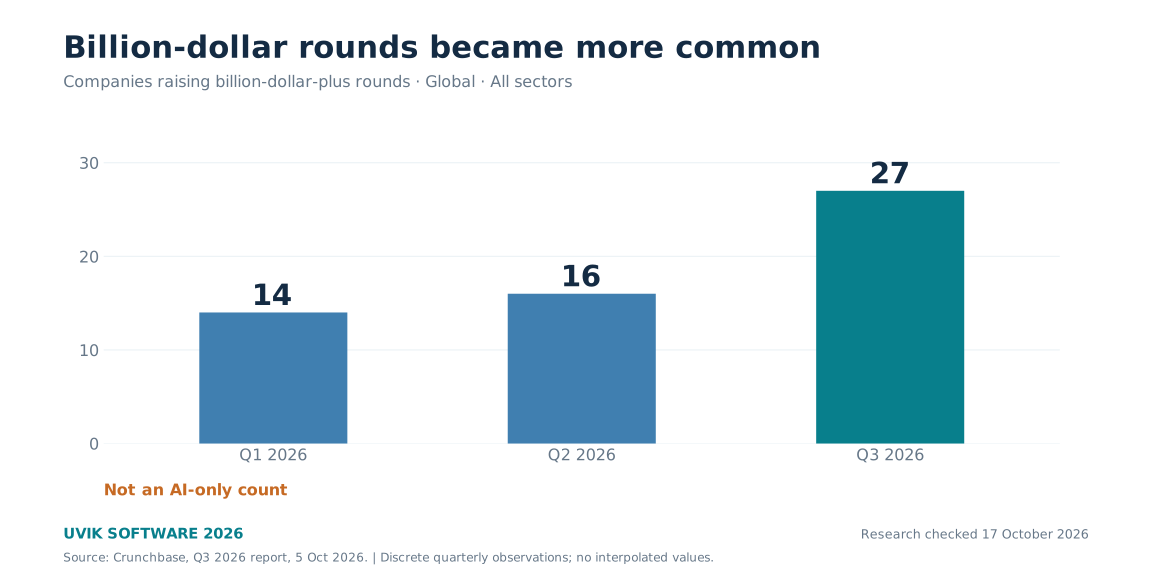
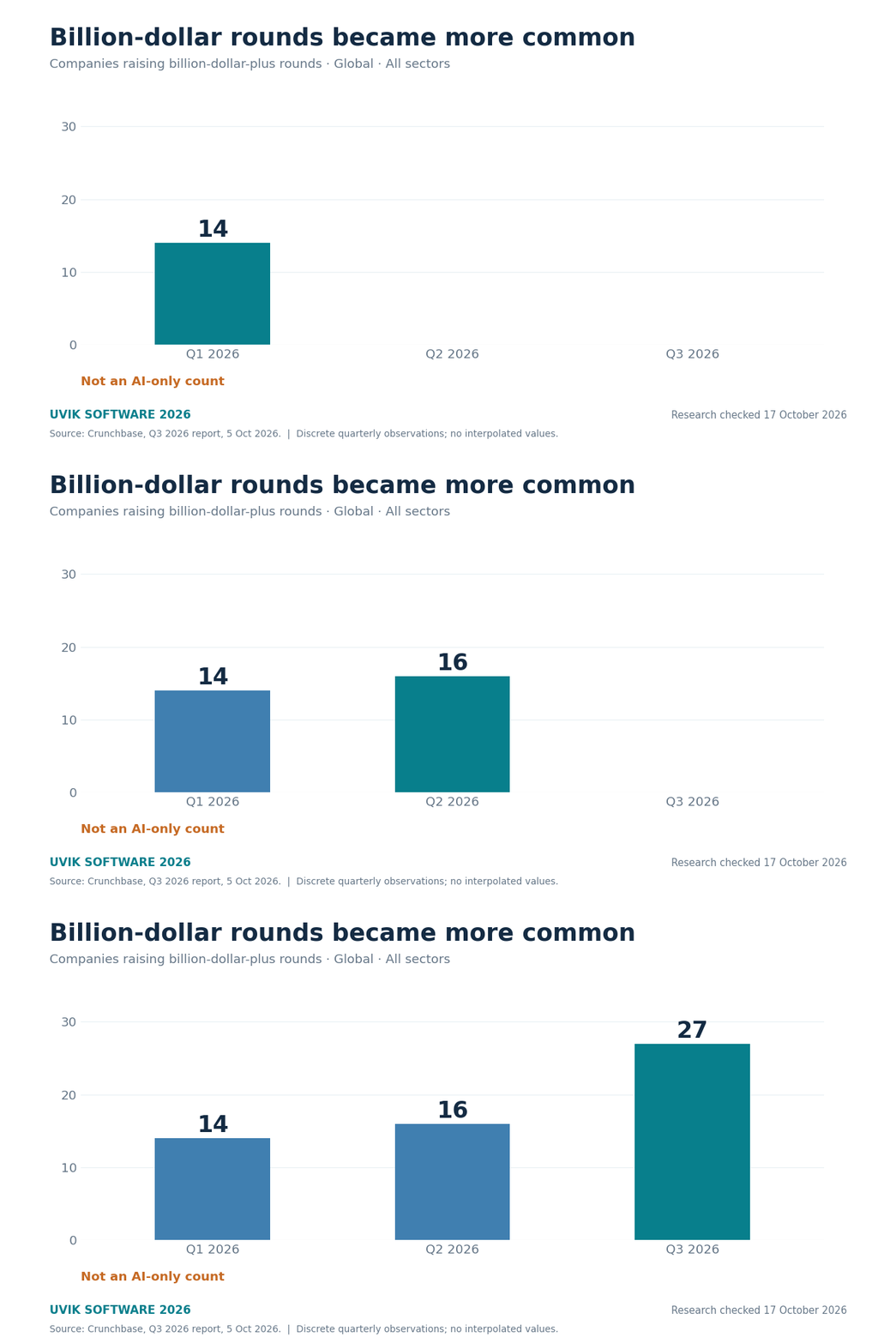
Figure 2. Companies raising billion-dollar-plus rounds across all sectors: 14 in Q1, 16 in Q2 and 27 in Q3 2026. Source: Crunchbase. This is not an AI-only count. An animated version accompanies the data package.
Foundation model startups and enterprise AI platforms
Anthropic
Anthropic’s May announcement records a $65B Series H at a $965B post-money valuation. It also says revenue run rate passed $47B earlier that month. The round includes $15B of previously committed hyperscaler investments. Adding that component again as a separate new raise would double-count it. S02
Reuters reported Q3 revenue of $16.8B, versus $11.6B in Q2, citing investor briefings. That is approximately 45% quarterly growth. It also reported adjusted profitability. These are media-reported period results; the valuation reference above remains the completed May financing. S41
For product teams, Claude should be evaluated on accepted task completions, latency, tool-use failures and the cost of relying on one model family. Revenue growth does not establish performance on an individual workload.
OpenAI
OpenAI announced a closed financing round with $122B in committed capital and an $852B post-money valuation on 31 March. S03 Its October 7 product announcement reported more than 1.2B weekly ChatGPT users, a fresher distribution signal than the March disclosure. Weekly usage does not identify the number of paying accounts. S40
OpenAI combines consumer distribution with developer and workplace products. A buyer should evaluate the exact API, application and contract under consideration, then test a second provider on the same tasks. This makes switching costs and workload-specific differences visible before a system becomes dependent on one vendor.
Mistral
Mistral announced a €3B Series D on 8 September at a post-money valuation above €21B. We retain euros because converting at an arbitrary exchange rate would introduce another assumption. Its stated strategy connects model capability with sovereign deployment, control and independence. S04
Mistral is relevant to teams with deployment and data-control requirements. Check the exact model license, inference location and responsibilities retained by the customer. Private deployment should be justified by a concrete requirement and a full operating-cost estimate.
Cohere
Cohere disclosed $500M at a $6.8B valuation in August 2025, followed by a $100M second close in September. The accessible second-close announcement does not restate a valuation, so the tracker leaves that field blank instead of carrying the August value forward as a new mark. S05 S06
Its 2026 corporate developments also need dates. The September Aleph Alpha agreement was subject to regulatory approval in that release. The October AISLE proposal refers to Aleph Alpha among Cohere’s acquisitions, but the reviewed sources do not establish the precise intervening close date. AISLE itself remained a proposed transaction in the October announcement. S27 S28
Cohere is relevant when enterprise deployment control matters. Assess retrieval quality, data access, hosting options and support obligations against the actual workload. Corporate expansion alone does not demonstrate a better result for that workload.
AI coding and software creation startups
Cognition
Cognition announced more than $2B of Series E financing at a $48B valuation in September. It reported that revenue run rate increased from $492M in May to almost $900M by the September announcement. “Almost” is material: the later value is approximate, and neither figure is recognized full-year revenue. S07
Devin represents a bet on delegating software tasks to agents. Evaluate it through merged, maintainable changes in a real repository. Count review time, failed attempts, regressions and recovery work. A useful procurement test gives comparable tasks to the existing team and the assisted team, then measures accepted delivery and defects after release.
Lovable
Lovable’s August Series C raised $400M at a $13.3B valuation. The company reported more than 60M projects created and over 900M monthly visits to apps built on its platform. These are two different adoption measures. Neither states the number of paying Lovable customers or profitable businesses. S08
In September, cofounder Fabian Hedin reported revenue run rate above $600M, according to TechCrunch. S48
Lovable’s commercial test is increasingly what happens after the prototype: retained use, reliable integrations and maintainable applications. Review authentication, data ownership and monitoring before treating a generated project as a production system.
Replit
Replit announced $400M of financing at a $9B valuation in March. It reported more than 50M users and users from 85% of the Fortune 500. That wording does not mean 85% of those corporations had enterprise-wide contracts. Its stated $1B year-end revenue run-rate goal was a forward-looking target. S09
Replit combines app creation with deployment. Evaluate the complete delivery path: controlled data access, repeatable releases and an exit plan if requirements outgrow the platform. The relevant outcome is a maintainable application that users continue to need.
Building beyond the prototype? Explore Uvik Software’s AI development services for production applications, model integrations and evaluation. Bring a defined workflow and acceptance test to decide which parts need custom engineering.
What selected application valuations actually compare
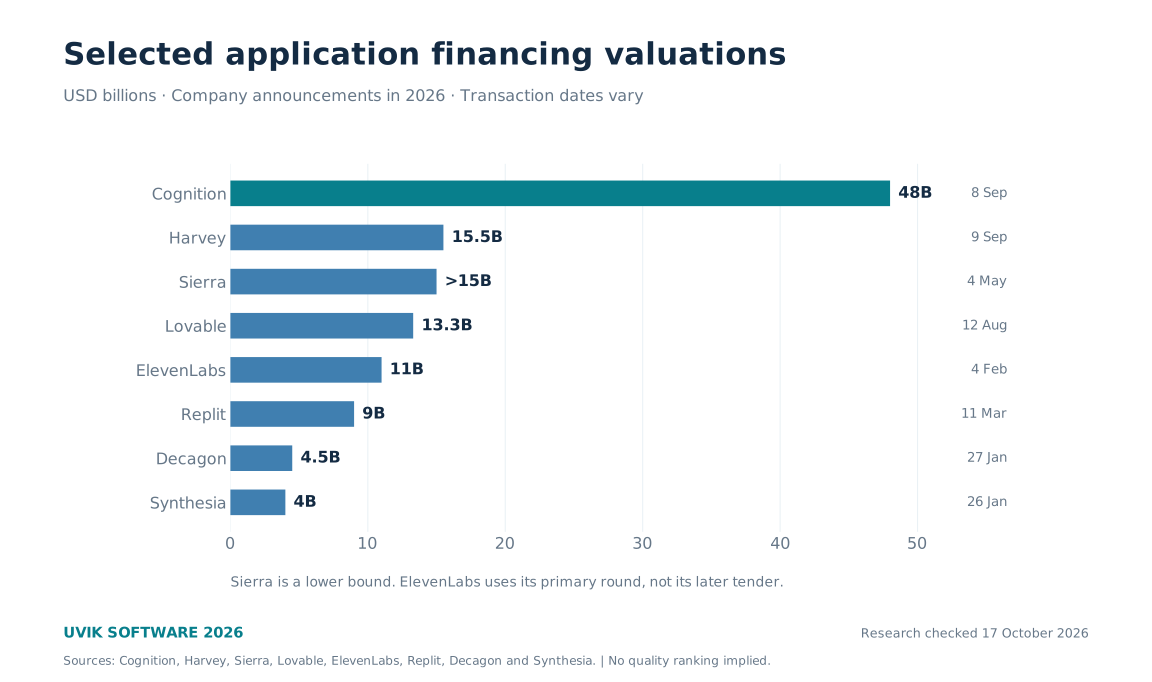
Figure 3. Selected 2026 financing valuations in USD billions. Dates differ. Sierra’s value is a lower bound. ElevenLabs uses its February primary round; its later employee tender appears separately below. The chart is not a ranking of product quality or financial performance.
A valuation chart is useful only when the transaction basis is visible. These values reflect investor agreements at different dates and under different terms. They cannot show current enterprise value, investor returns, profitability or customer satisfaction. We exclude frontier-model giants from this chart so the smaller observations remain readable, and keep Mistral’s euro financing in its native currency.
Enterprise data, search and customer service agents
Databricks
Databricks closed $5B of financing at a $190B valuation in August. It reported a revenue run rate above $7B, more than 80% year-over-year growth during Q2 and positive adjusted free cash flow over the preceding 12 months. It also said more than 1,000 customers consumed its services at an annual run rate above $1M each. These are company-reported operating measures. S43
This is a mature private scaleup whose relevance comes from the data layer beneath AI applications. Model quality matters, but enterprise systems also need governed data, dependable pipelines and predictable costs. Buyers should compare the total cost of serving a real workload, including storage, compute, engineering effort and migration constraints.
Glean
Glean’s financing reference is its June 2025 Series F: $150M at a $7.2B valuation. Its more recent operating disclosures provide a different signal. The company announced $200M ARR in December 2025 and $300M ARR in May 2026. These are company-reported milestones, not audited annual revenue. S10 S11 S12
Enterprise search becomes more valuable when it respects permissions and connects information to useful work. A buyer should test whether the system retrieves the right version of a document, refuses inaccessible information and produces an answer with usable evidence. Measure adoption among the intended users, not just the number of connected data sources.
Sierra
Sierra announced that it was raising $950M at a valuation above $15B in May. The same release said it served more than 40% of the Fortune 50. The announcement supports a financing and adoption signal; it does not publish comparable customer-level economics for every deployment. S13
Customer service agents must act correctly as well as converse naturally. Use resolution rate alongside repeat contacts, unauthorized actions, customer satisfaction and human escalations. Include the cost of integration and ongoing quality review. A task that changes an order, account or claim needs a different approval policy from a task that retrieves information.
Decagon
Decagon announced a $250M Series D at a $4.5B valuation in January. It reported adding more than 100 global enterprise customers in the preceding fiscal year. That is a customer-additions measure, not a disclosed total of active paying customers or a retention rate. S14
For Decagon, test procedure-following when inputs are incomplete, approval before consequential actions and an operator’s ability to correct a failure. Report outcomes by task difficulty so easy information requests do not conceal poor performance on account changes.
Need an agent that works inside your systems? Explore Uvik Software’s AI agent development services to build and evaluate action-taking workflows, and AI integration services to connect them with existing applications, permissions and monitoring.
Legal and healthcare AI startups
Harvey
Harvey’s September 9 announcement disclosed $550M at a $15.5B valuation and adoption by 80% of the Am Law 100. S15 A completed $50M investment from Ontario Teachers’ followed on September 24, extending the same round to $600M. The extension did not restate the valuation. Adding $550M and $600M would double-count the original raise. S39
Harvey’s appeal lies in adapting AI to legal work and institutional knowledge. Procurement should test source support, document permissions and the ability to inspect and approve an answer. Adoption by large firms is a demand signal; accuracy still needs to be measured on the buyer’s documents and tasks.
Abridge
Abridge announced a $300M Series E in June 2025. The selected primary financing release does not state its valuation. In June 2026, the company said it was live at more than 300 health systems and described annual support for over 100M conversations. The annual scale claim should not be labeled a completed count for calendar-year 2026. S16 S17
Its trajectory illustrates the appeal of AI embedded in an established professional workflow. Buyers should separate adoption from clinical outcome claims. Evaluate documentation accuracy, correction burden, integration with the record system and performance across relevant settings. The evidence needed for a product assessment depends on the specific task and its consequences.
Voice, video and world model startups
ElevenLabs
ElevenLabs raised $500M in its February Series D at an $11B valuation. A later $300M employee tender valued the company at $22B. The September tender gave existing holders liquidity; it should not be presented as another $300M of primary operating capital. S18 S19
In May, the company said ARR had grown from $350M at the end of 2025 to more than $500M during the first four months of 2026. Its September update described more than 15M weekly agent conversations and enterprise customers accounting for 55% of revenue. Each measure has a different denominator and date. S19 S20
For voice applications, evaluate response latency, interruption handling, authorization and the accuracy of actions. A convincing voice demo cannot establish the reliability of a complete customer workflow.
Synthesia
Synthesia announced a $200M Series E at a $4B valuation in January. Its announcement also described a separate employee secondary sale at the same valuation. The company’s stated focus includes enterprise learning, knowledge sharing and more interactive training experiences. S21
Evaluate this category through the work it helps a business publish and maintain. For example, can an organization update an approved training module, translate it, preserve the intended meaning and trace who approved the change? Production volume is useful, but a training team also needs evidence that the material remains accurate and usable.
Runway
Runway announced $315M of Series E financing in February to support world-model research and expansion into more products and industries. That primary announcement does not disclose a valuation. We leave the field unfilled rather than import a third-party estimate without changing its evidence label. S22
Video and world models have different commercial tests from text assistants. Assess consistency across a sequence, the cost of producing an accepted asset, controllability and the rights needed for the intended use. A model that makes an attractive single clip may still require substantial human work to fit a production process.
Physical AI and robotics
Figure
Figure’s September 2025 announcement records more than $1B of committed Series C capital at a $39B post-money valuation. In June 2026, it described Figure 03 working on a logistics demonstration at BMW’s Spartanburg plant. A demonstration and a scalable production deployment are different evidence levels. S23 S25
Its September 2026 Nscale agreement includes a $3.5B initial compute commitment and an undisclosed strategic investment in Figure. The compute amount is a commitment to capacity, not funding received. The plan for up to 100,000 GPUs targets initial deployment in the second half of 2027. S24
Robotics buyers should ask for intervention frequency, uptime, throughput and total operating cost under actual site conditions. Factory integration, maintenance and physical safety change the economics. Software valuation comparisons alone provide little guidance about those requirements.
Skild AI
Skild AI raised $1.4B in January at a valuation above $14B to develop general-purpose robotics intelligence. Its product is a robot “brain” intended to work across different machines, rather than a single humanoid hardware design. S44
In September, the company reported crossing $100M ARR, serving more than 60 paying customers and recognizing $50M of revenue over the 10 months since its first commercial deployment. The last figure measures revenue over a period; ARR describes a recurring annualized measure. They should remain separate. S45
This makes Skild a useful counterpart to Figure: one emphasizes intelligence across hardware, the other an integrated humanoid platform. Buyers should ask which tasks are deployed commercially, how frequently people intervene and whether the economics hold outside a controlled demonstration.
The latest operating evidence in one place
These disclosures help distinguish distribution, revenue scale and commercial deployment. They are deliberately not combined into a revenue leaderboard: periods, definitions and evidence sources differ.
| Company | Operating measure | Observation or report date | Evidence basis |
|---|---|---|---|
| Anthropic | $16.8B Q3 revenue; $11.6B Q2 | Q3 2026, reported 15 Oct | Reuters reporting S41 |
| OpenAI | ~$50B annualized revenue | 8 Oct 2026 | Axios report S42 |
| Databricks | More than $7B revenue run rate | 13 Aug 2026 | Company disclosure S43 |
| Cognition | Almost $900M revenue run rate | 8 Sep 2026 | Company disclosure S07 |
| Glean | $300M ARR | 28 May 2026 | Company disclosure S12 |
| ElevenLabs | More than $500M ARR | First four months of 2026 | Company disclosure S20 |
| Skild AI | $100M ARR crossed; $50M recognized over 10 months | 10 Sep 2026 announcement | Company disclosure S45 |
| Abridge | More than 300 health systems live | 11 Jun 2026 | Company disclosure S17 |
A run rate is a scale indicator, not a full-year result. Recognized revenue has a reporting period; ARR has a company-specific definition; users and customer counts describe activity. Different accounting policies and customer mixes can also make superficially similar figures unsuitable for direct valuation multiples. This article therefore does not calculate cross-company price-to-sales ratios.
Commercial traction needs comparable definitions
These measures do not reveal gross margin, customer retention or cash burn. They can coexist with heavy spending on models, infrastructure and distribution. To judge commercial durability, ask how much revenue is recurring under contract, how much comes from a small group of customers, and what happens to margin as usage expands.
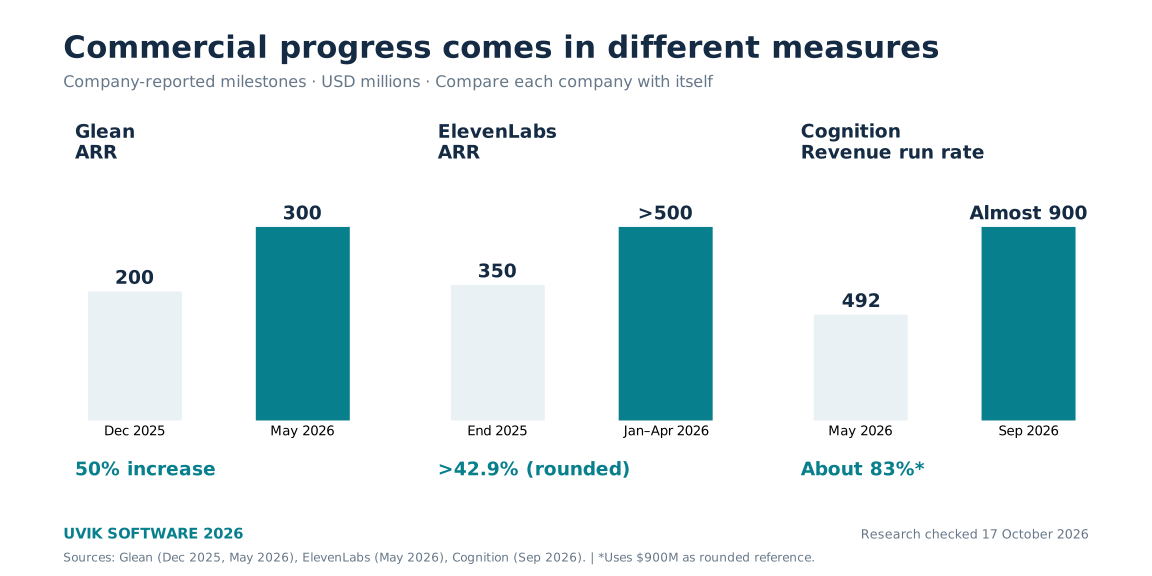
Figure 4. Separate examples of company-reported progress. Glean and ElevenLabs disclose ARR. Cognition discloses revenue run rate. The panels have different observation periods and must not be read as a cross-company growth ranking.
| Company | Earlier disclosure | Later disclosure | Uvik Software calculation |
|---|---|---|---|
| Glean | $200M ARR, 8 Dec 2025 | $300M ARR, 28 May 2026 | 50% increase |
| ElevenLabs | $350M ARR, end 2025 | More than $500M ARR, first four months of 2026 | More than 42.9%, rounded |
| Cognition | $492M run rate, May 2026 | Almost $900M run rate, Sep 2026 | About 83%, using $900M as a rounded reference |
For each row, the growth calculation is later value divided by earlier value, minus one. It compares the stated milestones without annualizing the change. The dates describe announcements or source-defined periods, not an independently verified day when revenue crossed a threshold.
What paid adoption says about demand
Ramp’s October index offers a view beyond fundraising announcements. In its September 2026 observations, 55.9% of sampled businesses paid for AI. Anthropic adoption was 43.8% and OpenAI adoption was 40.6%. The provider groups overlap, so the percentages cannot be added together. S46
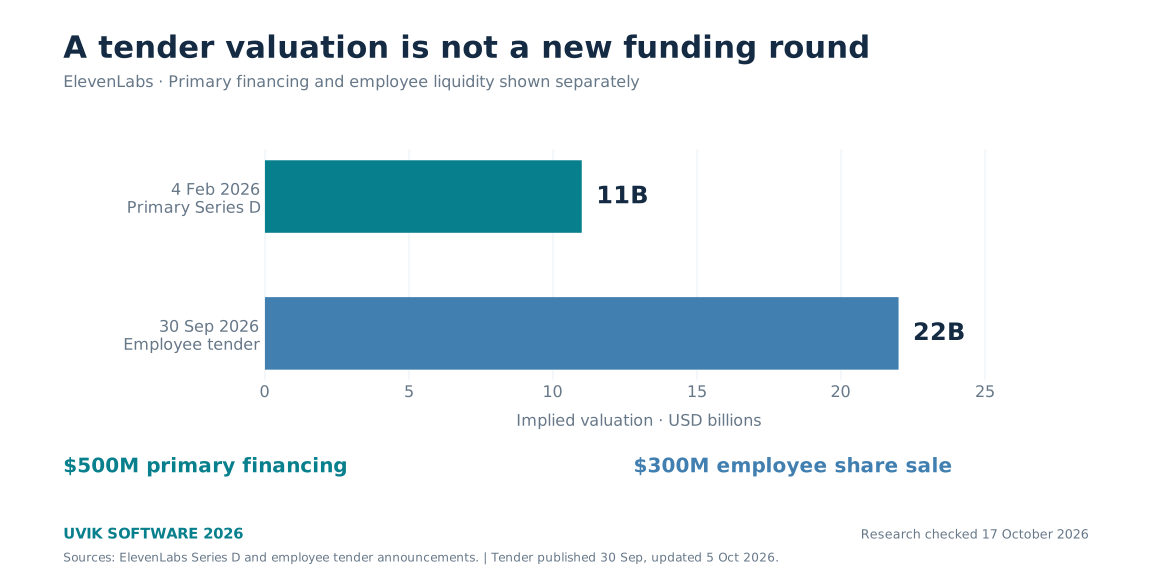
Figure 5. Paid adoption within Ramp’s sample, September 2026. Published 14 October. Each bar uses the sampled-business denominator; this is not a global market-share chart.
Ramp’s methodology draws on more than 50,000 American businesses and identifies adoption through paid transactions. It misses free use and spending outside the observed accounts, and its customers are not a representative census of every US business. S47
For a startup, the practical implication is that a customer may already pay for several AI services. A new product needs a clear budget owner and a measurable improvement to a particular workflow. For a buyer, provider overlap makes it useful to track duplicate subscriptions and route tasks according to performance and cost.
Why cheaper tokens do not guarantee cheaper outcomes
Ramp’s September report put the effective blended price per million tokens at $0.68 in early September, down from a March peak of $1.15. That is a roughly 41% decline. The blend changes with the models customers use, so it is not a price cut for an unchanged model. S52
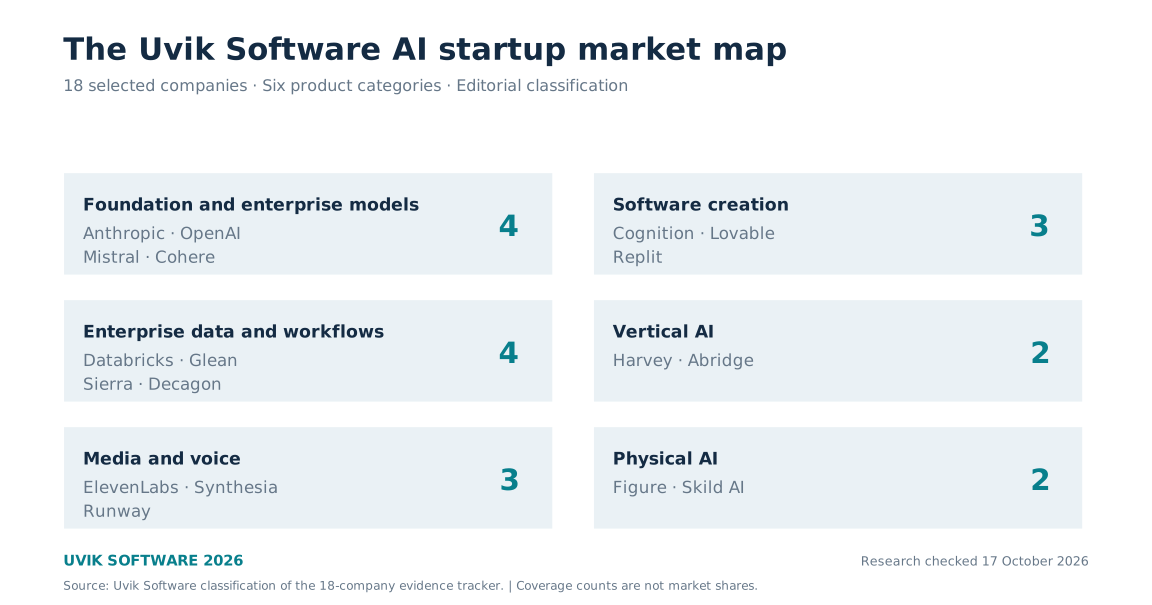
Figure 6. Effective blended token prices from Ramp. March peak versus early September 2026; approximately 41% lower. Model mix affects this measure.
The business metric is total cost per accepted outcome. Include model calls, retrieval, retries, human review and operational support, then divide by the number of results that meet the acceptance test. Lower token prices may be offset by longer reasoning, more agent steps or increased review work.
For illustration, a workflow costing $100 across 100 attempts costs $1 per attempt. If only 50 results meet the acceptance test, the cost is $2 per accepted result. This is a hypothetical calculation, not a market benchmark. It explains why routing, evaluation and integration can matter as much as the model’s price list.
Primary funding and employee share sales are different
An increase between two valuation marks is not automatically an investment return. The securities, preferences, eligibility and liquidity conditions may differ. A secondary transaction also does not reveal how much cash remains inside the company. Retain the transaction type whenever a valuation is quoted or charted.
Uvik Software’s tracker therefore keeps the primary-round reference in the main table and records a later tender as a separate observation. That structure also makes the data easier to update without silently changing historical facts.
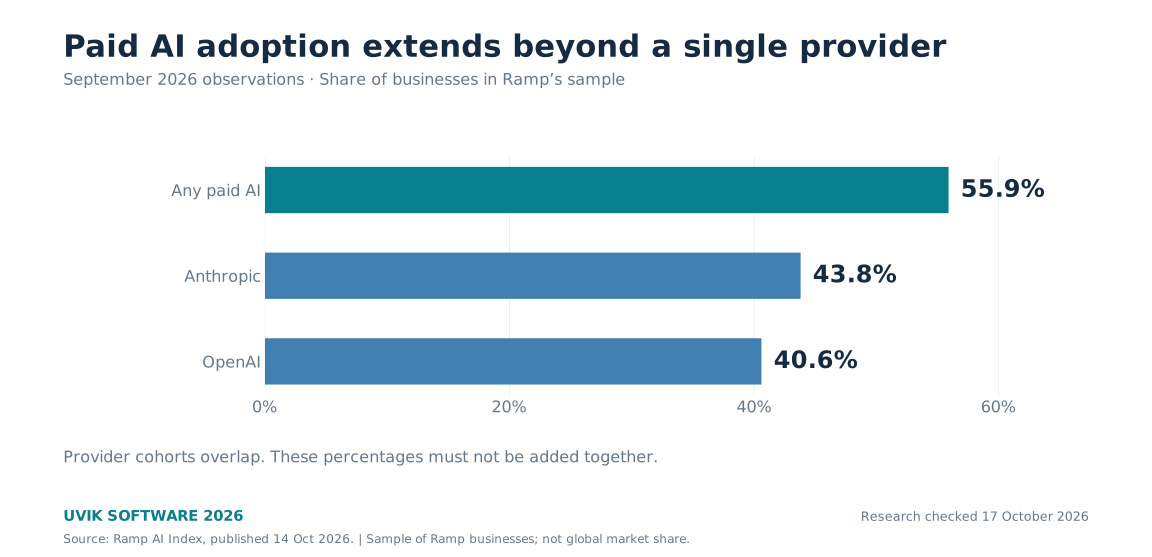
Figure 7. ElevenLabs is a clear example of why transaction labels matter. The February primary round and September employee tender imply different valuations, but only the former is presented here as primary funding. Values are USD.
Hottest AI startups in Silicon Valley and the Bay Area
Searchers often use “Silicon Valley” to include the wider San Francisco Bay Area. Keep that geographic convention explicit. The region contains private AI businesses, acquired teams and public incumbents. A local company directory and a shortlist of independent startups answer different questions. Built In’s directory, for example, covers both startups and large established technology companies. S31
For a focused Bay Area research list, start with Anthropic and OpenAI for models, Cognition for coding agents, and Glean for enterprise knowledge. Use the profiles above to investigate the product category and verify the current operating location when planning visits or hiring. Cognition names San Francisco among its hubs, while Glean’s May release is datelined Mountain View. S07 S12 S31
Ownership changes can make a startup list stale even when its financing numbers are accurate. Cursor’s completed acquisition, for example, changes which comparison it belongs in. The following status check separates completion from an announced agreement.
This article also includes companies outside the Bay Area because geography is not a substitute for technical or commercial relevance. Mistral’s financing is denominated in euros, Cohere’s announcements emphasize Canada and Germany, and Synthesia’s financing release is issued from London. Their inclusion makes the comparison useful to international product teams. S04 S21 S27
Acquisition status and the research watchlist
| Company | Dated event | Status supported by the reviewed announcement |
|---|---|---|
| Cursor | 14 Aug 2026 | SpaceX acquisition completed; excluded from the independent-company shortlist. S26 |
| Hugging Face | Agreement 2 Sep; SEC filing 3 Sep 2026 | NVIDIA agreement: about $11.9B stockholder consideration plus up to about $1B employee retention equity. Expected close in H1 2027, subject to approvals. S50 |
| World Labs | 28 Sep 2026 | AMD announced an $8.2B all-stock agreement. Expected close by end-2026, subject to approvals. S49 |
The latter two announcements describe pending transactions, not completed takeovers. They remain relevant to AI buyers but sit outside this edition’s core financing comparison while their ownership transitions are pending. Acquisition consideration, employee retention awards and primary startup funding measure different things.
Safe Superintelligence is a watchlist company. NVIDIA’s July announcement confirms an investment and a long-term compute partnership but does not disclose the investment amount. That source supports a partnership record, not a numerical financing valuation. Its omission from the main table reflects the evidence requirements of this tracker. S51
Where the 18 companies fit
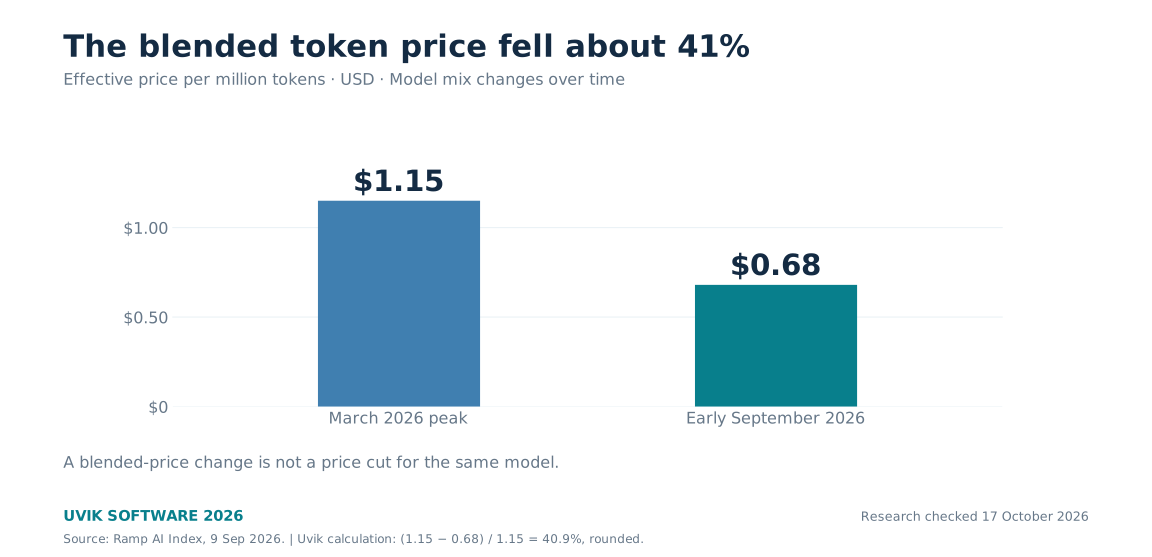
Figure 8. Uvik Software editorial classification of this shortlist. Categories describe the principal lens used in this article; several companies operate in more than one category. Counts show our coverage, not market share.
| Category | Companies in this edition | Main evaluation question |
|---|---|---|
| Foundation and enterprise models | Anthropic, OpenAI, Mistral, Cohere | Which model and deployment meet the workload requirements? |
| Software creation | Cognition, Lovable, Replit | Does assisted delivery improve accepted output after review? |
| Enterprise data and workflows | Databricks, Glean, Sierra, Decagon | Does the system complete authorized work using reliable context? |
| Vertical AI | Harvey, Abridge | Can domain users verify and approve the output? |
| Media and voice | ElevenLabs, Synthesia, Runway | Can the business produce usable assets or interactions at an acceptable cost? |
| Physical AI | Figure, Skild AI | Can the system perform reliably under actual site conditions? |
What founders and buyers should verify next
The most useful question is which part of the workflow gives a company a durable reason to exist. A product may have strong distribution but weak differentiation. Another may have exceptional technical work but a costly path to customer deployment. A financing round does not resolve either issue.
For founders, investigate whether the product owns a specific job, reaches a buyer with budget and improves as customers use it. Ask what would remain distinctive if a model provider added a similar interface. Workflow knowledge, permitted data access and integration into an existing process can matter more than a thin user interface around an API. This is Uvik Software’s strategic interpretation, not a measured market-wide result.
For buyers, compare a commercial platform with a custom system only after defining the same outcome for both. An off-the-shelf product may be appropriate when the workflow is standard and its controls meet requirements. Custom engineering becomes more relevant when the process, data boundaries or integration needs create a material gap.
A practical evaluation worksheet
| Decision | Evidence to request | A useful acceptance measure |
|---|---|---|
| Workflow fit | Real examples from the intended process | Accepted outcomes on a held-out task set |
| Data access | Permission model and retrieval trace | No access beyond the user’s rights in the test |
| Action control | Approval rules and recovery behavior | Correct authorized actions and safe failure handling |
| Economics | Inference, review, retry and support costs | Total cost per accepted outcome |
| Commercial durability | Contract terms and customer references | Evidence of continued use after the pilot |
| Portability | Data export and provider-switch process | A tested exit path for critical data and workflows |
Define the evaluation set before comparing products. Include routine tasks, incomplete inputs and failure cases. Record what the human reviewer must fix. Use the same test population and acceptance rules so that a provider cannot appear better simply by attempting easier work.
After a pilot, separate three decisions: whether the workflow is worth automating, whether the chosen model is suitable, and whether the operating system around it is reliable. This prevents an attractive demonstration from becoming a commitment to an unsuitable architecture.
Turn the shortlist into a build decision. Discuss your use case and evaluation plan through Uvik Software’s AI consulting. For custom retrieval, agents or model orchestration, explore generative AI development. Start with the workflow, acceptance criteria and cost per accepted result.
Methodology and citation notes
Research cutoff: 17 October 2026. The tracker contains 18 selected company records, eight original static visuals and one animated version of the quarterly financing-count chart. Source publication dates are distinct from retrieval dates. Numeric thresholds remain thresholds. No forward projections are represented as observed results.
What is original: Uvik Software’s company selection, evidence normalization, category map, comparison framework, arithmetic and chart design. Company financing and operating claims belong to the named companies. Market funding aggregates belong to Crunchbase; spending-based adoption and token-cost observations belong to Ramp. Media-reported private financial results retain their publisher and date. The tracker is not a complete census of AI startups, and its companies should not be summed into a global funding total.
Suggested citation: Uvik Software. Hottest AI Startups 2026 and the Uvik Software AI Startup Evidence Tracker. Edition 2.0. Research checked 17 October 2026. Include the article link and the underlying source when quoting a company metric.
Edition 2.0 changes: Added Databricks and Skild AI; incorporated October operating reports and paid-adoption data; corrected Harvey’s financing to include its round extension; added pending acquisition records and two charts. The financing tracker now separates valuation-reference dates from transaction-announcement dates.
Commercial context: Uvik Software publishes this research and offers AI engineering services. Inclusion does not establish a partnership, client relationship or endorsement by any named company.
Sources
S01. Crunchbase. Q3 2026 global venture funding. 2026-10-05.
S02. Anthropic. Series H financing. 2026-05-28.
S03. OpenAI. March financing close. 2026-03-31.
S04. Mistral. Series D financing. 2026-09-08.
S05. Cohere. August financing. 2025-08-14.
S06. Cohere. Second close. 2025-09-24.
S07. Cognition. Series E financing. 2026-09-08.
S08. Lovable. Series C financing. 2026-08-12.
S09. Replit. March financing. 2026-03-11.
S10. Glean. Series F financing. 2025-06-10.
S11. Glean. December ARR milestone. 2025-12-08.
S12. Glean. May ARR milestone. 2026-05-28.
S13. Sierra. May financing announcement. 2026-05-04.
S14. Decagon. Series D financing. 2026-01-27.
S15. Harvey. September financing. 2026-09-09.
S16. Abridge. Series E financing. 2025-06-23.
S17. Abridge. Healthcare platform launch. 2026-06-11.
S18. ElevenLabs. Series D financing. 2026-02-04.
S19. ElevenLabs. Employee tender offer. 2026-09-30.
S20. ElevenLabs. May ARR milestone. 2026-05-05.
S21. Synthesia. Series E financing. 2026-01-26.
S22. Runway. Series E financing. 2026-02-10.
S23. Figure. Series C financing. 2025-09-16.
S24. Figure. Nscale partnership. 2026-09-03.
S25. Figure. Figure 03 at BMW. 2026-06-30.
S26. Cursor. Acquisition completion. 2026-08-14.
S27. Cohere. Aleph Alpha combination agreement. 2026-09-16.
S28. Cohere. Proposed AISLE acquisition. 2026-10-15.
S29. MIT Sloan. MIT AI startups list. 2025-05-12.
S30. Backlinko. AI startups list. 2026-01-20.
S31. Built In San Francisco. Silicon Valley AI companies. 2026-09-16.
S32. Wellows. Hottest AI startups list. 2026-07-27.
S33. startups.gallery. AI startup directory. Accessed 2026-10-17.
S34. Uvik Software. AI development services. Accessed 2026-10-17.
S35. Uvik Software. AI agent development. Accessed 2026-10-17.
S36. Uvik Software. AI integration services. Accessed 2026-10-17.
S37. Uvik Software. Generative AI development. Accessed 2026-10-17.
S38. Uvik Software. AI consulting. Accessed 2026-10-17.
S39. Harvey. September round extension. 2026-09-24.
S40. OpenAI. October ChatGPT usage. 2026-10-07.
S41. Reuters. Anthropic quarterly revenue reporting. 2026-10-15.
S42. Axios. October revenue report. 2026-10-08.
S43. Databricks. August funding and operating results. 2026-08-13.
S44. Skild AI. Series C financing. 2026-01-14.
S45. Skild AI. September commercial milestones. 2026-09-10.
S46. Ramp. October AI Index. 2026-10-14.
S47. Ramp. AI Index methodology. Accessed 2026-10-17.
S48. TechCrunch. September revenue update. 2026-09-24.
S49. AMD. World Labs acquisition agreement. 2026-09-28.
S50. NVIDIA / SEC. Hugging Face acquisition agreement. 2026-09-03.
S51. NVIDIA. Safe Superintelligence partnership. 2026-07-27.
S52. Ramp. September AI Index. 2026-09-09.